
Registered Tangible Cultural Properties of Ibaraki
茨 城 県 の 登 録 有 形 文 化 財Ibaraki · Registered Tangible Cultural Properties
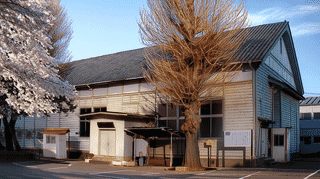
A single-storey timber hall of 1932 in Joso, Ibaraki, 541 square metres. Built as a school gymnasium and auditorium, it now serves as a martial arts hall.

A mid-Meiji tea shop of storehouse construction in Yuki, Ibaraki. Its walls carry an ochre sand-rubbed finish, and it was moved back bodily when the road widened.
A Taisho shop of storehouse construction in Yuki, Ibaraki. A road widening in 1934 cut a bay and a half from the front, leaving a gable meeting a half-hipped roof.
A single-storey timber reception wing joined to a merchant house in Makabe, Ibaraki, with 9, 10 and 8 mat rooms set in a row and a formal alcove. Registered in 2017.
A late Edo merchant house on Shinjuku-dori in Makabe, Ibaraki. Its shop block of 5 bays is built with storehouse walls, and the main house meets it at a right angle.
A late Edo timber gate opening onto Shinjuku-dori in Makabe, Ibaraki. The opening measures 2.6 meters and the front roof slope is laid in older heavy tiling.
The Arakawa Family Residence Stone Storehouse of 1909 stands at the northeast corner of the plot, its east gable framing an opening beneath a bracketed hood.
Dating from 1868, the Arakawa Family Residence Inner Storehouse is the oldest building on its Shimodate plot and carries a pine and crane plaster relief.
Late Meiji in date, the Arakawa Family Residence Former Shop Storehouse was hauled aside in 1933 when Route 50 was widened. Its exterior is seen from the pavement.
Built in 1892 for the Aratame wholesale house in Shimodate, the Arakawa Family Residence Main House graded its reception rooms by the visitor's rank. It is closed.
The Arakawa Family Residence Main House, built in 1933 in Shimodate, sets an Art Deco mortar facade under a pyramidal Japanese roof. Exterior viewing only.
Once one of 10 storehouses flanking a trolley rail in Shimodate, the Arakawa Family Residence Storehouse alone survives, its doors standing 2.7 meters high.
The Arakawa Family Residence Annex, a single-storey reception room of the early Taisho years, links the main house and the inner storehouse. It is not open.
Built in 1907 at Shimodate, the Arakawa Family Residence Shop Storehouse opens almost its whole upper front to the street. It still trades as a liquor shop.
A 19-meter concrete gravity weir of 1913 on the Okitagawa in Kitaibaraki, Ibaraki. Its right-angled intake gate turns the river into a conduit for the plant below.
An elliptical concrete tank of 1913 at Kitaibaraki, Ibaraki, where the open channel ends and the penstock begins. Two Stoney gates stand at its inlet.
A concrete desilting basin of 1913 below the intake weir at Kitaibaraki, Ibaraki. It measures 30 by 9 meters, and its side channel can flush its own sediment.
A 49-meter granite retaining wall of 1913 at Kitaibaraki, Ibaraki, built along the penstock between head tank and generating hall to hold the slope steady.
A single-storey concrete generating hall of 1913 beside the Okitagawa at Kitaibaraki, Ibaraki. Arched windows line its long wall, round ones the gables.
A 107-meter open channel of 1913 taking surplus water from the settling basin down to the Okitagawa at Kitaibaraki, Ibaraki. Its walls are diagonally coursed stone.
More from Ibaraki
Ibaraki’s registered properties across designations, with featured heritage and travel notes.
The complete kokuhō catalogue — browse by prefecture, period, and category.
Nationwide jūyō bunkazai — architecture, sculpture, painting, crafts, and documents.