
Taishō
Kumamoto · 大正Browse Kumamoto’s cultural heritage from the Taishō period (1912 – 1926). Filter by type and keyword, with concise stories, maps, and travel tips.
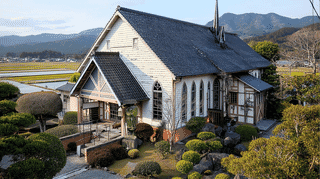
Discover Myodoji Temple Main Hall in Kumamoto Prefecture—a stunning fusion of Gothic and Buddhist architecture. This Registered Tangible Cultural Property features pointed arch windows and Mansard roofing in a Jodo Shinshu temple.

Built in 1920 as the record store of the Misumi court, this 45-square-metre brick building above Misumi West Port joined Japan's cultural property register in 2007.
This single-storey timber wing of 1920 held the waiting rooms of the Misumi court, linked to the courtroom block by a covered passage, and was registered in 2007.
The 1920 main building of the former Misumi Summary Court stands on a hill above the UNESCO-listed Misumi West Port. A rare surviving example of a regional courthouse built in pure Japanese style by the Ministry of Justice's works section, it is now open free to the public as the House of Law.
Completed in 1924 beside the springs of Hakenomiya in Kumamoto, this square brick pump station carries Expressionist detailing and keeps its original pump.
Built in 1924 to replace a wooden school lost to fire, this three-storey concrete building by ministry engineer Nagaoka Yue carries Secession-style capitals.
This 1921 storehouse in Yatsushiro shows exposed brick at street level and timber-framed brick above, rendered in mortar to imitate a traditional plastered kura.
Discover the Brick Wall of the Yatsushiro Convent of the Sisters of Saint Paul of Chartres in Kumamoto Prefecture. Built in 1919 by a French Catholic order, this 21-metre Registered Tangible Cultural Property is a rare survivor in central Yatsushiro and a quiet window onto Meiji- and Taisho-era Franco-Japanese exchange.
Founded in 1874 in Kumamoto's historic Shinmachi district, Nagasaki Jiro Bookstore is one of Kyushu's most storied bookshops. Its 1924 building, designed by architect Yasuoka Katsuya, is a Registered Tangible Cultural Property. Once visited by literary giants Mori Ogai and Natsume Soseki, the second-floor café offers specialty coffee with views of passing tram cars.
Built in 1924, the Hayano Building is believed to be Kumamoto's first rental office building. This reinforced concrete structure features distinctive continuous window surrounds and decorative pilasters, and is registered as a National Registered Tangible Cultural Property. Still home to galleries and design studios, this living cultural property preserves the spirit of Taisho-era Romanticism in the heart of Kumamoto City.
On the Tsuboi River by the stone Meiju Bridge stands the 1919 Dai-Ichi Bank Kumamoto Branch, the city's first concrete building, designed by Yoshitoki Nishimura.
In Miyahara, Kumamoto, a 20-meter red brick wall in English bond edges the old Iseri merchant estate. Its even buttresses and capping cornice show late-Taisho craft.
A small 1925 concrete bank in Miyahara, an old Kumamoto post town. Its Secession-style front carries four pilasters and a geometric parapet, and entry is free.
Built in 1925 to carry carts over the Koshi River, Himeibashi in Kikuchi, Kumamoto, is Japan's earliest surviving through-type reinforced concrete arch bridge.
Taisho-era wall of Aso welded tuff in Kikuchi, Kumamoto. Coursed nunozumi masonry, trapezoidal in section, 46 metres long, once nearly twice its present height.
A Taisho farmhouse in Kikuchi, Kumamoto, registered in 2013: timber from the family's own hillside, heavy beams over the doma, transoms carved with Aso's peaks.
Discover the Yamaga Toro Folk Craft Museum, a registered tangible cultural property housed in a 1925 Romanesque bank building. Explore exquisite paper lanterns crafted entirely from washi and glue in Yamaga, Kumamoto Prefecture.
Registered in 2013, this early Taisho two-storey block at Yoshino Ryokan in Hitoyoshi, Kumamoto, began as a bathhouse and keeps lath windows and coloured glass.