
Shōwa
Kumamoto · 昭和Browse Kumamoto’s cultural heritage from the Shōwa period (1926 – 1989). Filter by type and keyword, with concise stories, maps, and travel tips.
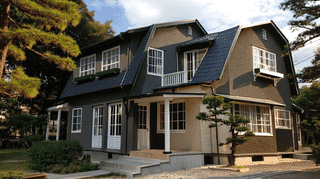
Explore the Jiaien Maude Powlas Memorial Museum, a 1927 Registered Tangible Cultural Property in Kumamoto. This charming former missionary residence tells the story of an American woman who revolutionized Japanese social welfare. Near Suizenji Garden.

Discover the Okawa Aso Shrine Rural Stage, a nationally registered tangible cultural property in Yamato, Kumamoto. This historic wooden stage is the birthplace of Seiwa Bunraku puppet theater, a tradition passed down since the Edo period.
Discover the Former Amakusa Education Hall Main Gate and Wall, a nationally registered tangible cultural property in Amakusa, Kumamoto. This 1934 reinforced concrete gate and wall showcase early Showa-era Western-influenced architecture on Japan's historic island archipelago.
Built in 1937 at Tamana High School in Kumamoto, this concrete pond reads as the character 中 seen from above and, with the school buildings, spells out 玉中.
Designed by Takeda Goichi and completed in 1931 as the library of Kumamoto Medical College, this reinforced concrete hall was moved 48 metres intact in 2006.
A timber kindergarten of 1929, paid for by an American Lutheran church, planned around daylight and ventilation, with a curved porch gable above an arched window.
Raised in 1938 where a storm surge had breached the Gunchiku sea wall, this three-arch sluice gate was cut in stone at a time when concrete had become standard.
Built in 1931 in Hitoyoshi, Kumamoto, Shin-Onsen is a Registered Tangible Cultural Property — a rare wooden public bathhouse that survived the devastating 2020 floods and embodies the spirit of Japan's early Showa-era hot spring culture.
The Sagara-mura Furusato-kan in Sagara Village, Kumamoto Prefecture, is a two-storey wooden building originally constructed in 1942 as the office of the former Shiura Village and carefully relocated to its present site beside Sagara Onsen Sayuri in 2000. With its hipped tiled roof and generous bands of windows, it is a rare surviving example of early Showa-era rural Japanese government architecture, registered as a National Tangible Cultural Property in 2007.
Built in 1926 in central Yatsushiro, this timber townhouse carries glazed doors across its full upper frontage, a balustrade, and two twelve-mat rooms behind.
Takagi Clinic in the Kumfu district of Kikuchi City, Kumamoto Prefecture, is a wooden two-story medical building constructed in 1931 featuring a distinctive half-timber style facade. With its jerkinhead copper roof, dormer windows, and elegant Western-style entrance porch, the clinic preserves the atmosphere of early Showa-era Kikuchi and was registered as a national Tangible Cultural Property in 2013.
The Japanese Evangelical Lutheran Kumamoto Church, located in central Kumamoto City, is a wooden church designed by architect William Merrell Vories in 1950. Featuring a hammer-beam truss roof, pointed-arch openings, and a spired corner tower, this Gothic-inspired timber structure was registered as a national Tangible Cultural Property in 2019. A symbol of postwar reconstruction beloved by the local community, it stands as one of Vories's final architectural masterworks.
A brick water tower at Kumamoto's Hamada Shoyu, built around 1950 and still pumping the well water used to make its soy sauce, rebuilt after the 2016 earthquake.
About 8 square meters, the Hamada Shoyu Yokan is a 1930s former tobacco shop with Western detailing, set at a long-running soy sauce brewery in Kumamoto.
A 1933 timber inn entrance on the Kuma River in Hitoyoshi, Kumamoto, registered in 2013. See its hip-and-gable porch, courtyard glass doors, and post-flood revival.
The 1933 central building of Hitoyoshi Ryokan, a riverside hot-spring inn in Kumamoto, with four rooms per floor and varied wooden lattice, now registered heritage.
On the Kuma River in southern Kumamoto, this 1953 guest wing of a working inn is a Registered Tangible Cultural Property, reopened in 2022 after a major flood.
Registered in 2013, the 1930s East Wing of Kumamoto's Hitoyoshi Ryokan keeps a fan-shaped alcove window and fine-timber rooms, rebuilt after the 2020 flood.