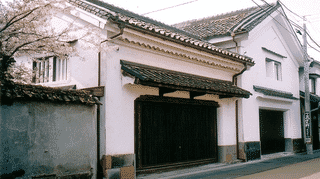
The Yoshikawa Family Residence Warehouse 3, a Koji Room of 1908
The Yoshikawa Family Residence Warehouse 3 (吉川家住宅倉庫三, Yoshikawa-ke Jūtaku Sōko San) is a sake brewery building in Taketa City, Oita Prefecture, built in 1908 and once used as the koji room (Kojimuro), and was registered as a Registered Tangible Cultural Property (structure) on 2 October 2007.
The Agency for Cultural Affairs records a wooden building of 2 storeys under a gabled (Kirizuma-zukuri) pantiled roof, with a building area of 86 square metres. The Yoshikawa Family Residence Warehouse 3 was registered as a Registered Tangible Cultural Property under number 44-0138, for its contribution to the historic landscape of the country. It belongs to Taketa City.
It stands toward the south-west back of the plot, and it is the newest of the buildings on the plot that served the brewing.
Why It Was Registered: The Room Where Koji Grew
The Agency's description says the Yoshikawa Family Residence Warehouse 3 was formerly used as a muro, a koji room. It has an earthen floor and keeps traces of that room inside; it carried one stage of the brewing, the description concludes.
Koji is steamed rice on which a mould, Aspergillus oryzae, has been grown. The mould turns the starch in rice into sugar, and sake brewing depends on it. The room where it grows is kept warm and humid.
The neighbouring Warehouse 2 held the rice-washing room and the furnace room for steaming. In the order of the work, part of the steamed rice went next to the room in Warehouse 3.
What the traces of the room actually are, whether the build of the walls and ceiling or fittings such as shelving, the Agency does not say.
A Late Meiji Addition at the Back of the Plot
The Yoshikawa Family Residence Warehouse 3 went up in 1908, 30 years after warehouses one and two and the storehouse, which date from 1878. Warehouse 2 was extended in the same year, so 1908 saw a round of work on the brewery buildings.
It sits toward the south-west back of the plot, away from the street. A koji room depends on holding its heat and moisture, and a place set back from foot traffic and outside air suits that use, though the record gives no reason for the choice of site.
At 86 square metres, it is the smallest of the three warehouses. It still has 2 storeys under a gabled roof; what the upper floor held is not recorded.
What to Look For at the Yoshikawa Family Residence Warehouse 3
The Yoshikawa Family Residence Warehouse 3 stands at the back of the plot, so expect not to see the whole building from the street.
If you are able to go inside, start with the floor: the Agency specifically records it as earth. Then look for whatever survives of the koji room.
Follow on from the furnace and washing rooms of Warehouse 2 and the sequence of washing, steaming and making koji turns into a line of buildings running from the front of the plot to the back.
Visiting the Yoshikawa Family Residence Warehouse 3
The Yoshikawa Family Residence Warehouse 3 is owned by Taketa City.
Under an ordinance adopted in 2013, the city keeps the Yoshikawa residence warehouses as castle-town brewery buildings that show their features and the working spaces of the time, and opens them for learning and exchange. The rules issued the same year set opening hours of 9:00 a.m. to 4:00 p.m. and close on Mondays, the day after a national holiday, and from 29 December to 3 January, unless the Board of Education decides otherwise.
The ordinance numbers the warehouses 1 to 5, which do not correspond to the registered numbering, and it does not say which of them is the registered Warehouse 3.
The city's first Plan for Maintaining and Improving Historic Character, approved in 2014, planned repairs to warehouses two and three; the fiscal 2018 mid-term review says repairs had not begun because no use had been decided. To find out how much of the interior can be seen now, and whether photography is allowed, contact the Taketa City Board of Education, Cultural Properties Division (telephone 0974-63-1111). Directions to the whole residence are on the Yoshikawa Family Residence page.
Q&A
- What was the Yoshikawa Family Residence Warehouse 3 used for?
- According to the Agency for Cultural Affairs, it was formerly the koji room (muro). It has an earthen floor and keeps traces of the room inside.
- When was the Yoshikawa Family Residence Warehouse 3 built?
- In 1908, 30 years after warehouses one and two and the storehouse on the same plot, which date from 1878.
- What is the koji room in the Yoshikawa Family Residence Warehouse 3?
- A room where koji mould is grown on steamed rice. It is kept warm and humid so that the mould thrives.
- Can visitors see the Yoshikawa Family Residence Warehouse 3?
- Its owner, Taketa City, provided for opening the warehouses in a 2013 ordinance, and its rules set hours of 9:00 a.m. to 4:00 p.m., closed on Mondays and some other days. Check current access with the Taketa City Board of Education, Cultural Properties Division (0974-63-1111).
- When was the Yoshikawa Family Residence Warehouse 3 registered?
- On 2 October 2007, as a Registered Tangible Cultural Property, number 44-0138 (Agency for Cultural Affairs).
Basic Information
| Name | Yoshikawa Family Residence Warehouse 3 (吉川家住宅倉庫三) |
|---|---|
| Location | 21 and others, Oaza Taketa-machi, Taketa City, Oita Prefecture |
| Designation | Registered Tangible Cultural Property (Structure) |
| Year Designated | Registered 2 October 2007 |
| Quantity | 1 building |
| Dimensions | Wooden, 2 storeys, tiled roof, building area 86 square metres |
| Owner | Taketa City |
| Public Access | Opened under Taketa City ordinance and rules; ask the Taketa City Board of Education, Cultural Properties Division about access to the interior |
References
- Agency for Cultural Affairs, Database of National Cultural Properties: Yoshikawa Family Residence Warehouse 3
- https://kunishitei.bunka.go.jp/bsys/maindetails/101/00006372
- Taketa City: Ordinance on the Management and Opening of the Yoshikawa Residence Warehouses
- https://www.city.taketa.oita.jp/section/reiki/reiki_honbun/r335RG00001061.html
- Taketa City: Rules for the Ordinance on the Yoshikawa Residence Warehouses
- https://www.city.taketa.oita.jp/section/reiki/reiki_honbun/r335RG00001062.html
- Taketa City: Plan for Maintaining and Improving Historic Character (First Plan), Chapter 6
- https://www.city.taketa.oita.jp/material/files/group/23/chapter6.pdf
- Taketa City: Mid-Term Review of the Plan for Maintaining and Improving Historic Character, Fiscal 2018
- https://www.city.taketa.oita.jp/material/files/group/23/middle-hyoka31.pdf
- Taketa City: Plan for Maintaining and Improving Historic Character (Second Plan), Chapter 2
- https://www.city.taketa.oita.jp/material/files/group/23/rekifu_capter2.pdf
Last verified: 2026.11.12