
Historic Sites, Places of Scenic Beauty, and Natural Monuments of Okayama
岡 山 県 の 史 跡 名 勝 天 然 記 念 物Okayama · Historic Sites, Places of Scenic Beauty, and Natural Monuments
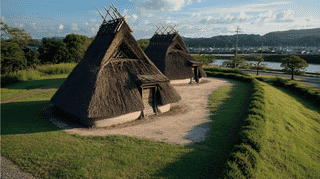
A settlement site in Setouchi, Okayama, running from the early Yayoi to the Kamakura period. Its shell mound gave its name to a type of Yayoi pottery.

Discover Iwayadani, a National Place of Scenic Beauty in Takahashi City, Okayama. Explore towering 100-meter limestone cliffs, 30 hectares of primeval forest, rare flora at the northern edge of their range, and the legendary Iwayado Cave with its world-famous helictite formations.
Designated a National Historic Site in 1922, the Innoshō Yakata Site in Tsuyama, Okayama, is the legendary location where the samurai Kojima Takanori carved a ten-character poem into a cherry tree to encourage Emperor Go-Daigo as he was being escorted into exile in 1332. Today the grounds are home to Sakura Shrine, dedicated to the emperor and to Takanori himself, and remain one of the most evocative cherry-blossom sites in northern Okayama.
Discover Urama Chausuyama Kofun, a nationally designated historic site in Okayama. This 3rd-century keyhole-shaped burial mound is the oldest large-scale tomb of the ancient Kibi Kingdom and a half-scale replica of the legendary Hashihaka Kofun.
Oga no Oshikabuse (the Oga Decken) in Niga, Kawakami-cho, Takahashi City, Okayama Prefecture, is a geological wonder where Paleozoic limestone, around 300 million years old, sits atop younger Mesozoic mudstone and sandstone of about 200 million years. Discovered in 1923 by geologist Yoshiaki Ozawa and designated a National Natural Monument in 1937, it is the first overthrust structure ever formally reported in Japan and a landmark site documenting the early Cretaceous orogeny known as the Oga Movement.
An ancient mountain fortress on the ridges of eastern Okayama City, encircled by 3.2 kilometers of earthen ramparts and stone water gates built in the 7th century. Designated a National Historic Site in 2005, this kogoishi-style fortress was constructed amid the international tensions following the Battle of Baekgang.
Okayama Korakuen is one of the Edo period's most renowned daimyo gardens, built between 1687 and 1700 by Ikeda Tsunamasa, second lord of the Okayama domain, with construction directed by his retainer Tsuda Nagatada. Set on a sandbar in the Asahi River with Okayama Castle as borrowed scenery, this 14.4-hectare stroll garden links Yuishinzan hill, Sawa-no-ike Pond, Ryuten pavilion, and the lord's hall Enyoutei through paths and a 640-meter winding stream. Designated a Special Place of Scenic Beauty in 1952, it is counted alongside Kenrokuen and Kairakuen as one of Japan's Three Great Gardens.
A unique National Historic Site that unites three locations across Okayama Prefecture: the Confucian-style Waidani burial ground, the Buddhist Sogenji Temple, and the tomb of the master administrator Tsuda Nagatada, together documenting the philosophy and cultural achievements of the Ikeda lords across the entire Edo period.
Onoue Kurumayama Kofun, located in Onoue, Kita Ward, Okayama City, is a large keyhole-shaped tumulus built in the late 4th century, measuring about 138.5 meters in total length. Its slender 'handle-mirror' form, traces of fukiishi covering stones, and haniwa fragments testify to the power of an early Kibi chieftain who once watched over the inland sea. It was designated a National Historic Site in 1972.
Mt. Gagyu in Takahashi City, Okayama Prefecture, is best known as the site of Bitchu Matsuyama Castle, the highest of Japan's still-standing original mountain castles. Yet the same forest is home to a wild troop of Japanese macaques. Designated a National Natural Monument in 1956, the Mt. Gagyu Macaque Habitat protects not a single animal but an entire mountain ecosystem. Around 160 macaques still roam roughly 700 hectares of forest, making this one of Japan's rare places where a famous castle and a thriving wild primate community share the same ridge.
An area designation at Shizutani in Bizen City, listed in 1922 and raised to Special Historic Site in 1954. It covers the school ground and four attached sites.
In Tsuyama, Okayama, a parasitic fungus marks Yashadake bamboo culms with dark elliptical patterns. The 198 m² site has been a national natural monument since 1976.
Magane Ichirizuka is a pair of Edo-period roadside mounds on Okayama's old Sanyo Highway, planted with pine and hackberry. A National Historic Site since 1928.
One of just two national Kajika frog habitats in Japan, the Tabane River in Yubara Onsen rings with the males' bell-clear breeding calls from late May through July.
Around 1605, Kobori Enshu laid out this karesansui in Bicchu: white sand, crane and turtle islands, sculpted azalea hedges, Mount Atago borrowed beyond the wall.
More from Okayama
Okayama’s registered properties across designations, with featured heritage and travel notes.
The complete kokuhō catalogue — browse by prefecture, period, and category.
Nationwide jūyō bunkazai — architecture, sculpture, painting, crafts, and documents.