
Historic Sites, Places of Scenic Beauty, and Natural Monuments of Osaka
大 阪 府 の 史 跡 名 勝 天 然 記 念 物Osaka · Historic Sites, Places of Scenic Beauty, and Natural Monuments
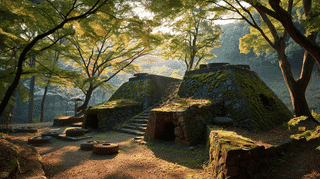
A Heian-period kiln site in Suita, Osaka Prefecture, Japan. Two quite different kinds of kiln over there each served the two stages of the firing now.

The Abuyama Tomb in Takatsuki, Osaka, a Historic Site since 1983, is a moundless late Kofun grave whose lacquered coffin held a man widely thought to be Kamatari.
A late Kofun keyhole tomb in Takatsuki, Osaka, thought to be the true tomb of Great King Keitai, a Historic Site since 1958, with a reconstructed haniwa rite of 200 figures.
Completed in 1953 by Mirei Shigemori, this stone garden at Kishiwada Castle sets nine rock groups after Zhuge Liang's eight battle formations, best seen from above.
On Osaka's Okawa River stand the remains of Japan's first modern mint, founded in 1871. Senpukan, the old main gate, a guard house and early gas lamps survive here.
On a ridge in Osaka's Chihayaakasaka, these earthworks formed Kusunoki Masashige's main stronghold, besieged in 1333 and lost when its water supply was cut.
Kurohimeyama Kofun, a 114-meter keyhole tomb between Sakai's two World Heritage tomb groups, held 24 sets of iron armor, the largest find from one Japanese tomb.
Over 1,000 years old, with a trunk 12.5 meters around, the Kungai-Kusu camphor at Mitsushima Shrine in Kadoma, Osaka, became a National Natural Monument in 1938.
The Kokufu Site in Fujiidera, Osaka, preserves traces of life from the Ice Age to medieval times, and is where Japan's first scientific excavation began in 1917.
In Habikino, Osaka, the Konda Shiratori kiln complex fired the haniwa that once lined Emperor Ojin's tomb and the other great burial mounds of the Furuichi group.
Sakurai Station Site in Osaka marks an ancient post station and the spot where, by legend, the warrior Kusunoki Masashige parted from his son before battle in 1336.
The Tosa Eleven Martyrs' Tombs in the grounds of Hojuin Temple in Sakai City, Osaka, is a National Historic Site marking the burial place of eleven Tosa Domain samurai who committed seppuku in 1868 to resolve the diplomatic crisis known as the Sakai Incident. Designated in 1938, the site preserves a key memorial of Japan's earliest international confrontation under the Meiji government and the Western witnesses' shock at the practice of harakiri. Combined with a visit to nearby Myokoku-ji Temple, it offers a moving experience of late-Edo and early-Meiji history.
Nanshuji Garden, set on the south side of the abbot's quarters at the Rinzai Zen temple Nanshuji in Sakai, Osaka, is an early-Edo karesansui designated a national Place of Scenic Beauty in 1983. This guide introduces its bold Izumi sandstone and chlorite schist composition, its Momoyama-period design lineage tied to Sen no Rikyu and Furuta Oribe, and practical visitor tips for exploring this quietly powerful Zen garden.
More from Osaka
Osaka’s registered properties across designations, with featured heritage and travel notes.
The complete kokuhō catalogue — browse by prefecture, period, and category.
Nationwide jūyō bunkazai — architecture, sculpture, painting, crafts, and documents.