
Important Cultural Property of Osaka
大 阪 府 の 重 要 文 化 財Osaka’s Important Cultural Properties — designated for their value to the nation’s cultural history.
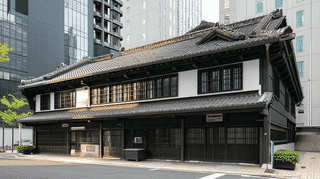
Three Meiji-period townhouse buildings in Osaka Prefecture. Its own name says former while its own reading field there leaves that word out completely.
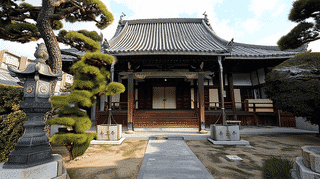
A late Kamakura-period Buddhist main hall in Kumatori, Osaka Prefecture. Its own front and its own depth there both measure exactly three bays even now.
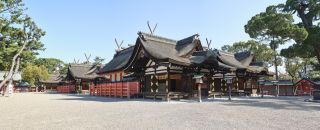
The Important Cultural Property Sumiyoshi Taisha in Osaka covers thirteen buildings, from Hideyori's 1607 South Gate and stone stage to the offering halls of 1810.
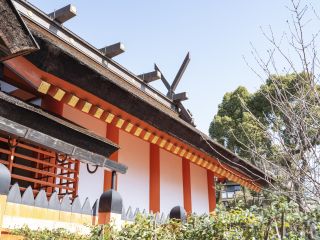
Built in 1708, the main hall of Daikai Shrine at Sumiyoshi Taisha is the oldest surviving Sumiyoshi-zukuri sanctuary, predating the National Treasure halls.

An Important Cultural Property of Japan, this Edo-period sword guard (tsuba) by Nara Toshinaga (1667–1737) is among the supreme achievements of Japanese metalwork. Its high-relief carving and luxurious mixed-metal inlay depict the warrior Omori Hikoshichi carrying a demon woman — the vengeful spirit of Kusunoki Masashige — in a wraparound composition drawn from the Taiheiki chronicle. This guide introduces the work, its master craftsman, and where to encounter comparable tsuba masterpieces in Japan.
A 14th-century Bizen great sword by Motoshige, cut down and gold-inlaid with his name by the appraiser Honami Koon. 87.6 cm long, with a reverse-choji temper.
An unsigned katana attributed to Akihiro, a Nanbokucho-period Sagami smith and master of the hitatsura temper. An Important Cultural Property held in Osaka.
An unsigned katana attributed to Kyoto master Rai Kuniyuki, held privately in Osaka. We explain how a Kamakura blade lost its signature and where to see his swords.
A wide, unsigned katana attributed to the Kamakura smith Sadamune, now an Important Cultural Property in Osaka. Its broad form earned the byname Habahiro.
Discover the Murakumo-Gō, an Important Cultural Property attributed to the legendary Nanbokuchō-period swordsmith Gō Yoshihiro. Named by Toyotomi Hideyoshi for the cloud-like nie crystals along its blade, this celebrated katana passed through the Maeda clan, Shogun Tokugawa Tsunayoshi, and the Yanagisawa family.
Called the Masamune of Osaka for his steel's clarity, Inoue Shinkai forged this Important Cultural Property in 1676, its tang bearing the imperial chrysanthemum.
Discover the Important Cultural Property katana inscribed 'Yamashiro Daijō Fujiwara Kunikane / An Auspicious Day in the Eighth Month of Kan'ei 5' (1628), held privately in Osaka. Forged by the first-generation Sendai Kunikane—official swordsmith of Date Masamune—just one year after he received his court title, this masterpiece revived the ancient Yamato Hōshō tradition of straight-grain forging.
Designated as an Important Art Object, this katana was forged in 1614 by the first-generation Echizen Yasutsugu, official swordsmith to the Tokugawa shogunate, using imported nanban iron in Edo. A pioneering example of foreign iron in Japanese swordsmithing and a historically significant blade created in the year of the Siege of Osaka Castle.
Discover the Excavated Items from the Yokoi Temple Ruins in Yamato Province, an Important Cultural Property of Japan housed at the Osaka Museum of History. Unearthed from a long-vanished Nara-period temple in Nara City, the collection includes a gilt-bronze standing Bodhisattva, a Tang-influenced mountain-cloud double luan-bird mirror, ancient bronze coins, and other ritual metalwork that vividly evoke eighth-century Buddhist devotion.
A wakizashi dated 1586 by Horikawa Kunihiro, the smith later called the founder of Japan's new sword era. An early work, now an Important Cultural Property in Osaka.
The Colored-Picture Decorated Paper, Ink-Written Kanfugen-kyo (Fragment / Fan-Shaped Sutra) is a single surviving leaf of the celebrated Senmen Hokekyo Sasshi, originally a ten-volume fan-shaped sutra booklet from late Heian Japan. Layered with mica, gold and silver leaf, yamato-e painting, and elegant ink calligraphy, it is now an Important Cultural Property held by the Fujita Museum in Osaka.
Held in Osaka Prefecture, this Important Cultural Property is a black-ink drawing on paper that depicts both the layout of a Buddhist goma fire-ritual altar and the thirty-seven principal deities of the Diamond Realm Mandala rendered as their symbolic samaya emblems. Transmitted within the lineage of the great pilgrim-monk Chishō Daishi Enchin (814–891), it offers a rare window into the visual language of Japanese Esoteric Buddhism.
Seventy-six fusuma panels by Kano school artists from the early 17th century adorn four rooms of Daian-ji Temple's Main Hall in Sakai City, Osaka. Designated as an Important Cultural Property, these gold-ground polychrome and ink paintings are the sole surviving barrier paintings from Sakai — once one of Japan's wealthiest trading cities. The collection includes the legendary 'Pine with Added Branch' featured in prewar Japanese textbooks.
In an Osaka museum, this pair of Momoyama folding screens paints Europeans arriving by ship and Christian worship on gold leaf. It opens only in May and November.
Grave goods from the Amamiyayama Tomb in Takatsuki, Osaka, an Important Cultural Property since 2000: bronze mirrors, iron swords and strung glass beads.
More from Osaka
Osaka’s registered properties across designations, with featured heritage and travel notes.
The complete kokuhō catalogue — browse by prefecture, period, and category.
Nationwide jūyō bunkazai — architecture, sculpture, painting, crafts, and documents.