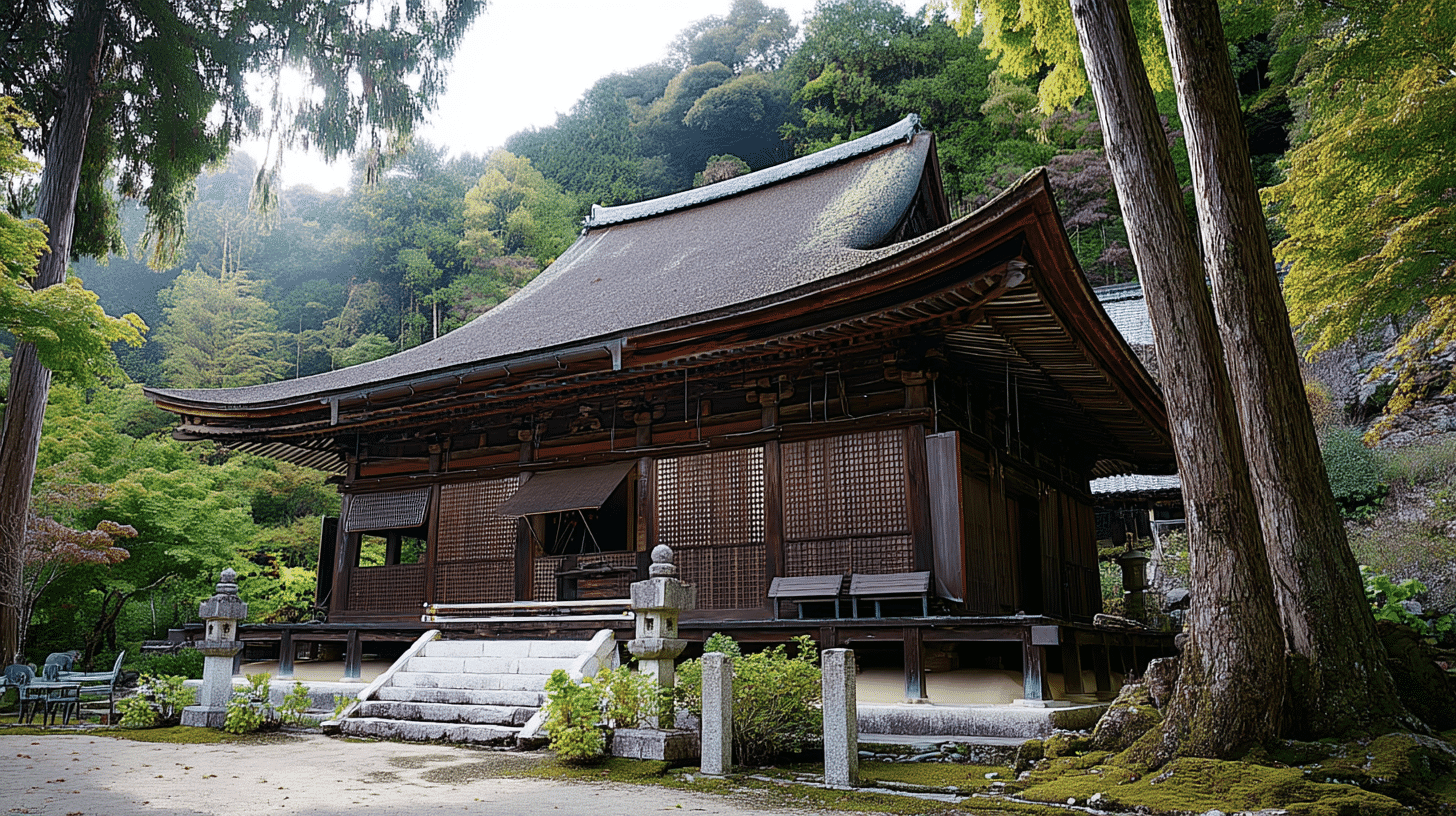
Kuwanomi-ji Temple Main Hall: Where Ancient Healing Legends Meet Medieval Architectural Grace
Perched on the western slopes of Mount Kinugasa in Shiga Prefecture, Kuwanomi-ji Temple offers visitors a rare glimpse into early Muromachi-period Buddhist architecture. While the nearby Azuchi Castle ruins draw crowds eager to trace Oda Nobunaga's footsteps, this Tendai sect temple quietly preserves one of Japan's most elegant examples of 14th-century temple construction. The Main Hall, designated as an Important Cultural Property since 1904, stands as a testament to the refined aesthetic sensibilities and masterful carpentry techniques that flourished during Japan's medieval era.
The Legend Behind the Temple Name
Kuwanomi-ji's origins are wrapped in a captivating legend that connects imperial healing with the introduction of sericulture to Japan. According to temple records, the fourth daughter of Emperor Tenji, Princess Ahe (later Empress Genmei), fell gravely ill during the 7th century. When monks prayed for her recovery, Yakushi Nyorai, the Buddha of Healing, is said to have emerged from Lake Biwa in a brilliant azure light, curing not only the princess but also countless others suffering from an epidemic spreading through the region.
Deeply moved by this miraculous healing, Emperor Tenji ordered the construction of a temple in 677. Jōe, the eldest son of the powerful statesman Fujiwara no Kamatari, was tasked with founding the sanctuary. Jōe had recently returned from studies in Tang China, bringing with him mulberry seeds. These seeds took root in the surrounding hills, and local farmers began cultivating silkworms—marking what some historians consider the birthplace of Japanese sericulture. The temple's name, Kuwanomi-ji, literally means "Mulberry Seed Temple," commemorating this agricultural legacy that would transform Japanese textile production for centuries.
Understanding the Architectural Significance of the Main Hall
The Main Hall of Kuwanomi-ji represents the refined simplicity that characterized early Muromachi period (1333-1392) temple architecture. Unlike the ornate decorations that would emerge in later periods, this hall embodies the transitional aesthetic between Kamakura-era austerity and the elaborate embellishments of the Momoyama period.
The structure measures five bays across the front (ken width of approximately 9 meters) and six bays deep, creating an unusually deep floor plan where the depth exceeds the width—a distinctive feature that sets it apart from many contemporary temple halls. Rising as a single-story building with an elegant irimoya-zukuri (hipped-and-gabled) roof, the hall is crowned with hinoki bark shingles (hinokibuki) that have weathered to a beautiful silver-gray patina over the centuries.
Architectural historians particularly value the Main Hall for its restrained decorative program. The building lacks the elaborate cusped gables (karahafu) and forward-projecting worship porches (kōhai) that became standard in later periods. Instead, visitors encounter the pure, unadorned elegance of medieval temple design. The main façade features traditional shitomido (latticed shutters) that can be raised, allowing light and air to enter while maintaining the sacred atmosphere within. Circular pillars support the roof through degumi bracket complexes, with simple kaerumata (frog-leg struts) decorating the central bay. These struts feature relief carvings of botanical motifs—an early example of architectural ornamentation that hints at the more elaborate temple carvings that would follow in subsequent centuries.
Why This Hall Received Cultural Property Designation
The Japanese government designated Kuwanomi-ji's Main Hall as an Important Cultural Property (formerly "Special Protection Structure") on February 18, 1904. This early recognition—among the first wave of architectural designations following the establishment of Japan's cultural protection system—reflects the building's exceptional value as an authentic example of early Muromachi religious architecture.
Several factors contributed to this designation. First, the hall preserves construction techniques and aesthetic principles from a pivotal period in Japanese architectural history. Second, despite its age, the building retains remarkable structural integrity, thanks in part to careful restoration work completed between 1982 and 1986. Third, the hall maintains its original purpose as an active Buddhist worship space, housing not only the principal Yakushi Nyorai statue but also images of Dainichi Nyorai and Fudō Myōō. This continuity of religious function adds immeasurable cultural and spiritual significance to the physical structure.
The Temple's Connection to Samurai History
Kuwanomi-ji's historical significance extends beyond its architectural merits. In 1532, Ashikaga Yoshiharu, the twelfth shogun of the Muromachi shogunate, sought refuge here while fleeing political turmoil in Kyoto. For three years, under the protection of the powerful Rokkaku clan, Yoshiharu established a provisional military government at the temple. During this period, he commissioned the creation of the Kuwanomi-ji Engi Emaki, a pair of illustrated scrolls depicting the temple's founding legends. Painted by Tosa Mitsushige, a master of the imperial court painting workshop, these scrolls are themselves designated Important Cultural Properties and represent some of the finest examples of Muromachi narrative art.
The temple's connection to Oda Nobunaga adds another layer to its rich history. After establishing Azuchi Castle nearby in 1576, Nobunaga extended his protection to Kuwanomi-ji, helping restore what had become a declining institution. However, the relationship took a dark turn in 1582 when, according to historical records, court ladies from Azuchi Castle violated Nobunaga's prohibition on leaving the castle grounds to worship at the temple during his absence. The warlord's fury resulted in tragedy for both the women and the monks who had welcomed them—a sobering reminder of the brutal realities of Sengoku-period politics.
Experiencing Kuwanomi-ji Today
Visiting Kuwanomi-ji requires a commitment that rewards the dedicated traveler with an authentic mountain temple experience. From the village at the mountain's base, approximately 650 stone steps wind upward through a forest that seems to swallow the modern world entirely. The ascent takes roughly 20-25 minutes for most visitors, passing remnants of the many sub-temples that once dotted these slopes during the temple's heyday when it supported sixteen monastic halls.
Upon reaching the compact hillside precinct, visitors discover a composition where architecture and nature blend seamlessly. The temple grounds, carved into the mountainside, are deliberately designed to blur the boundaries between garden and forest. The Main Hall commands the central position, its aged timbers and silver-gray roof harmonizing with the surrounding cedars and maples.
Inside the Main Hall, visitors can approach the Buddhist images with unusual intimacy. The principal Yakushi Nyorai, popularly known as "Kama Yakushi" (meaning the Buddha who heals skin conditions), remains a source of spiritual comfort for pilgrims. This sacred image is revealed to the public once every twelve years during special ceremonies. Beyond the main object of worship, the hall's interior atmosphere—the subtle scent of incense, the play of filtered light through latticed shutters, the profound silence broken only by distant birdsong—offers visitors a meditative experience rare in more frequently visited temples.
The Journey to Kannon-shōji Temple
Kuwanomi-ji's location makes it an ideal starting point for exploring the sacred geography of Mount Kinugasa. A mountain trail continues eastward from the temple, leading to Kannon-shōji, the 32nd temple on the Saigoku Kannon Pilgrimage route. This connection has made Kuwanomi-ji an important waypoint for pilgrims traversing one of Japan's most venerable pilgrimage circuits. Those with time and energy can combine both temples in a single mountain excursion, experiencing the layered religious landscape that has drawn worshippers to these slopes for over a millennium.
Seasonal Highlights
Each season brings different charms to Kuwanomi-ji. Spring sees cherry blossoms scattered along the stone approach, while summer's deep green canopy provides cool respite from lowland heat. However, many consider autumn the ideal time to visit, when maple trees transform the mountainside into a tapestry of crimson and gold, and the temple's ancient timbers seem to glow with warm reflected light. Winter visits, though challenging due to occasional snow on the stone steps, reward hardy pilgrims with pristine silence and views of mist-shrouded Lake Biwa glimpsed through bare branches.
Nearby Attractions
Kuwanomi-ji forms part of a historically rich region that deserves unhurried exploration. The Azuchi Castle ruins, just a short distance away, transport visitors to the momentous days when Nobunaga was reshaping Japanese history. The Azuchi Castle Archaeological Museum and Nobunaga no Yakata museum offer detailed exhibits on this transformative period. For those interested in Lake Biwa's cultural landscape, the nearby Nishinoko wetlands and traditional waterway communities provide insight into centuries of lakeside living. The area around Azuchi Station has developed as a pleasant base for exploring these interconnected historical sites.
- 📍 Plan Your Visit to Shiga
- Find tours, activities & transport passes near Kuwamiji Temple Main Hall
- [ Hikone Castle & Lake Biwa Cruise Experiences ]
Q&A
- How difficult is the climb to Kuwanomi-ji Temple?
- The approach involves approximately 650 stone steps and takes 20-25 minutes for visitors with average fitness. The stones can be uneven in places, so sturdy footwear is recommended. Walking sticks are available at the temple gate for those who need additional support. Take your time and enjoy the forest atmosphere along the way.
- Can I see the principal Yakushi Buddha statue?
- The main Yakushi Nyorai statue is a hibutsu (hidden Buddha) revealed only once every twelve years. However, a maedachi (substitute image) is always on display for veneration. The most recent public viewing was in 2022, with the next scheduled for 2034. Even without viewing the main statue, the spiritual atmosphere of the hall and its other Buddhist images provide a meaningful experience.
- Is Kuwanomi-ji Temple accessible for wheelchair users?
- Unfortunately, due to the mountain location and stone stairway approach, Kuwanomi-ji is not accessible for visitors using wheelchairs or those with significant mobility limitations. There is no alternative route to the temple grounds. Visitors with concerns should consider contacting the temple directly before planning a visit.
- How can I combine a visit to Kuwanomi-ji with other nearby attractions?
- Kuwanomi-ji pairs naturally with Azuchi Castle ruins for a half-day exploring Sengoku history. For a full-day mountain excursion, continue from Kuwanomi-ji to Kannon-shōji Temple via the mountain trail (allow 60-90 additional minutes). Renting a bicycle at Azuchi Station provides convenient access to multiple sites in the area, including the Azuchi Castle Archaeological Museum.
- Are there any English explanations available at the temple?
- Signage at Kuwanomi-ji is primarily in Japanese, and English-language pamphlets may not always be available. Preparing with advance research and perhaps a translation app will enhance your visit. The temple staff may have limited English ability but are generally helpful and welcoming to international visitors.
Basic Information
| Official Name | Kuwanomi-ji (桑実寺) |
|---|---|
| Mountain Name | Kinugasayama (繖山) |
| Buddhist Sect | Tendai-shū |
| Principal Buddha | Yakushi Nyorai (Buddha of Healing) |
| Founding | 677 (Hakuhō 6) by Jōe |
| Main Hall Construction | Early Muromachi Period (1333-1392) |
| Architectural Style | 5 bays × 6 bays, single-story, irimoya-zukuri, cypress bark shingles |
| Cultural Designation | Important Cultural Property (designated February 18, 1904) |
| Address | 292 Kuwanomiji, Azuchi-chō, Ōmihachiman-shi, Shiga 521-1321 |
| Telephone | 0748-46-2560 |
| Hours | 9:00 - 17:00 |
| Admission | ¥300 |
| Access (Train) | JR Biwako Line to Azuchi Station, 20 min walk to mountain base, then 20-25 min climb |
| Access (Car) | Meishin Expressway Ryūō IC, approx. 20 min; limited parking at mountain base |
| Pilgrimage Affiliation | Saigoku Yakushi 49 Sacred Sites, No. 46 |
References
- 桑実寺 - Wikipedia
- https://ja.wikipedia.org/wiki/%E6%A1%91%E5%AE%9F%E5%AF%BA
- 国指定文化財等データベース - 桑実寺本堂
- https://kunishitei.bunka.go.jp/heritage/detail/102/1475
- 桑實寺 | 西国四十九薬師霊場会
- https://yakushi49.jp/46kuwanomidera/
- 桑實寺(桑峰薬師) | 滋賀県観光情報
- https://www.biwako-visitors.jp/spot/detail/533/
- 新近江名所圖會 第355回 - 滋賀県文化財保護協会
- https://www.shiga-bunkazai.jp/shigabun-shinbun/best-place-in-shiga/
- 桑実寺 - 甲信寺社宝鑑
- https://www.hineriman.work/entry/2021/06/13/063000
Last verified: 2026.01.02
Nearby heritages
- Kannonji Castle Ruins
- Azuchi Town, Gamo County, Higashiomi City
- Former Miyaji Family Residence (formerly Located in Kunitomo
- 6839 Yamada, Shimo Toyoura, Azuchi-cho, Omihachiman City, Shiga Prefecture
- Chomei-Ji Temple Documents (4,567 Documents)
- Shiga Prefectural Azuchi Castle Archaeological Museum 6678 Shimo Toyoura, Azuchi-cho, Omihachiman City, Shiga Prefecture
- Bronze Bell with Kesadasuki Design / Bronze Bell with
- 6678 Shimo Toyoura, Azuchi-cho, Gamo-gun
- Artifacts Excavated from the Omi Shinkai Kofun Tumulus
- 6678 Shimo Toyoura, Azuchi-cho, Gamo-gun
- Wooden Tablets Excavated from the Nishikawahara Ruins in
- 6678 Shimo Toyoura, Azuchi-cho, Omihachiman City, Shiga Prefecture
- Kannonshoji Temple Jizo Hall
- 2 Ishidera, Hinoyama, Azuchi-cho, Omihachiman City, Shiga Prefecture
- Kannonshoji Temple Goma Hall
- 2 Ishidera, Hinoyama, Azuchi-cho, Omihachiman City, Shiga Prefecture
- Kannonshoji Temple
- 2 Ishidera, Hinoyama, Azuchi-cho, Omihachiman City, Shiga Prefecture
- Kannonshoji Temple Chozuya
- 2 Ishidera, Hinoyama, Azuchi-cho, Omihachiman City, Shiga Prefecture