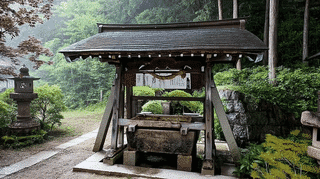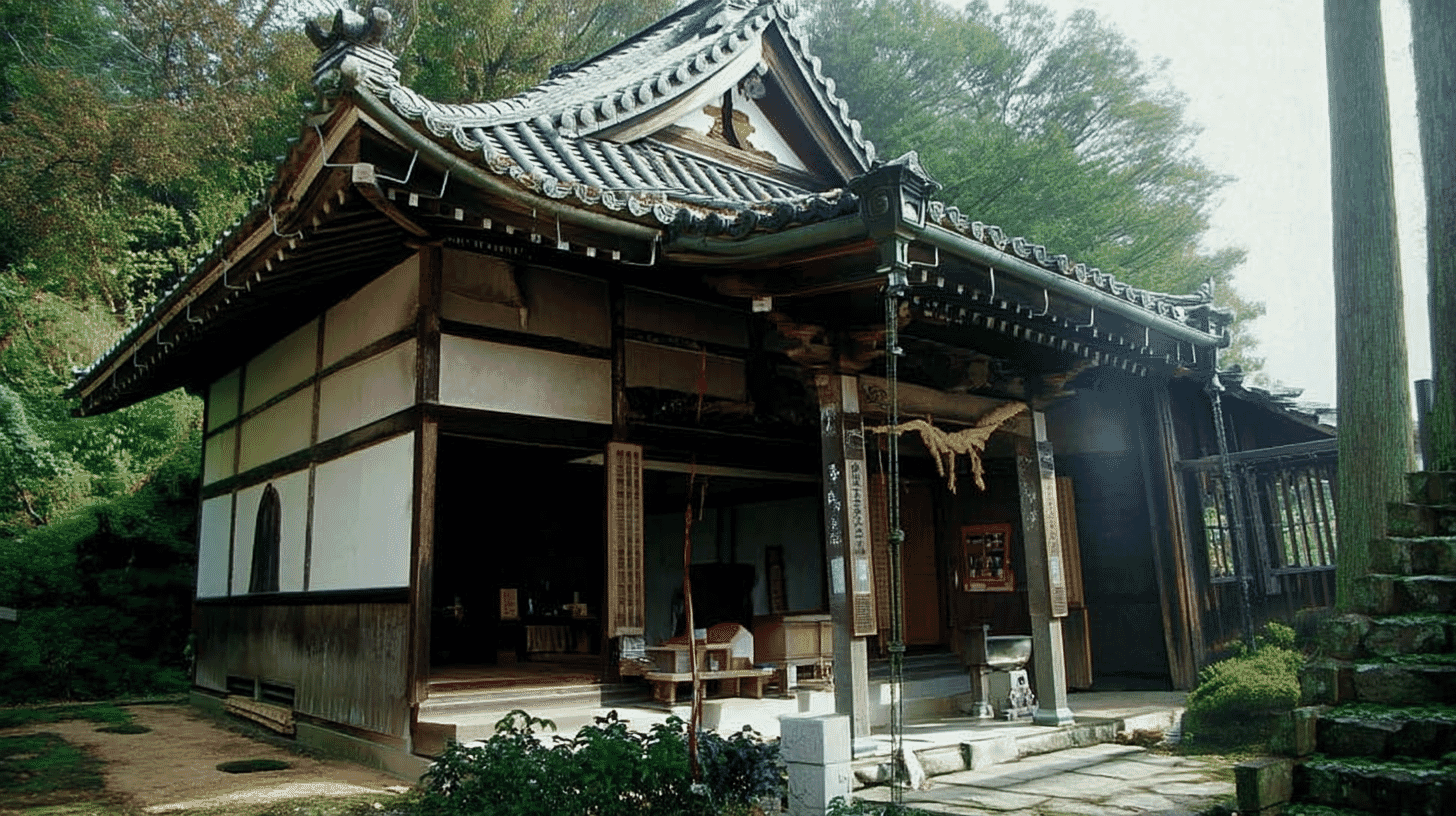
One Goma Hall, a Registered Tangible Cultural Property since 2021
Kannonshoji Temple Goma Hall (観音正寺護摩堂, Kannonshoji Gomado) stands at Kinugasayama 2, Ishidera, Azuchi, Omihachiman City, Shiga Prefecture, a Showa-period structure entered on the register of tangible cultural properties on 14 October 2021. It is a registered property rather than a designated one.
The quantity is one building. The owner is the temple.
The structure is timber, single-storeyed, tiled, with a floor area of 43 square metres. The date field reads early Showa and the year field 1928.
Built from the Members of an Older Hall
The timbers of a building that stood before were put together again.
The Agency records that this modern hall was built by reusing the members of a hall put up in the Anei era.
That era runs from 1772 to 1781. Timbers from a hall of those years went into this building of 1928.
At the Haba residence, an old gassho-zukuri house was bought from another settlement after a fire and re-erected. That moves a whole building.
The former Gakushuin hall was likewise moved twice, from Tokyo to Chiba. That too is the building itself.
Here a building was taken apart and only its members carried into a new one. The Agency closes that it is valuable for what it shows of how the precinct changed. The timbers carry the record of what stood before.
Different Roofs Front and Back
One building, with its roof divided between front and rear.
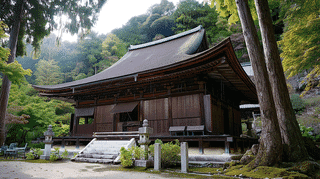
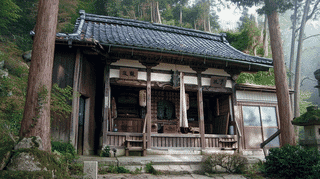
The Agency gives it as 3 bays square, hip-and-gable at the front and gabled at the back, roofed in pantiles, with a projecting canopy over the entrance.
Hip-and-gable at the front, gabled at the back. Seen from before and from behind, the outline of the roof changes.
At the Seianji guest hall, the south side is hip-and-gable and the north gabled: the same pairing.
That is a guest hall and this a Buddhist hall, so the kinds of building differ. The way the roof is made, however, agrees.
The tiling is pantile in both cases as well. The canopy over the entrance belongs to this building alone.
An Altar Bay Twice the Depth of the Other Halls
The interior differs from the other halls at this temple by one bay.
The Agency records a single room with a battened ceiling and an altar set in the innermost bay.
A battened ceiling carries its boards on slender strips laid across.
The Jizo hall and the fuda hall each set their altar in the innermost half-bay, under a curved beam.
Here it is a full bay, twice that. The hall is built for goma rites, and a canopy projects over the entrance.
Within a floor area of 43 square metres stands one room, with a whole bay given to the altar.
Visiting
The hall stands at Kinugasayama 2, Ishidera, Azuchi, Omihachiman City, Shiga Prefecture, owned by the temple.
Its position is recorded: south of the Jizo hall, facing west.
The fuda hall in turn stands south of this one, also facing west. The Jizo hall, the goma hall and the fuda hall run southward in order, each facing west.
A canopy projects over the entrance, so the front steps forward a stage from the body of the hall.
The roof is hip-and-gable at the front and gabled at the back. The hall faces west, so the gable of the hip-and-gable end is what shows as one comes up the path. The temple lies in the hills, and visiting follows its own arrangements. Check before travelling.
Q&A
- When was the hall registered?
- On 14 October 2021, as a registered tangible cultural property. It is registered rather than designated, and the quantity is one building.
- How was it built?
- The Agency records that it was built by reusing the members of a hall put up in the Anei era. Timbers from an older building were assembled anew.
- What form is the roof?
- It differs front and back: hip-and-gable at the front, gabled at the rear, roofed in pantiles, with a canopy over the entrance.
- How large is it?
- A floor area of 43 square metres. Inside is one room, with a full bay given to the altar, twice the half-bay of the Jizo and fuda halls.
- Where does it stand?
- South of the Jizo hall, facing west. The Jizo hall, this hall and the fuda hall run southward in order, each facing west.
Basic Information
| Name | Kannonshoji Temple Goma Hall (観音正寺護摩堂, Kannonshoji Gomado) |
|---|---|
| Location | Kinugasayama 2, Ishidera, Azuchi, Omihachiman City, Shiga Prefecture |
| Designation | Registered tangible cultural property (structure, religious architecture); registered rather than designated; 7 buildings at the temple were registered on the same day |
| Year Designated | 2021 (14 October), registered |
| Quantity | 1 building |
| Dimensions | Timber, single-storeyed, tiled, with a floor area of 43 square metres. 3 bays square on all 4 sides, hip-and-gable at the front and gabled at the back, roofed in pantiles, with a projecting canopy over the entrance. Inside is 1 room with a battened ceiling and an altar set in the innermost 1 bay. The members of a hall of the Anei era were reused. The date field reads early Showa and the year field 1928 |
| Owner | Kannonshoji |
| Public Access | Within the grounds of a temple in the hills; visiting follows its own arrangements |
References
- Cultural Heritage Online: the Kannonshoji goma hall
- https://bunka.nii.ac.jp/heritages/detail/544581
- Cultural Heritage Online: the Kannonshoji fuda hall
- https://bunka.nii.ac.jp/heritages/detail/572622
- Agency for Cultural Affairs, National Cultural Properties Database
- https://kunishitei.bunka.go.jp/
- Omihachiman City: cultural properties
- https://www.city.omihachiman.lg.jp/
Last verified: 2026.09.13