
Important Cultural Property of Shiga
滋 賀 県 の 重 要 文 化 財Shiga’s Important Cultural Properties — designated for their value to the nation’s cultural history.
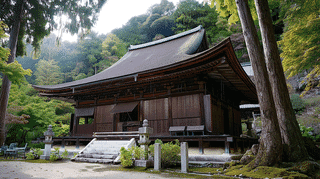
An early Muromachi-period Buddhist main hall in Shiga Prefecture. The Agency's own commentary field for the hall there has been left entirely empty now.
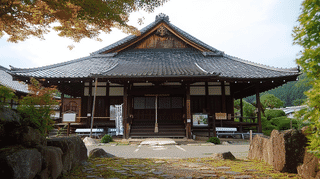
Discover the Seianji Guest Hall, an Important Cultural Property of Japan near Lake Biwa. Explore Momoyama-era architecture, Hasegawa school paintings, and legendary Ano-shu stone walls in Sakamoto, Otsu.

Nine documents by Kawachiya Kashō, a wealthy farmer and brewer, and his heirs reveal how an educated villager in Edo Japan weighed family, learning, and survival.
Discover the 953-item Important Cultural Property collection documenting the achievements of Kunitomo Ikkansai (1778–1840), the 'Edison of the Edo Period.' From Japan's first reflecting telescope and sunspot observation records to the country's first practical air gun, explore the extraordinary scientific legacy born in a small gunsmith village in Shiga Prefecture.
Discover the Ichiji Kinrin Image, a Kamakura-period silk painting designated an Important Cultural Property in 1940 and privately preserved in Ichinobe, Higashiomi, Shiga. Explore the mystical iconography of this supreme esoteric Buddhist deity and the rich cultural heritage of eastern Ōmi.
Discover the Anyoji Thirteen-Story Stone Pagoda, a nationally designated Important Cultural Property from the late Kamakura period, standing within the grounds of Tohozan Anyoji Temple in Ritto City, Shiga Prefecture. This 334 cm granite pagoda features exquisite relief carvings of four Buddhas and elegant eave curvature.
The Main Hall of Hando Shrine, perched atop Mt. Hando (664 m) in Koka City, Shiga Prefecture, is a nationally designated Important Cultural Property rebuilt in 1650. Adorned with vermilion lacquer and gold leaf in the Momoyama architectural style, it crowns a sacred mountain renowned as a Shugendo training ground and legendary home of the Koga ninja.
The Main Hall of Ikuwa Shrine in Yasu City, Shiga Prefecture, is an Important Cultural Property dating from the early Muromachi period (c. 1333–1392). Built in the ichikensha nagare-zukuri style with a hinoki cypress bark roof, it enshrines Fujiwara no Tadashige, a legendary lord who slew a great serpent and reclaimed marshland for the local community. The shrine grounds also house the Kamakura-period Kasuga Shrine subsidiary hall, another Important Cultural Property.
The subsidiary Kasuga Shrine Main Hall within Ikuwa Shrine in Yasu City, Shiga Prefecture, is an Important Cultural Property dating to the late Kamakura period. Built in the nagare-zukuri style with cypress bark roofing, this compact shrine hall preserves older architectural techniques than the adjacent main Ikuwa Shrine hall, making it a rare and valuable example of medieval Japanese sacred architecture.
The honden of Isasa Shrine, located along the old Nakasendo highway in Kusatsu City, Shiga Prefecture, is a nationally designated Important Cultural Property built in 1468 during the Muromachi period. This elegant single-bay flowing-gable structure with a hinoki bark roof features exquisite openwork carvings and is just an eight-minute walk from JR Kusatsu Station.
A mid-Muromachi one-bay shrine hall with a flowing roof in the Inari Shrine precinct at Yasu, Shiga. Designated in 1917, it once served the vanished Fukurin-ji.
Enkoji Kujunoto in Yasu, Shiga, is a granite nine-storey pagoda of about 1256, now 3.94 m without its finial. Its lowest tier bears the four Diamond Realm Buddhas.
Enkoji Hondo in Yasu, Shiga, built in 1257, is dated by ink writing on its ridgepole. Its gabled roof, rare on a Buddhist hall, was restored in a 1956 repair.
Built inside the Kyoto palace in 1619 for Tokugawa Masako and granted to Enman-in in 1647, this 19.7-metre shingle-roofed shoin hall in Otsu was designated in 1902.
A bronze spire on a hilltop behind Enryaku-ji's West Pagoda hall, traced to Saichō in 820 and recast in bronze around 1895. Inside are copied sutras, not relics.
Built in 1634 as a Tokugawa shrine hall, Enryaku-ji's Great Lecture Hall was moved up Mount Hiei in 1963. An Important Cultural Property of early Edo carpentry.
Built in 1347 as Onjō-ji's main hall beside Lake Biwa, it was carried up Mount Hiei by Hideyoshi in 1595 and is now Enryaku-ji's oldest surviving building.
Oisugi Shrine Main Hall in Kusatsu, Shiga, is a 1452 nagare-zukuri hall with painted carvings, designated in 1906, and host to the UNESCO Sanyare Odori.
Rebuilt in 1581 on Oda Nobunaga's order, the Main Hall of Oiso Shrine in Shiga is a three-bay nagare-zukuri hall roofed in cypress bark, set in the old Oiso Forest.
The 1427 Main Hall of Shinohara Shrine in Yasu, Shiga, stands beside a National Treasure. This Important Cultural Property is nicknamed the Rice-Cake Shrine.
More from Shiga
Shiga’s registered properties across designations, with featured heritage and travel notes.
The complete kokuhō catalogue — browse by prefecture, period, and category.
Nationwide jūyō bunkazai — architecture, sculpture, painting, crafts, and documents.