
Shōwa
Shimane · 昭和Browse Shimane’s cultural heritage from the Shōwa period (1926 – 1989). Filter by type and keyword, with concise stories, maps, and travel tips.
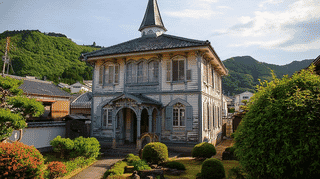
The priest's house at Tsuwano Catholic Church in Shimane is a timber building of 1917 in 2 storeys, slate-roofed and clad differently on each floor. Registered 2010.

Built in 1927 to electrify the line to Matsue, Nunosaki Substation still feeds Ichibata's trains. Its symmetrical front carries a giant order of pilasters.
Built in 1930, registered in 1996: Ichibata's Izumo Taisha-mae station wears a Secession-style roof, and coloured glass patterns the floor of a working terminus.
The early-Showa tea-garden arbor of the Itohara house, barely three square metres under a cedar-bark roof, where guests paused before a tea gathering.
Built in 1929 at Matsue's Imbe plant, this 683-square-metre concrete slow sand filter bed was registered in 2008 and still filters the city's drinking water today.
Discover Karakoro Art Studio, the beautifully preserved former Bank of Japan Matsue Branch in Shimane Prefecture. Designed by architect Nagano Uheiji in 1938 and registered as a National Tangible Cultural Property, this Greek-inspired landmark now serves as a vibrant food, culture, and art complex in the heart of Matsue's castle town.
Discover the Former Tadokoro Elementary School Auditorium in Ohnan, Shimane Prefecture. Built in 1928, this Registered Tangible Cultural Property features a grand irimoya roof and early Shōwa-era wooden architecture, now serving as a local history museum.
Built in 1933 facing the family's main house on Izumo's Momen Kaido, this tall two-storey wing is pierced by a kakedashi passage running through to the canal.
A 19-metre reinforced concrete chimney built in 1957 at Shimomori Brewery in Tsuwano. It vented the kiln that steamed sake rice and now marks the brewery from afar.
The early-Showa rice mill at Shimomori Brewery in Tsuwano handled rice polishing, the first step of sake-making, and completes a quiet street front beside the storehouse.
Located in Matsue City, Shimane, the Shimane Prefectural Government Building Assembly Hall was completed in 1959 to a design by Yasuda Kataski and is registered as a National Tangible Cultural Property. This reinforced concrete structure on the former third bailey of Matsue Castle is celebrated as a leading example of post-war provincial modernist architecture.
Discover the Shimane Prefectural Government Main Office Building in Matsue, a 1959 modernist masterpiece designed by Shimane-born architect Yasuda Kataru. Standing on the former third bailey of Matsue Castle, this Registered Tangible Cultural Property harmonises exposed concrete, horizontal white canopies and local stone with the historic landscape.
Facing Matsue Castle across the moat, the Shimane Prefectural Civic Center is a 1968 modernist landmark designed by architect Yasuda Kataji. At the heart of the award-winning Shimane Prefectural Government Area Improvement Plan, it was registered as a Tangible Cultural Property of Japan in 2021. Its colonnaded façade engages in a deliberate dialogue with the prefectural office across the water.
Standing across the moat from Matsue Castle in Shimane Prefecture, the Shimane Prefectural Library is a celebrated work of postwar Japanese modernism. Designed by Kiyonori Kikutake and completed in 1968, the building was registered as a National Tangible Cultural Property in 2021. Its L-shaped reading-room modules, bold steel-roofed central lobby, and carefully aligned wall-columns that preserve views toward the castle reveal an architect thinking deeply about both function and setting. Still in use as a public library today, it is freely open to visitors and sits within easy walking distance of Matsue Castle, the samurai streets of Shiomi Nawate, and other Kikutake works including the Shimane Art Museum on Lake Shinji.
Discover Shimane Prefectural Budokan in Matsue, a 1970 martial arts hall designed by celebrated Metabolist architect Kiyonori Kikutake. Registered as a National Tangible Cultural Property, its bold closed façade and vast 40-meter steel truss dojo make it a hidden gem of modern Japanese architecture near Matsue Castle.
Discover the Sumikawa Power Station Main Building in Masuda, Shimane—a rare 1943 modernist industrial landmark, still generating power today, tucked deep in the Hikimi River valley of western Japan.
Discover the Chugoku Electric Power Hikimi Power Station Main Building, a registered tangible cultural property in Masuda City, Shimane. Built in 1928 with large concrete blocks in a charming Western church-like style, it remains a working hydroelectric plant on the Hikimi River, an evocative landmark of early Showa modernization heritage set amid the Nishi-Chugoku mountains.
The Tsumori Internal Medicine Clinic in Honjō-chō, Matsue City, Shimane Prefecture, is a nationally Registered Tangible Cultural Property built in the late Taishō period. Featuring a steeply pitched copper-plate half-hipped roof, an elegant bay window, and refined Western-style detailing, this charming clinic has served the community for nearly a century. Combine your visit with nearby attractions including Mount Makuragi's Kezōji Temple and the scenic shores of Lake Nakaumi.
Tsuwano Catholic Church in Shimane, rebuilt in 1929 in single-spired Gothic style with a tatami floor, stands where Urakami Christians died. Registered in 1996.
Hoseikan Yusentei at Tamatsukuri Onsen in Matsue, Shimane, is a timber pavilion of 1931 built for imperial guests and registered as a Cultural Property in 2018.