
Edo
Shimane · 江戸Browse Shimane’s cultural heritage from the Edo period (1603 – 1868). Filter by type and keyword, with concise stories, maps, and travel tips.
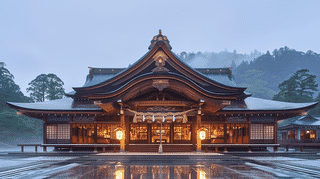
The main hall of Izumo Taisha in Shimane was built in 1744 in the taisha-zukuri form and is the largest surviving example. It became a National Treasure in 1952.

Kandenan and Kogetsutei in Matsue, Shimane, are tea rooms built around 1792 to daimyo Matsudaira Fumai's own drawing. A 42cm board keeps the one-mat room open.
Takuhi Shrine, perched within a natural rock cavern on the slopes of Mt. Takuhi on Nishinoshima Island in the Oki Islands of Shimane Prefecture, is renowned for its extraordinary setting where sacred architecture merges with the mountain itself. The main hall, prefabricated in Osaka in 1732 and assembled on site, together with the connecting hall and worship hall, forms the oldest surviving shrine complex in the Oki Islands, designated as an Important Cultural Property of Japan in 1992. Revered for centuries as the guardian deity of maritime safety across the Sea of Japan, the shrine was famously depicted by ukiyo-e masters Hiroshige and Hokusai.
A late Edo farmhouse in Yoshika, Shimane, 7.6 by 6.0 metres with a thatched hip-and-gable roof, showing the form of a small ordinary farmhouse. Designated in 1969.
An 18th-century farmhouse in Unnan, Shimane, and an Important Cultural Property. Its great hall is held open without posts by raised nobori-bari beams.
On the rugged island of Dōgo in Japan's remote Oki Islands stands Mizuwakasu Shrine, the highest-ranked shrine of the former Oki Province. Its Main Hall, rebuilt in 1795, is a nationally designated Important Cultural Property celebrated for its rare Oki-zukuri architectural style — a hybrid found nowhere else in Japan. With its dramatic thatched gable roof, ancient pine-lined approach, classical sumo ring, and biennial festival of yamabiki and yabusame, this shrine offers travelers a profound encounter with island spirituality and over a thousand years of recorded history.
This late Edo four-legged gate at Ikoji in Masuda carries hexagonal relief along its tie-beam and stepped brackets under the eaves. It was registered in 2017.
The late-Edo main house of the Ishibashi Residence in Izumo, Shimane, covers 262 square metres, its frontage widened by pent roofs, with checkerboard namako tiling.
The ceremonial gate of the Itohara ironmaster house, a late-Edo timber gate roofed in tile with flanking walls, opened only for the lord of Matsue's formal visits.
The late-Edo rice storehouse of the Itohara house, oldest of the family's stores. Registered farmers who held samurai rank, they built wealth on rice as well as iron.
The plainest of Sasaya's four registered buildings in Tsuwano, and the one with the best door: kakeko-nuri plasterwork whose stepped edges leave fire no way in.
A tiny Edo storehouse built to be looked at: namako tile wall base, copper shutters, a crest on top. It makes the Honmachi streetscape with the shop it stocked.
Thick fireproof walls, one grilled window, and inside a six-mat tatami room with polished log rafters. A merchant family's tea-room sealed in a strongbox, Tsuwano.
Fourteen meters of frontage on Honmachi in Tsuwano. Plastered okabe walls bury the frame, udatsu parapets rise at each end, and the ground floor still sells kimono.
The storehouse at Shimomori Brewery in Tsuwano is the oldest of the seven, dating to the late Edo period. It sets red Sekishu tiles against white plaster.
The Shimada Family Residence Sake Brewery in Masuda, Shimane, is a late Edo earthen storehouse of 298 square metres, extended in Meiji and registered in 2017.
A late-Edo timber wall, 26 metres long, dividing three forecourts before the main house of a merchant compound in Gotsu Honmachi, Shimane. Registered in 2009.
An 11-metre-wide merchant townhouse on Tsuwano's old highway, rebuilt after the great fire of 1853, registered in 2010. Its shopfront glass bears the family crest.
A two-storey earthen storehouse behind the Bundoya shop in Tsuwano, built after the 1853 fire. Clay walls, a cut-stone base, a family crest raised in gable plaster.
Hozumi Residence Shita-no-kura, Onan, Shimane: a late Edo storehouse east of the main house, its posts leaning inward and a curved timber carrying the ridge beam.