
Registered Tangible Cultural Properties of Tokushima
徳 島 県 の 登 録 有 形 文 化 財Tokushima · Registered Tangible Cultural Properties
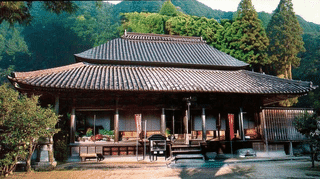
Discover Manpuku-ji Main Hall, a Registered Tangible Cultural Property in Naka Town, Tokushima. This 170-year-old Edo period Buddhist temple showcases unique "shiho-buta minka" regional architecture with traditional thatched roofing—an authentic off-the-beaten-path destination in Shikoku.

A 1915 retirement house at the centre of a walled compound in Mima, Tokushima, built by a family that grew rich on indigo and then on construction work.
Built in 1756, the vermilion Anrakuji Temple Main Gate in Mima, Tokushima pairs orthodox Zen bracketing above with an unconventional lower storey. Registered 2009.
Built in 1925, the Anrakuji Shoin in Mima, Tokushima holds two matted rooms with alcoves and writing bays, carved transoms between them. Registered in 2009.
Raised on a dressed-stone podium in Mima, Tokushima, the 1911 Anrakuji Temple Bell Tower has curved leaning posts, a coffered ceiling and a shachi on its ridge.
At the sixth Shikoku pilgrimage temple in Kamiita, Tokushima, the late Edo Anrakuji Temple Hojo has a thatched roof edged in tile and a raised lord's room.
Built in 1938 and covering 517 square meters, the Anrakuji Temple Main Hall in Mima, Tokushima is a seven-bay Shin hall with a carved porch, registered in 2009.
Discover Daisendō, a registered Tangible Cultural Property in Tsurugi Town, Tokushima. This Edo-period Buddhist hall serves as the 13th stop on the Haba Shikoku pilgrimage—a local 88-temple route created so that ordinary villagers could experience the spiritual journey of Shikoku.
Nestled along the Otanigawa in Mima City, Tokushima, this curving stone sabo dam was built in the Meiji era under the guidance of Dutch engineer Johannis de Rijke. It is the only surviving Meiji-era erosion-control dam in Shikoku and the largest of its kind associated with de Rijke in Japan. Its graceful three-tiered stonework now anchors De Rijke Park, where Dutch-style windmills and 15,000 spring tulips honor an engineer whose ideas still hold back the sediment of the Sanuki Mountains today.
Tucked into a hillside in Tsurugi-chō, Tokushima Prefecture, Kaize-dō is the 34th station of the Haba Shikoku 88 Sacred Places, a local Edo-period miniature version of Shikoku's great pilgrimage. Originally founded in 1616 and rebuilt in 1816, this three-bay pyramid-roofed hall with open south and east sides was registered as a national tangible cultural property in 2017, and it preserves a vivid trace of rural folk Buddhism in the Shikoku mountains.
The Kakimoto Family Barrack in Naruto City, Tokushima Prefecture, is a National Registered Tangible Cultural Property and one of the only surviving wooden barracks from the Bandō Prisoner of War Camp, where German prisoners gave the first complete performance of Beethoven's Ninth Symphony in Asia in 1918. Discover its history, the moving Japanese-German friendship it represents, and how to visit the nearby Naruto German House and German Village Park.
Located in the Kyōjō district of Higashi-Iya, Miyoshi City, Tokushima Prefecture, the Kawai Hyakkaten is a historic general store that served the daily needs of one of Japan's most remote mountain communities in the Iya Valley. Registered as a National Registered Tangible Cultural Property in 2019, this traditional wooden commercial building preserves the commercial heritage and historical landscape of a vanishing mountain village.
The Sanmon gate of Ganshoji Temple in Mima City, Tokushima Prefecture, is a Meiji-era eight-legged gate registered as a National Registered Tangible Cultural Property in 2009 for its uniquely creative design, featuring a distinctive flower-head arch opening and elaborate plant motifs. Standing as the entrance to one of Shikoku's oldest temples, it invites visitors to explore a hidden cultural treasure alongside the oldest dry landscape garden in Shikoku and the historic temple district of Mima.
Kita Pharmacy in Nishi-Iya, Miyoshi City, Tokushima Prefecture, is a historic commercial building registered as a National Registered Tangible Cultural Property in 2019. Discover the history and charm of this traditional drugstore that served the remote mountain communities of the Iya Valley, one of Japan's three great secluded regions.
The Former Oiso Family Residence in Matsushige, Tokushima, is a National Registered Tangible Cultural Property built during the late Edo period as the home of the Oiso family, who prospered through indigo dye manufacturing. Featuring a distinctive gable roof with plaster walls and a robust timber framework, it preserves the legacy of the Awa indigo industry. Now maintained within the grounds of Kashino Club.
The Former Kashino Family Residence in Matsushige, Tokushima Prefecture, is a grand two-story wooden residence built between 1915 and 1925 by the Kashino family, who prospered through the lime trade. Featuring an irimoya-zukuri hip-and-gable roof and a building area of 381 square meters, this lavishly crafted mansion was registered as a national Tangible Cultural Property in 1999 and now serves as the Kashino Club wedding venue.
The Former Kawaguchi Post Office Building and Main House in Miyoshi City, Tokushima Prefecture, is a National Registered Tangible Cultural Property built in 1905. This charming wooden structure uniquely combines Western and Japanese architectural styles, featuring painted clapboard siding and traditional lattice windows along the Yoshino River.
A timber shed of just eleven square metres behind a 1959 bank branch in Miyoshi, Tokushima, built to house motorcycles. Registered as a cultural property in 2023.
Built in 1959 on the old Iyo Kaido in Miyoshi, Tokushima, this concrete bank branch wears washed mortar scored to imitate cut stone. Registered in 2023.
Relocated from an indigo merchant's house in 1954, the Tatsumi Zashiki at Tokushima's Awa Jurobei Yashiki is a 21-mat room of fine timbers, registered in 2024.
More from Tokushima
Tokushima’s registered properties across designations, with featured heritage and travel notes.
The complete kokuhō catalogue — browse by prefecture, period, and category.
Nationwide jūyō bunkazai — architecture, sculpture, painting, crafts, and documents.