
Registered Tangible Cultural Properties of Wakayama
和 歌 山 県 の 登 録 有 形 文 化 財Wakayama · Registered Tangible Cultural Properties
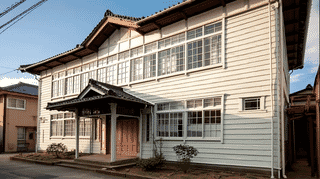
A school building of 1937 south of the Shingu Castle ruins in Wakayama, its entrance porch carrying a transom carved as an abacus. Listed as heritage in 2024.

The guest wing of the Izumi family house in Hirogawa, Wakayama, built in 1904 by the eighth head of the family, has high-ceilinged rooms finished with delicate care.
The incense waterwheel mill of the Itani family in Susami, Wakayama, a late Taisho mill on the Kumano Kodo with 16 stone mortars, ground cedar leaves for incense.
Ichiki Ryokan Old Building is a late Meiji two-storey guest wing moved to this Kainan inn in 1937, with a four-room banquet suite and showy sukiya timberwork.
Ichiki Ryokan Entrance Building is a small 1937 hall in Kainan, Wakayama, whose black-stone entry floor leads to corridors joining three guest buildings of the inn.
Ichiki Ryokan New Building is an early Showa guest wing at the back of a Kainan inn, with five self-contained sukiya rooms whose verandas overlook the Miya River.
Ichiki Ryokan Main Building is a late Edo town house on the road to Chohoji in Kainan, Wakayama, with an earthen passage, low tiled eaves and formal rear rooms.
Ichiki Ryokan Gate and Wall fronts the road to Chohoji in Kainan, Wakayama: a 1937 cedar-bark gate with knotted posts and a plaster wall skirted with split logs.
A late Edo farmhouse moved to Kitano, Wakayama City in 1941, with castle-like plastered walls and a tiled irimoya roof; No. 30-0001 in the first 1996 register.
A c.1916 farmhouse in Nakamitani, Kinokawa, with a four-room grid plan and a west parlor whose alcove and shelves sit on separate walls to keep a garden view.
The oldest building on a Kinokawa farm estate: a late Edo 2-storey storehouse with an okiyane roof and torii-framed door, its outer walls joined to the estate wall.
A 59-meter Taisho-era earthen wall around a Kinokawa farm estate, set on stone footings and faced with small green chlorite schist stones packed without gaps; 2023.
A 1970 hipped-and-gabled gatehouse facing the lane at a Kinokawa farm estate, with double doors, a wicket, a barn and a boat-hull-ceiling room; registered in 2023.
The Ueda family's main house, built around 1929 on the Kinokawa's south bank in Hashimoto, Wakayama, pairs a traditional hipped roof with a quietly modernised plan.
On the river side of the Ueda estate in Hashimoto, Wakayama, two joined late-Edo earthen storehouses survive as the oldest buildings on this former headman's grounds.
At the western edge of the Ueda estate in Hashimoto, Wakayama, this late-Meiji detached parlour holds three eight-mat guest rooms, raised on walls of Kishu blue stone.
A small barn in Kimino, Wakayama, whose ridgepole went up on March 5, 1957, framed in new cypress and chestnut salvaged from an older building; registered in 2019.
An early 18th-century farmhouse and former teahouse in Kimino, Wakayama, with an oshiita alcove, a tokozashi ceiling and adze-marked beams; registered in 2019.
A late Edo gatehouse in Kimino, Wakayama, with a gable at one end and a hip-and-gable at the other, that held the farm's cow shed and kitchen; registered in 2019.
A detached room of around 1957 in Kimino, Wakayama, built of fine cypress, with a black fukiyose batten ceiling, kumiko latticework and views east; registered 2019.
More from Wakayama
Wakayama’s registered properties across designations, with featured heritage and travel notes.
The complete kokuhō catalogue — browse by prefecture, period, and category.
Nationwide jūyō bunkazai — architecture, sculpture, painting, crafts, and documents.