
Important Cultural Property of Wakayama
和 歌 山 県 の 重 要 文 化 財Wakayama’s Important Cultural Properties — designated for their value to the nation’s cultural history.
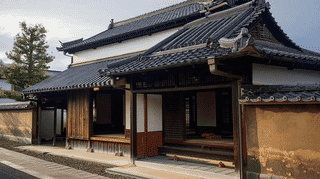
Three mid-Edo-period buildings in Kinokawa in Wakayama Prefecture. The place name bracketed in its own title there is still an older one even now today.

Held by Nachisan Seigantoji Temple in Nachikatsuura, Wakayama Prefecture, this small gilt-bronze thin-relief plaque of Ratnasambhava is part of a three-dimensional Vajra Realm Mandala buried by the monk Gyoyu in 1130 in hope of rebirth in the Pure Land of Nachi. Excavated in 1918 and designated an Important Cultural Property in 1937, it stands as a singular example of a metalwork mandala in Japan and a precious witness to the flourishing of Kumano faith in the late Heian period.
Discover the naginata signed by Rai Kunitoshi, an Important Cultural Property preserved on Mount Koya in Wakayama Prefecture. Forged by one of the late Kamakura period's most celebrated swordsmiths of the Yamashiro Rai school, this rare polearm showcases the refined steel and elegant tempering of the Rai tradition, and offers a window into Japan's medieval warrior craftsmanship and the UNESCO World Heritage of Koyasan.
Built in 1596, Kada Kasuga Shrine's main hall in Wakayama is an Important Cultural Property whose carved struts show shrimp, shells, Ebisu, and a rare kalavinka.
A thatched three-bay hall of 1427 in upland Wakayama, dated by its ridge tablets, housing a 1494 shrine cabinet and a village rite still held each lunar new year.
A 1937 timber schoolhouse in Hashimoto, Wakayama, designated an Important Cultural Property in 2014 and still holding classes. A 98-metre range, four wings.
The Main House of the Former Yanagawa Residence, an 1807 townhouse built by a Kishu lacquer wholesaler in Kuroe, now stands at Kii Fudoki no Oka in Wakayama City.
The bell tower of Gokokuin at Kimiidera, Wakayama, a Momoyama-period tower of 3 by 2 bays with a skirted base and a tiled hip-and-gable roof, was designated in 1908.
The tahoto pagoda of Gokokuin at Kimiidera, Wakayama, a three-bay two-storey pagoda of 1449 roofed in hongawara tiles, was designated in 1908 with a ridge tag.
The two-storey gate of Gokokuin at Kimiidera, Wakayama, a gate of the mid Muromachi period three bays wide with a tiled hip-and-gable roof, was designated in 1908.
The Kongobuji Temple designation covers nine Danjo Garan halls on Mount Koya, from the 1834 Saito pagoda to the 1883 Juntei-do, with notes on access to the Mieido.
Built by Ishida Mitsunari in 1599 beside Kobo Daishi's mausoleum, the Kongobuji Temple Okunoin Sutra Repository houses a painted revolving bookcase. How to visit.
The Kongobuji Temple Kondo (1932) and Konpon Daito (1937) hide concrete frames under timber. See the 48-meter pagoda's mandala interior and how to visit both.
The Kongobuji Temple Sannoin Main Hall comprises three shrines to Koyasan's guardian deities, rebuilt in 1522 per the Agency, with oversized Kasuga-style forms.
The Kongobuji Temple Daimon Gate, rebuilt in 1705 at Mount Koya's western edge, stands 25.1 meters tall with giant Nio guardians. Free to view; see what to look for.
Two ornate spirit halls for Ieyasu and Hidetada form the Kongobuji Temple Tokugawa Family Mausoleum on Mount Koya. Dates, decoration, fees and opening hours.
At Jōmyō-ji in Arida, Wakayama, this two-storied pagoda rises 12.95 meters. Built in the mid-Kamakura period, it holds five Wisdom Buddhas and old wall paintings.
In Arida, Wakayama, Jōmyō-ji's Main Hall is a late-Kamakura, tile-roofed hall that survived the 1585 fire which razed its temple. An Important Cultural Property.
Built in 1560 and named an Important Cultural Property in 1955, this single-bay Kasuga-style hall in mountainous Aridagawa keeps carved peonies and faded polychrome.
Built in 1785 for a village headman in Aridagawa, Wakayama, the Suzuki Residence is dated by its ridge tag and its four-room plan, an Important Cultural Property.
More from Wakayama
Wakayama’s registered properties across designations, with featured heritage and travel notes.
The complete kokuhō catalogue — browse by prefecture, period, and category.
Nationwide jūyō bunkazai — architecture, sculpture, painting, crafts, and documents.