
Edo
Aichi · 江戸Browse Aichi’s cultural heritage from the Edo period (1603 – 1868). Filter by type and keyword, with concise stories, maps, and travel tips.
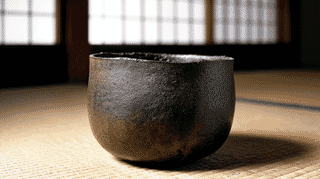
An Edo-period tea bowl by Hon'ami Koetsu in Nagoya, Aichi. Black glaze covers it but thins in places, letting the clay body show through. Designated in 2007.

An Edo-period katana by the Kyoto smith Kunimichi, a leading pupil of Horikawa Kunihiro, held privately in Aichi, designated an Important Cultural Property in 1959.
Held in a private collection in Aichi Prefecture, this Important Cultural Property is a hexagonal plate made by the potter Ogata Kenzan with painting by his elder brother, the Rinpa master Ogata Korin. Dated 1710 on its base, it is the only known collaborative ceramic by the two brothers bearing a specific year, and its rare hexagonal form, Korin's crane and pine painting, and Kenzan's own poetic inscription make it a cornerstone reference work in the study of Rinpa ceramics.
Founded by the Matsudaira ancestors of the Tokugawa, Iga Hachimangu in Okazaki keeps a polychrome early-Edo shrine whose main hall Ieyasu built in 1611.
Owari's second shrine in Inuyama, Aichi, restored in 1661 by lord Tokugawa Mitsutomo, with a rare twin hip-and-gable main hall and ritual hall in the Owari layout.
The early Edo worship hall of Owari Okunitama Shrine in Inazawa, Aichi: an open, round-pillared gabled hall that keeps to a restrained traditional style.
The tower gate of Owari Okunitama Shrine in Inazawa, Aichi: its lower storey is late Muromachi and its upper storey dates from 1646, under a cypress-bark roof.
On the old Chuma road in Asuke, Toyota City, the Suzuki family compound preserves sixteen buildings and their land, a great merchant household across Edo and Meiji.
A mid-Edo mountain house in Toyone, Aichi, framed on unusually wide bays with a six-room plan borrowed from samurai housing. Three buildings designated in 1974.
The tomb of Tokugawa Yoshinao, founder of the Owari domain, beside Jokoji in Seto, Aichi, built in 1651 and 1652 on a rare Confucian plan by Chen Yuanyun.
An 1808 five-storey pagoda at Koshoji temple in Nagoya, Aichi, restrained in the wayo style and keeping archaic features such as an earth-floored first storey.
One of the four Kannon temples guarding Nagoya Castle, Jimokuji in Ama, Aichi preserves a pagoda of 1627 and an east gate of 1634, designated nationally in 1953.
Oda Urakusai's two-and-a-half-mat teahouse of about 1618, known for its calendar-papered walls and slanting wall, now standing in Inuyama's Urakuen Garden.
Rebuilt in the Keian era of the 1640s, the Main Hall of Shokaiji in Inazawa, Aichi, sets an early Edo frame around a Kamakura altar platform and ceiling.
Oda Urakusai's retirement residence of about 1618, built beside his teahouse Joan in Kyoto and now in Inuyama's Urakuen, with doors painted by Hasegawa Tohaku.
Ordered by the third shogun Iemitsu and finished in 1646, Takisan Tosho-gu in Okazaki keeps its main hall, gate and other buildings in vivid lacquer and colour.
On Mt. Hōrai in Aichi, this shrine to Tokugawa Ieyasu is tied to a legend of his birth. Its cypress-bark halls of 1651 are an Important Cultural Property.
A vermilion two-storey gate of 1651, donated by Shogun Iemitsu, on the long stone-stepped approach to Horaiji in Shinshiro, Aichi, with carved tigers and qilin.
The Former Hotta Family Residence in Tsushima, Aichi, is an Owari merchant townhouse of 1765 and 1770, designated in 1978. Three storehouses and a tea room survive.
The shoin behind the main hall of Mandaraji in Konan, Aichi, built between 1663 and 1674 and used to entertain the shogun's inspectors. Important Cultural Property.