
Shōwa
Aichi · 昭和Browse Aichi’s cultural heritage from the Shōwa period (1926 – 1989). Filter by type and keyword, with concise stories, maps, and travel tips.
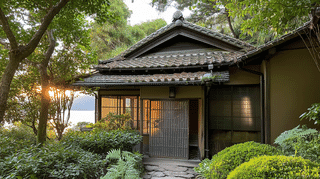
A single-storey timber tea house on a hill in Gamagori, Aichi, with a small tea room and an eight-mat guest room, built in the sukiya manner. Registered in 2022.
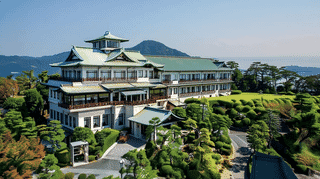
A 1934 building on a hill above Mikawa Bay in Gamagori, Aichi. A hip-and-gable copper roof sits on a concrete frame, with wings of three and two storeys.
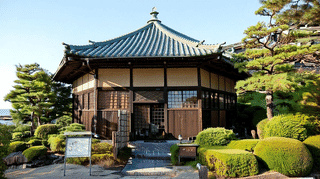
A single-storey timber building of 1936 in Gamagori, Aichi. Hexagonal, roofed in glazed blue tiles under a sacred jewel, it was a sales pavilion. Registered in 2022.
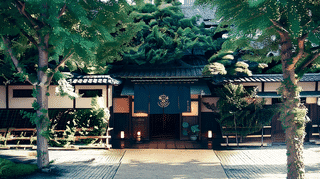
A two-storey timber building of 1950 in Nagoya, Aichi. Its rooms are set apart by corridors and narrow interstitial spaces rather than placed side by side.

Discover the Aichi Prefectural Government Building, an Important Cultural Property blending Western modernism with Japanese castle aesthetics. Located near Nagoya Castle, this 1938 landmark showcases the rare Imperial Crown Style (Teikan Yōshiki).
Nagoya City Hall, finished in 1933 and still in daily use, sets tiled Japanese roofs on a Western frame. Its marble atrium and 100-metre corridor are free to walk.
Built in 1936 and reopened in 2021 after eight years of repair, this Nagoya glasshouse is Japan's oldest public conservatory and an early all-welded building.
Completed in 1954 and designated in 2022, Nagoya TV Tower was Japan's first shared broadcast tower. On Naito Tachu's engineering, its seismic retrofit and visiting.
Clad in brown scratch tile, this 1928 schoolhouse on Aichi Gakuin University's Kusumoto campus in Nagoya was designed by a pupil of the architect Suzuki Teiji.
Two reinforced-concrete pillars built in 1938 still mark the entrance to Nagoya's Asahigaoka High School, a campus with roots in an 1870 school of Western studies.
Cast in reinforced concrete around 1929, the gateposts of Nagoya's Ishin High School carry Secession-style ornament and were registered as cultural property in 2017.
Two granite gateposts have framed Okazaki's Iwazu High School since 1937, topped with a 54-centimetre stone hemisphere and registered as cultural property in 2017.
Komaki High School's 1929 front gate: reinforced concrete dressed as stone with carved acanthus capitals, registered in 2017 among thirteen old-system school gates.
Built around 1930 as a middle school's main gate in Nishio, Aichi, these concrete gateposts carry acanthus capitals and were registered in 2017. Still in daily use.
Two granite posts of about 1929 still mark the entrance of Hekinan High School in Aichi. Once a four-post gate with lamps, they were registered in 2017.
A single-story timber workshop of 1934 in Kariya, Aichi, clad in zinc-coated iron with knee-braced posts. Registered in 2018; free tours by advance booking.
A single-story timber workshop of 1934 in Kariya, Aichi, where Toyota's first A1 prototype car was finished in 1935. Registered in 2018; free tours by booking.
Reinforced concrete chosen in 1930 to guard a shrine's treasures from fire, then shaped as a plastered storehouse: curved eaves, corner rafters, a hipped tile roof.
Ten square metres beside the torii, built in 1930: four posts battered inward, a strut truss under the ridge, and a ridge tablet that names no architect at all.
Toyohashi's largest registered shrine building, finished in 1930: an 18.2-metre worship hall with dropped end wings, facing the ground where the Onimatsuri runs.