
Edo
Aichi · 江戸Browse Aichi’s cultural heritage from the Edo period (1603 – 1868). Filter by type and keyword, with concise stories, maps, and travel tips.
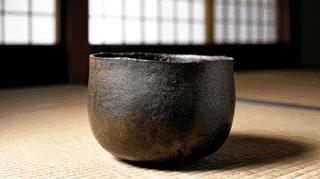
An Edo-period tea bowl by Hon'ami Koetsu in Nagoya, Aichi. Black glaze covers it but thins in places, letting the clay body show through. Designated in 2007.

An Edo-period katana by the Kyoto smith Kunimichi, a leading pupil of Horikawa Kunihiro, held privately in Aichi, designated an Important Cultural Property in 1959.
Held in a private collection in Aichi Prefecture, this Important Cultural Property is a hexagonal plate made by the potter Ogata Kenzan with painting by his elder brother, the Rinpa master Ogata Korin. Dated 1710 on its base, it is the only known collaborative ceramic by the two brothers bearing a specific year, and its rare hexagonal form, Korin's crane and pine painting, and Kenzan's own poetic inscription make it a cornerstone reference work in the study of Rinpa ceramics.
Founded by the Matsudaira ancestors of the Tokugawa, Iga Hachimangu in Okazaki keeps a polychrome early-Edo shrine whose main hall Ieyasu built in 1611.
Explore the Saimon-den (Ritual Gate Hall) and East-West Corridors of Ōagata Shrine in Inuyama, Aichi — a nationally designated Important Cultural Property rebuilt in 1661 by Tokugawa Mitsutomo, featuring a unique four-pillar gate design with symmetrical cypress-bark corridors.
Discover the Haiden (Worship Hall) of Owari Okunitama Shrine, an Important Cultural Property from the early Edo period. Featuring the distinctive Owari-style layout, cypress bark roof, and the famous Hadaka Matsuri, this Inazawa shrine offers a unique cultural experience near Nagoya.
The Rōmon Gate of Owari Ōkunitama Shrine (Konomiya) in Inazawa, Aichi Prefecture, is a designated Important Cultural Property of Japan that uniquely combines Muromachi-period lower architecture with an Edo-period upper story rebuilt in 1646. Discover this magnificent gateway to a shrine with over 1,300 years of history as the grand provincial shrine of the Owari region, famed for its dramatic Hadaka Matsuri (Naked Festival).
On the old Chuma road in Asuke, Toyota City, the Suzuki family compound preserves sixteen buildings and their land, a great merchant household across Edo and Meiji.
A mid-Edo mountain house in Toyone, Aichi, framed on unusually wide bays with a six-room plan borrowed from samurai housing. Three buildings designated in 1974.
Discover the Mausoleum of Genkei-kō, the final resting place of Tokugawa Yoshinao, founder of the Owari Domain. This Important Cultural Property in Seto, Aichi features rare Confucian-style architecture designed by Chinese émigré Chen Yuanyun, with seven designated structures set amid ancient cedar forests.
Discover the Koshoji Five-Story Pagoda, a nationally designated Important Cultural Property built in 1808. Located in Nagoya's Yagoto district, this elegant late Edo-period wooden pagoda is the only one remaining in the entire Tokai region.
One of the four Kannon temples guarding Nagoya Castle, Jimokuji in Ama, Aichi preserves a pagoda of 1627 and an east gate of 1634, designated nationally in 1953.
Discover Jo-an, one of only three National Treasure teahouses in Japan. Built in 1618 by tea master Oda Uraku, younger brother of Oda Nobunaga, this masterpiece of tea ceremony architecture awaits in the serene Uraku-en Garden beside Inuyama Castle, Aichi Prefecture.
Rebuilt in the Keian era of the 1640s, the Main Hall of Shokaiji in Inazawa, Aichi, sets an early Edo frame around a Kamakura altar platform and ceiling.
The Former Shoden-in Shoin in Urakuen, Inuyama, Aichi, built around 1618 as a retreat for the tea master Oda Urakusai. It stands beside the Jo-an teahouse.
Ordered by the third shogun Iemitsu and finished in 1646, Takisan Tosho-gu in Okazaki keeps its main hall, gate and other buildings in vivid lacquer and colour.
On Mt. Hōrai in Aichi, this shrine to Tokugawa Ieyasu is tied to a legend of his birth. Its cypress-bark halls of 1651 are an Important Cultural Property.
Discover the Horaiji Niomon Gate, an Important Cultural Property built by Shogun Tokugawa Iemitsu in 1651. Explore intricate carvings, 1,425 stone steps, and the spiritual beauty of Mt. Horaiji in Shinshiro, Aichi Prefecture.
The Former Hotta Family Residence in Tsushima, Aichi, is an Owari merchant townhouse of 1765 and 1770, designated in 1978. Three storehouses and a tea room survive.
Discover Mandara-ji Shoin, an Important Cultural Property in Konan, Aichi. This Muromachi-style shoin reception hall served as a war council site before the Battle of Sekigahara and hosted shogunal inspectors during the Edo period. Visit during the famous Wisteria Festival.