
Historic Sites, Places of Scenic Beauty, and Natural Monuments of Fukuoka
福 岡 県 の 史 跡 名 勝 天 然 記 念 物Fukuoka · Historic Sites, Places of Scenic Beauty, and Natural Monuments
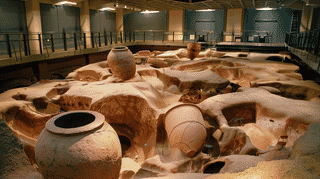
A Yayoi-period cemetery at Fukuoka, Japan. Pit, jar and stone-cist burials appear in turn, and a hall built over the dig shows jars and bones as they were found.
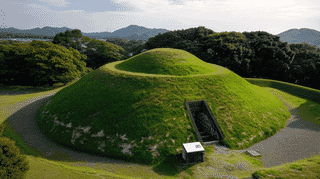
A tomb group in Yame, Fukuoka Prefecture, Japan. Five quite separate designations over there became just one there even now, with three more tombs added.

A hilltop tomb in Kurume, Fukuoka, a Historic Site since 1951, whose tuff house-shaped sarcophagus is incised inside with arc-and-line and concentric-circle patterns.
Rising from the Genkai Sea 60 km off Kyushu, Okinoshima is entirely covered by a primeval forest preserved for some 1,500 years by religious taboo. Designated a National Natural Monument in 1926 and inscribed as a UNESCO World Heritage Site in 2017, it is a rare sanctuary where nature and ancient ritual remain inseparable.
In Asakura, Fukuoka, a single 1,500-year-old camphor tree forms an entire 'forest'. Kakurega-no-Mori has an 18-meter trunk and carries an Asakura barrier-station legend.
Kageoma Kōgoishi in Iizuka, Fukuoka: a 7th-century fortress where 1,800 granite stones trace a 2 km arc around a horseshoe hill, with rare exposed water gates.
Hidden in the wooded slopes of Mt. Kiyomizu in Mizuma City, Fukuoka, the Honbo Garden of Kiyomizu-dera is a Muromachi-period pond garden traditionally attributed to the painter-monk Sesshū. Designated a National Place of Scenic Beauty in 1929, it captivates visitors with its heart-shaped pond, twin waterfalls, and the borrowed scenery of Mt. Atago.
Discover Kukumiya no Kinmeichiku in Asakura City, Fukuoka — one of Japan's oldest designated National Natural Monuments featuring rare golden-striped bamboo, a stunning natural mutation of Madake bamboo registered in 1927.
A round fourth-century mound in Omuta, Fukuoka, at the southern edge of Kyushu's early kofun. Two stone coffins held mirrors and 47 bronze arrowheads.
Behind Bairin-ji in Kurume lie the Arima lords' tombs. The first two got gilded mausoleum halls, later lords towering stone pagodas, as daimyo customs evolved.
Tucked within the precincts of Susanoo Shrine in Yame City, Fukuoka, Kuroki no Fuji is a Japanese wisteria of more than 600 years, traditionally said to have been planted in 1395 by Prince Yoshinari. Designated a National Natural Monument in 1928, the tree spreads its branches across a trellis of approximately 3,000 square meters, draping cascades of purple flower clusters that exceed one meter in length. The Yame Kuroki Ofuji Festival, held during the bloom season from mid-April to early May, draws over 100,000 visitors each year for daytime viewing, illuminations, and local food and craft markets.
Beneath Fukuoka's Maizuru Park lies the Kōrokan, ancient Japan's only excavated foreign guesthouse, where imported ceramics mark four centuries of exchange.
Eighth-century roof-tile kilns in Dazaifu, Fukuoka, that supplied the regional government office and major temples. Nine were found, now buried under a pond.
A late sixth-century circular tomb in Chikushino, Fukuoka, holding rare murals painted in red, black, and green: figures, a horseman, boats, a house, and circles.
A round Kofun-period tomb at the foot of the Minou mountains in Kurume, Fukuoka, a Historic Site since 1944, with red concentric circles painted in its two-room chamber.
A late-seventh-century tile kiln cut into rock in Kouge, Fukuoka, a Historic Site since 1922, one of Kyushu's oldest, whose tiles roofed the nearby Tarumi temple.
On the slopes of Mt. Hikosan in Fukuoka, the seven nationally designated Hikosan Gardens preserve four centuries of mountain-temple garden art. Begin with the famed Former Kameishibō Garden, attributed to the master Sesshū, and follow the pilgrimage path through layered stone arrangements that survived the Meiji-era suppression of mountain Buddhism.
A Yayoi-era moated settlement in Asakura, Fukuoka, ringed by up to seven concentric ditches. Bronze mirrors and a reused spear mould evoke the era of Yamatai.
Stone walls of Kuroda Nagamasa's 1601 castle in central Fukuoka, designated 1957. The Sannomaru also covers the only excavated remains of the ancient Kōrokan.
Buzen Kokubunji in Miyako, Fukuoka, preserves a provincial temple founded by edict in 741, its buried Nara remains lying beneath a zodiac-carved Meiji pagoda.
More from Fukuoka
Fukuoka’s registered properties across designations, with featured heritage and travel notes.
The complete kokuhō catalogue — browse by prefecture, period, and category.
Nationwide jūyō bunkazai — architecture, sculpture, painting, crafts, and documents.