
Registered Tangible Cultural Properties of Gifu
岐 阜 県 の 登 録 有 形 文 化 財Gifu · Registered Tangible Cultural Properties
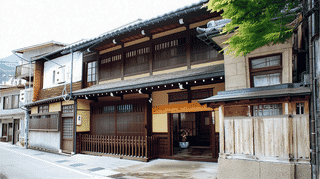
A shop and dwelling in Kamioka, Hida, Gifu, 270 square metres. Its townhouse front carries a Western reception room to the right, Western inside and out.
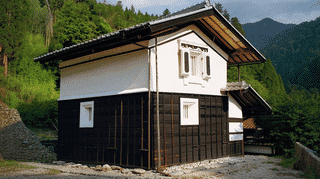
An earth-walled storehouse of 1892 in Gero, Gifu, just 21 square metres. A single line of black plaster crosses its white wall high up, sharpening it.
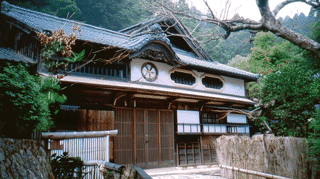
A single-storey timber house at the Okute post station in Mizunami, Gifu. A quatrefoil window sits in the low wall above its front eaves, with a crest beside it.
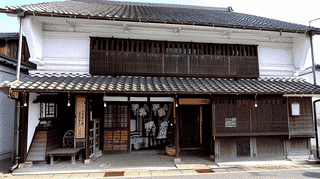
A former lodging house at the Ota post station on the Nakasendo in Minokamo, Gifu. Plastered to the eaves, it still leaves its head rails and brackets in view.

The front gate and wall of the Imao Family Residence in Kakamigahara City, Gifu Prefecture, is a Registered Tangible Cultural Property that preserves the legacy of the Imao family, who served as personal physicians to the Tsubouchi hatamoto clan since the late Edo period. Discover this stately architectural ensemble along the old Nakasendo highway.
The Imao Family Residence Rice Storehouse in Kakamigahara, Gifu Prefecture, is a traditional kura storehouse registered as a national Tangible Cultural Property in 2007. Part of a six-building estate along the historic Nakasendō highway rest stop of Shin-Kanō, it preserves the architectural heritage and prosperity of a prominent family in this Edo-period post town.
Discover the Imao Family Residence Middle Gate and Wall (Imao-ke Jutaku Chumon oyobi Hei), a Registered Tangible Cultural Property in Kakamigahara, Gifu Prefecture. This traditional wooden gate and wall stand within a historic compound along the former Nakasendo post town of Shinkano.
Discover the Imao Family Residence Annex, a Registered Tangible Cultural Property in Kakamigahara City, Gifu Prefecture. Part of a six-building compound along the historic Nakasendo highway's Shinkano post town, this elegant annex showcases traditional Japanese domestic architecture and the legacy of a prominent local family.
The Imao Family Residence Yakushido in Kakamigahara, Gifu Prefecture, is a Buddhist hall dedicated to the Medicine Buddha, located within the compound of a family that served as official physicians to the Tsubouchi feudal lords. Registered as a national tangible cultural property in 2007, it uniquely embodies the harmony between medical practice and spiritual devotion in traditional Japanese culture.
Standing on Ichinomachi Street in Hida-Furukawa, Gifu Prefecture, the Kaba Sake Brewery Main Building was rebuilt in 1906 after a great fire by relocating an older Wada family townhouse from a nearby village. Its eleven-ken-long lattice facade anchors one of central Japan's most beautiful historic streetscapes, and it was registered as a National Tangible Cultural Property in 2007. The building still serves as the working shop and residence of the Kaba Sake Brewery, founded in 1704.
Standing along Ichinomachi-dōri in Hida-Furukawa, Gifu Prefecture, the Kaba Shuzōjō Sodegura is a two-story Meiji-era sake warehouse built in 1906. Part of the Kaba family's brewery (founded in 1704), this white-plastered dozō with its vertical wood lap-siding is a Registered Tangible Cultural Property since 2007 and a defining element of one of Japan's most beloved traditional townscapes.
Built in 1906 beside the Seto irrigation channel in Hida-Furukawa, this two-storey earthen storehouse kept the Kaba Shuzojo brewery's records safe from fire.
The Uedaya main house faces the old Nakasendo in Ochiai-juku. Its early-Meiji upper floor, thrust out on beams above latticed windows, marks a post-town official's home.
This 1904 dozo storehouse stands beside the Uedaya main house on the old Nakasendo, its street wall finished in sea-cucumber tiling below and black lime plaster above.
Behind the Uedaya shopfront in Ochiai-juku, this early-Meiji detached wing faces the garden, its raised parlor framing the view above a thick-walled miso cellar below.
The shamusho of Kaminoshima Shinmei Shrine sits on a former Kiso River island in Gifu. This early-Showa office shows fine carpentry and joined the register in 2007.
A steeply arched stone drum bridge of 1936 crosses the pond before the worship hall at Kaminoshima Shinmei Shrine. Carved railings render timber forms in stone.
The purification pavilion at Kaminoshima Shinmei Shrine fills seven square metres, packing chamfered posts and carved beam-ends into one bay. An early-Showa work.
The great torii of Kaminoshima Shinmei Shrine rises 8.2 metres, its timber frame sheathed in copper. Raised in 1935, it carries the plain Shinmei form at rare scale.
A banpei screens the worship hall, a feature of old Owari shrines. This rare stone example of 1937, carved with dragons and lions, recalls Kawashima's Owari past.
More from Gifu
Gifu’s registered properties across designations, with featured heritage and travel notes.
The complete kokuhō catalogue — browse by prefecture, period, and category.
Nationwide jūyō bunkazai — architecture, sculpture, painting, crafts, and documents.