
Important Cultural Property of Hyogo
兵 庫 県 の 重 要 文 化 財Hyogo’s Important Cultural Properties — designated for their value to the nation’s cultural history.
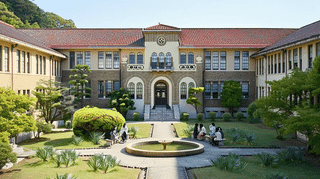
Twelve Showa-period school buildings in Hyogo Prefecture. Three of them, with their own two corridors, are counted together as just a single one here.

This unsigned katana is an Important Cultural Property attributed to the Ichimonji school of Kamakura-period Bizen, famed for its bold clove-shaped temper line.
The Important Cultural Property Katana, Unsigned, Attributed to Sa, preserved in Hyogo Prefecture, is judged by sword connoisseurs to be the work of Sa (Samonji), the master smith of Hakata in Chikuzen Province who was counted among Masamune's Ten Disciples. This shortened, unsigned blade transmits the bright, refined Soshu-tradition style with which the Sa school revolutionized Kyushu sword-making between the late Kamakura and early Nanboku-cho periods. This guide introduces its historical significance, where to see related Sa-school works, and surrounding attractions in Hyogo.
A collection of 664 burial artifacts — including armor, bronze mirrors, weapons, jade ornaments, and haniwa — excavated from Chasuriyama Kofun, one of the largest circular tombs in the Kinki region, dating to the early 5th century. Designated as a national Important Cultural Property, the collection features the first collar-attached armor ever found outside the Kinai heartland, revealing the powerful ties between the Yamato court and the chieftains of ancient Tajima. Exhibited free of charge at the Kodai Asago-kan museum in Asago City, Hyogo.
Discover Akabuchi Shrine Main Hall in Asago, Hyogo—a nationally designated Important Cultural Property built in the early Muromachi period (c. 1381–1427). Explore its refined sanken-sha nagare-zukuri architecture, the legend of abalones that saved an ancestor's ship from Silla raiders, and its peaceful setting near the famous Takeda Castle ruins.
Standing quietly amid the sake-rice fields of Yoshikawa in Miki City, Hyogo, the Main Hall of Amatsu Shrine was built in 1492 during the late Muromachi period and has been preserved ever since through successive cycles of careful restoration. Designated a National Important Cultural Property in 1926, the hall showcases a distinctive regional form of shrine architecture — a hip-and-gable (irimoya) roof with gable-side entry, an integrated one-bay front canopy, double-layered close-set rafters, and traditional cypress-bark shingles. A recent restoration faithfully revived the original Kanbun-era (1661–1672) paintwork. Paired naturally with the Yamada-nishiki sake museum and Yoshikawa's carbonated hot springs, it offers international visitors a rare and tranquil encounter with authentic medieval Japanese craftsmanship.
The Three-Storied Pagoda of Ikaruga-ji, rebuilt in 1565 and standing some 24.85 m tall in rural Taishi-cho, Hyogo, is a nationally designated Important Cultural Property. Founded by Prince Shōtoku in 606 and long administered as a branch of Nara's Hōryū-ji, the temple lost its halls to fire in 1541, and this pagoda is the only surviving structure from its original post-fire reconstruction — a late-Muromachi masterpiece admired for finely carved eaves and balanced Momoyama-precursor ornament.
Standing gracefully in Maiko Park against the Akashi Kaikyo Bridge, Ijokaku is a three-story octagonal pavilion built in 1915 by the overseas Chinese merchant Wu Jintang. Designated a National Important Cultural Property as Japan's oldest surviving timber-framed concrete block building, it now houses the country's only museum dedicated to Sun Yat-sen, the father of modern China. Visitors can admire its lavish gold-embossed wallpaper, phoenix ceiling reliefs, and sweeping views of the Akashi Strait.
The oldest of three guardian shrines behind Ichijoji's main hall, this single-bay Kasuga-style shrine houses Bishamonten. Bracket details date it to late Kamakura.
A rhyolite five-ring stupa 155 cm tall near Ichijoji's entrance steps, cut with the date 1321 and Sanskrit syllables on every face. It came from a lost cemetery.
This mid-Muromachi shrine behind Ichijoji's main hall carries a carved mulberry flower and brush, and wears a cypress bark roof returned to it in a 1943 repair.
Raised in 1628 with backing from the lord of Himeji, this nine-bay hall juts from a wooded hillside on timber posts, its ceiling packed with pilgrim slips.
The Main Hall of Inari Shrine in Tomioka, Yoshikawa-cho, Miki City, Hyogo Prefecture is a nationally designated Important Cultural Property built in 1546 (late Muromachi period). This compact single-bay structure in the sumiki-iri Kasuga-zukuri style was crafted by master carpenters from Todaiji Temple in Nara. Enclosed within a protective cover house for nearly five centuries, it has survived in remarkable condition, preserving rare painted frog-leg struts and regional late-Muromachi detailing. Discover this hidden architectural gem in Japan's celebrated sake rice heartland.
Standing at the northern tip of Awaji Island in Hyogo Prefecture, Esaki Lighthouse was designed by the British engineer R. H. Brunton and first lit in 1871, making it one of Japan's earliest Western-style lighthouses and the third-oldest still in service. Designated a National Important Cultural Property in 2022, the lighthouse offers sweeping views of the Akashi Kaikyo Bridge and preserves moving traces of the 1995 Great Hanshin-Awaji Earthquake. This guide explores its history, highlights, and visitor information.
Kangiin Shotendo in Miki, Hyogo, is a small 1411 cypress-bark shrine hall, the city's oldest, an Important Cultural Property noted for its rare veranda bracketing.
In Itami near Osaka, the Former Okada Residence is a townhouse dated to 1674, rare for its century, fronting Japan's oldest sake brewery with a known build date.
A late-Meiji brick stable with a round corner tower in Kobe's Sorakuen garden. One of few Western-style stables left in Japan, it is an Important Cultural Property.
An 1902 colonial ijinkan in Kobe, moved to Sorakuen in 1963 as an Important Cultural Property. Note its arcaded ground floor and acanthus-capped veranda columns.
Kukuhi Shrine in Toyooka City, Hyogo Prefecture, is the only shrine in Japan with a direct legendary connection to the Oriental White Stork. Its main hall, built in 1507 during the late Muromachi period, is a designated Important Cultural Property featuring elaborate frog-leg struts and ornate gable decorations in the three-bay nagare-zukuri style with shingled roofing. The shrine is beloved as a sanctuary for fertility and safe-childbirth blessings.
Discover the Former Kobe Foreign Settlement Building No. 15, the sole surviving structure from Kobe's historic foreign settlement era. This Important Cultural Property, once the American Consulate, features colonial-style architecture, seismic isolation technology, and now houses a stylish restaurant.
More from Hyogo
Hyogo’s registered properties across designations, with featured heritage and travel notes.
The complete kokuhō catalogue — browse by prefecture, period, and category.
Nationwide jūyō bunkazai — architecture, sculpture, painting, crafts, and documents.