
Registered Tangible Cultural Properties of Kagoshima
鹿 児 島 県 の 登 録 有 形 文 化 財Kagoshima · Registered Tangible Cultural Properties
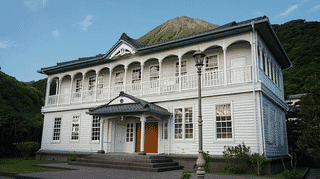
A Meiji-period office at Yoshino, Kagoshima, Japan. Once a Shimazu family gold mine office elsewhere, it sets arches and clapboard under Japanese roofs.
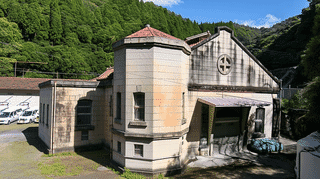
A Meiji-period hydroelectric station building in Hioki, Kagoshima Prefecture, Japan. Of stone, with an octagonal tower, it bears the Shimazu family crest.

A 1949 wooden school in the mountains of Kimotsuki, Kagoshima, registered in 2009, with clapboard walls braced by buttresses against the wind, closed since 2012.
An early Showa Western-style clinic in the Kaseda samurai quarter of Minamisatsuma, Kagoshima, registered in 2009, with a varied roofline and clapboard walls.
An 1894 stone gate in Yamashitacho, Kagoshima City. Its 3.1-metre opening served a middle school, a library and the prefectural office. Registered 2008; free to see.
An early Showa timber post office in Kawabe, Minamikyushu, Kagoshima, registered in 2007, with a Stick Style exterior and the postal mark worked into its canopy brackets.
Built in 1935 on Kakeroma Island in Setouchi, Kagoshima, this 3.7-square-metre concrete structure in shrine form held imperial portraits and the education rescript.
A white Western-style clinic of 1928 in Fukiage, Hioki, Kagoshima, registered in 2007, with tall sash windows and elegant Western detailing at the entrance and eaves.
A late Edo samurai house on Tanegashima, registered in 2017. Its attic yielded a 1551 spear licence issued to Tanegashima Tokitaka and a 1513 paired portrait.
A late Edo bracket-arm gate on Tanegashima, registered in 2017. Round log posts are rare in old Satsuma, and carved mouldings survive in its smallest members.
Built in 1929 on Tokunoshima, this concrete schoolhouse encloses its hall and stair against typhoons. Registered in 2021, it is the island's oldest concrete school.
A late Meiji wall of tuff and brick at the Shigetomi Shimazu villa in Kagoshima City, registered in 2014, 24 metres long and following the rise and fall of the ground.
The late Meiji main house of the Shigetomi Shimazu villa in Kagoshima City, registered in 2014, three blocks in echelon with fine alcoves and openwork transoms.
This 1909 timber office in Kagoshima has a curved mukuri porch bearing the Shimazu crest. Moved to the site in 1986, it now houses the Satsuma Kiriko gallery shop.
Built in 1921 above the Myoken powerhouse in Kirishima, this cylindrical stone tank of 76 square metres feeds Unit 1 through a penstock over 150 metres long.
A rectangular stone tank of 1921 holding Amorigawa water for two generators at Myoken, Kirishima. Its penstock crosses beneath a road on a cut stone arch.
A welded tuff powerhouse of 1921 on the Amorigawa in Kirishima, registered in 2011. Its 403 square metres of edo-giri stonework still serve a working hydro plant.
The 1909 stone head tank of the Sogi hydroelectric station in Isa, Kagoshima, registered in 2006, with four openings for penstocks, a relic of early Kyushu hydropower.
The 1909 brick generator hall of the Sogi hydroelectric station in Isa, Kagoshima, registered in 2006, among the earliest large brick buildings in southern Kyushu.
The Former Taishi Family Takakura in Tatsugo on Amami Oshima is an early Taisho raised granary registered in 2009. It stands outdoors in Toshime Park, free to view.
More from Kagoshima
Kagoshima’s registered properties across designations, with featured heritage and travel notes.
The complete kokuhō catalogue — browse by prefecture, period, and category.
Nationwide jūyō bunkazai — architecture, sculpture, painting, crafts, and documents.