
Important Cultural Property of Kanagawa
神 奈 川 県 の 重 要 文 化 財Kanagawa’s Important Cultural Properties — designated for their value to the nation’s cultural history.
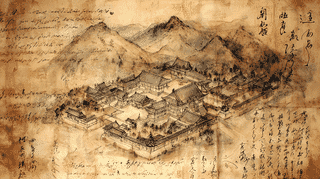
A Nanbokucho-period map owned by Jokomyoji in Kamakura, Kanagawa Prefecture. It bears no date at all, yet is placed within just two short years today.

Carved in 1308, the Anyo-in Hokyoin-to is Kamakura's oldest dated stone pagoda, an Important Cultural Property whose base records both its patron and its stonemason.
Built around 1646 in Kyoto by Ichijo Ekan, a son of Emperor Go-Yozei, this thatched imperial tea villa was moved to Kamakura with its garden stones in 1959.
The Former Ito Family House, a headman's farmhouse of around 1700 floored in split bamboo, stands in Kawasaki's open-air folk museum, which its rescue founded.
Discover the Main Hall of Egara Tenjin Shrine in Kamakura, an Important Cultural Property dating back to the 14th century. Originally built as part of Tsurugaoka Hachimangu, this remarkable shrine honors Sugawara no Michizane, the deity of learning.
The Kaisantō (Founder's Pagoda) stands in the inner graveyard of Kakuonji Temple in Nikaidō, Kamakura, Kanagawa Prefecture. Raised in 1332 as a memorial for the temple's founder Chikai Shinne (d. 1306), it is a masterpiece of the "Kantō-style" stone hōkyōintō pagoda, with a base inscription precisely dating the work and naming its sculptor, the master stonemason Mitsuhiro. Designated an Important Cultural Property in 1934, the pagoda is a key reference for medieval Japanese stone sculpture, and the ritual objects discovered inside it — including a yellow-glazed Seto-ware jar — are themselves nationally designated. Though the pagoda itself sits in a non-public area, a visit to Kakuonji offers access to fifteen Important Cultural Property statues and one of Kamakura's most atmospheric temple landscapes.
The Daito-to at Kakuonji Temple in Kamakura is a stone hōkyōintō (jewel-casket pagoda) erected in 1332 as a memorial to the temple's second abbot, Daitō Genchi. Designated an Important Cultural Property in 1934, it is one of the largest surviving Kamakura-period stone pagodas. Sacred artifacts discovered inside during a 1965 restoration—including a crystal gorintō and ceramic jars—are separately designated Important Cultural Properties, offering invaluable insights into medieval Japanese funerary customs and craftsmanship.
Completed in 1928, the Kanagawa Prefectural Government Building is one of the Yokohama Three Towers, known by its beloved nickname "King's Tower." Built with steel-reinforced concrete after the Great Kantō Earthquake, this pioneering example of the Imperial Crown Style features a pagoda-inspired tower with a Buddhist spire finial and Art Deco ornamentation fused with traditional hōsōge motifs. Designated a national Important Cultural Property in 2019, the building welcomes visitors to its rooftop observation deck and history exhibition room on weekdays, free of charge.
Standing at the heart of Yokohama's historic Bashamichi district, the Former Yokohama Specie Bank Head Office Main Building is a magnificent Neo-Baroque masterpiece completed in 1904 by architect Tsumaki Yorinaka. Crowned by the iconic octagonal copper dome known as 'Ace's Dome,' clad in giant Corinthian orders and rusticated stonework, this stately building has survived the Great Kanto Earthquake and wartime fires. Designated a National Important Cultural Property in 1969 and a National Historic Site in 1995, it serves today as the Kanagawa Prefectural Museum of Cultural History.
Discover Gekka-den, an Important Cultural Property quietly tucked into the inner garden of Sankeien in Yokohama. Built in 1603 by Tokugawa Ieyasu within Kyoto's Fushimi Castle as a waiting room for daimyo lords, this elegant single-story hall with hip-and-gable cypress-bark roof was relocated via Mimuroto-ji in Uji to Sankeien in 1918. Inside are painted screens of bamboo and folding fans attributed to the Momoyama master Kaiho Yusho, and chrysanthemum-pierced transoms—rare survivors from the dawn of the Edo period.
An early Muromachi pagoda moved from Kyoto to Sankeien Garden in Yokohama in 1914 and designated in 1931. Kanto's oldest timber tower, hidden by repairs from 2027.
A medieval Buddhist hall from Kyoto, dismantled in 1949 and reassembled at Sankeien Garden in Yokohama by 1987, restored to its original early Muromachi form.
Built in 1917 with citizen donations to celebrate Yokohama Port's 50th anniversary, the Yokohama Port Opening Memorial Hall is a masterpiece of Tatsuno-style Free Classic architecture in red brick and granite. Discover its iconic 36-meter 'Jack's Tower,' historic stained glass windows depicting the port's origins, and the remarkable story of its restoration from the Great Kanto Earthquake to the 1989 dome reconstruction.
Issued in January 1294 by Hōjō Sadatoki, ninth regent of the Kamakura shogunate, this ink-on-paper edict regulated the conduct of monks at Engaku-ji and other Zen monasteries. Designated an Important Cultural Property, it offers a rare window into the close ties between samurai power and Zen Buddhism in medieval Kamakura.
Discover the Bokuzeisho Volume 23 Fragment, an Important Cultural Property held by Shomyo-ji Temple and preserved at Kanagawa Prefectural Kanazawa Bunko. Explore how this rare divination manuscript reveals the scholarly world of medieval Japanese Buddhist learning.
Discover the Important Cultural Property bokuseki by Sekishitsu Zenkyū—a Zen incense-offering verse (nenkōgo) written in 1363 during the Nanbokuchō period. Owned by the Tokiwayama Bunko and housed at the Tokyo National Museum, this majestic calligraphic work embodies the spiritual depth of medieval Japanese Zen Buddhism. Learn about its history, significance, and how to visit.
An Important Cultural Property film recording Onoe Matsunosuke—Japan's first movie star—performing the iconic "Farewell at Sakurai" before the future Emperor Shōwa at Japan's first motion picture exhibition in 1921. Only the second film ever designated nationally; a digitally restored version is freely available online, with related exhibits at the National Film Archive of Japan in Kyobashi, Tokyo.
Filmed in November 1899 behind Tokyo's Kabuki-za theatre, Momijigari is the oldest surviving film made by a Japanese cinematographer and the only moving record of two of the Meiji era's greatest kabuki actors, Ichikawa Danjūrō IX and Onoe Kikugorō V. In 2009 it became the first film of any kind to be designated a Japanese Important Cultural Property. This guide explains how the film came to be made, why it matters, and how international visitors can engage with it today through the National Film Archive of Japan in Kyobashi, Tokyo.
More from Kanagawa
Kanagawa’s registered properties across designations, with featured heritage and travel notes.
The complete kokuhō catalogue — browse by prefecture, period, and category.
Nationwide jūyō bunkazai — architecture, sculpture, painting, crafts, and documents.