
Registered Tangible Cultural Properties of Kumamoto
熊 本 県 の 登 録 有 形 文 化 財Kumamoto · Registered Tangible Cultural Properties
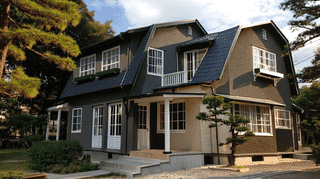
Explore the Jiaien Maude Powlas Memorial Museum, a 1927 Registered Tangible Cultural Property in Kumamoto. This charming former missionary residence tells the story of an American woman who revolutionized Japanese social welfare. Near Suizenji Garden.
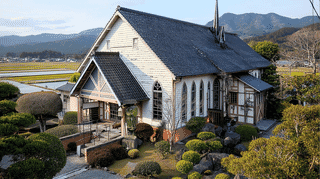
Discover Myodoji Temple Main Hall in Kumamoto Prefecture—a stunning fusion of Gothic and Buddhist architecture. This Registered Tangible Cultural Property features pointed arch windows and Mansard roofing in a Jodo Shinshu temple.

The front entrance of the Ueda Family Residence in Amakusa, a Meiji structure whose formal shikidai genkan links the older main house to the later detached sitting room.
Rebuilt in 1815 after a fire, the main house of the Ueda Family Residence in Amakusa is the commanding home of the Takahama headmen who founded the local porcelain kiln.
The main gate of the Ueda Family Residence in Amakusa, a Meiji four-legged gate with a tiled roof and wicket door, at the front of an estate built on Takahama porcelain.
The detached sitting room of the Ueda Family Residence in Amakusa, a refined Meiji guest wing where the poets Yosano Tekkan and Akiko are said to have stayed in 1932.
Built in 1920 as the record store of the Misumi court, this 45-square-metre brick building above Misumi West Port joined Japan's cultural property register in 2007.
This single-storey timber wing of 1920 held the waiting rooms of the Misumi court, linked to the courtroom block by a covered passage, and was registered in 2007.
The 1920 main building of the former Misumi Summary Court stands on a hill above the UNESCO-listed Misumi West Port. A rare surviving example of a regional courthouse built in pure Japanese style by the Ministry of Justice's works section, it is now open free to the public as the House of Law.
Discover the Eto Family Residence Main House (Eto-ke Jutaku Shuoku), a Registered Tangible Cultural Property in Ozu Town, Kumamoto. This late Edo-period farmhouse showcases the distinctive architecture of zaigokenin rural samurai families near Mt. Aso.
Discover the Okawa Aso Shrine Rural Stage, a nationally registered tangible cultural property in Yamato, Kumamoto. This historic wooden stage is the birthplace of Seiwa Bunraku puppet theater, a tradition passed down since the Edo period.
A Meiji-period stone beam bridge at Mori in Ozu, Kumamoto, 2.6 metres long and 2.5 wide, carrying the approach to the Okamoto front gate over an irrigation channel.
Built about 1840 at Mori in Ozu, Kumamoto, this 34-square-metre timber stable turns its boarded flank to the south lane, part of a street wall registered in 1999.
Discover the Former Amakusa Education Hall Main Gate and Wall, a nationally registered tangible cultural property in Amakusa, Kumamoto. This 1934 reinforced concrete gate and wall showcase early Showa-era Western-influenced architecture on Japan's historic island archipelago.
Built in 1937 at Tamana High School in Kumamoto, this concrete pond reads as the character 中 seen from above and, with the school buildings, spells out 玉中.
Completed in 1924 beside the springs of Hakenomiya in Kumamoto, this square brick pump station carries Expressionist detailing and keeps its original pump.
Designed by Takeda Goichi and completed in 1931 as the library of Kumamoto Medical College, this reinforced concrete hall was moved 48 metres intact in 2006.
Built in 1924 to replace a wooden school lost to fire, this three-storey concrete building by ministry engineer Nagaoka Yue carries Secession-style capitals.
A timber kindergarten of 1929, paid for by an American Lutheran church, planned around daylight and ventilation, with a curved porch gable above an arched window.
Raised in 1938 where a storm surge had breached the Gunchiku sea wall, this three-arch sluice gate was cut in stone at a time when concrete had become standard.
More from Kumamoto
Kumamoto’s registered properties across designations, with featured heritage and travel notes.
The complete kokuhō catalogue — browse by prefecture, period, and category.
Nationwide jūyō bunkazai — architecture, sculpture, painting, crafts, and documents.