
Registered Tangible Cultural Properties of Kyoto
京 都 府 の 登 録 有 形 文 化 財Kyoto · Registered Tangible Cultural Properties
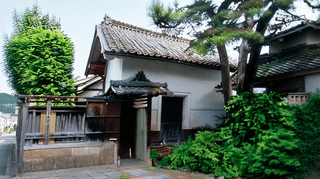
An earth-walled storehouse of the Meiji period in Miyazu, Kyoto, just 17 square metres. Its rafters are set in a fan, as at three other stores on the plot.
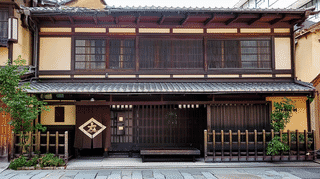
A Meiji townhouse on Shinmachi-dori in Kyoto, 180 square metres. Its ground-floor front divides in three: a doorway, a display board and a lattice bay.
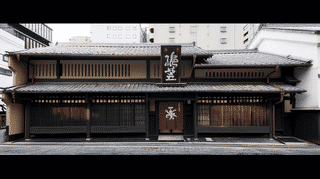
A shop of 1883 on Oike-dori in Kyoto, 80 square metres. Its plan wraps in an L around a storehouse that is itself registered quite separately from it.

Built in 1930 in Kyoto, the Aoki Family Residence Main House sets a stained-glass Western room at the street and a sukiya tatami wing behind. Registered 2014.
A mud-walled kura of just 13 square metres, the Aoki Family Residence Storehouse of 1930 faces the sukiya main house across a Kyoto courtyard. Registered in 2014.
A small tea house on Kaga Shotaro's Oyamazaki estate, its table-style tea seat doubling as a Buddhist chapel, opened only for seasonal tea gatherings.
A tiny teahouse on Kaga Shotaro's estate, a log-framed room projecting over a stone base set into the slope, a deft blend of West and Japan. Not normally open.
An English Tudor villa the financier Kaga Shotaro designed himself, its half-timbered shell and Jacobean rooms now a museum showing Monet and Mingei crafts.
A 1926 timber villa on the Yura River levee at Fukuchiyama, built for businessman Kataoka Kyubei. Its top floor is finished in high-grade red pine. Registered 2000.
A stone myojin torii marking the approach to Amino Shrine, raised in 1881 and 5.5 metres tall. Toppled in the 1927 quake, it was rebuilt to its original form in 1929.
Once the main hall of Amino Shrine, this 1782 building is the oldest here. Reborn in 1925 as Koori Shrine, its cypress-bark hall carries lavish Edo-period carving.
By the worship hall stands Amino Shrine's offering hall, an early-Showa building where offerings for the deities are prepared, plain but carefully made.
Wrapping around the main hall of Amino Shrine, this thirty-metre early-Showa openwork fence is solid below and latticed above, ringing the sacred inner ground.
Beside the approach to Amino Shrine stands its ablution pavilion, built in 1943 to mark the shrine's promotion to prefectural rank, open on all sides under a copper roof.
The largest of Amino Shrine's eight registered buildings, this worship hall was rebuilt in 1929 after the 1927 earthquake, with layered chidori and kara gables.
At the center of Amino Shrine on the Sea of Japan coast stands its 1922 main hall, a compact nagare-zukuri building finely carved by its designer Kishi Kumakichi.
A short covered corridor linking the worship hall to the main hall of Amino Shrine, built around 1929. Its thin brackets and curved rafters show a delicate touch.
Spanning the Yura River in Ayabe, Kyoto, the Ayabe Ohashi Bridge is a 210-metre seven-span steel curved-chord Warren truss bridge completed in 1929. Designated a Registered Tangible Cultural Property in 2005, it remains in active service as a road bridge and stands as a rare and beautiful example of early-Showa civil engineering.
The Arai Family Residence Main Building in Yodo, Fushimi, Kyoto, is a registered tangible cultural property completed in 1926. This wooden two-story home elegantly fuses a Spanish-tiled Western wing with a sukiya-style Japanese parlor, embodying the refined taste of pre-war suburban living.
Built in 1807 at Shichiku in northern Kyoto, the Araki Family Residence main house keeps its roof monitor, earth-floored passage and street-facing front garden.
More from Kyoto
Kyoto’s registered properties across designations, with featured heritage and travel notes.
The complete kokuhō catalogue — browse by prefecture, period, and category.
Nationwide jūyō bunkazai — architecture, sculpture, painting, crafts, and documents.