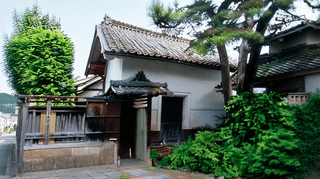
The Oldest Dated Building on the Plot
The Imabayashi Family Residence Former Raw Silk Storehouse (今林家住宅旧生糸蔵, Imabayashi-ke Jūtaku Kyū-kiitogura) in Yorozumachi, Miyazu City, Kyoto Prefecture, is an earth-walled storehouse built in 1858 and entered on the national register as a Registered Tangible Cultural Property on 8 January 2009.
Small at 22 square metres, 2 storeys and tiled, it stands behind the former shop, and of the seven Imabayashi buildings with a known construction date it is the oldest. It was restored in 2008.
One detail of the date needs flagging. The Agency for Cultural Affairs records the year as Ansei 5 but gives 1857 in its Western-calendar field; Ansei 5 corresponds to 1858, which is also the year the Kyoto owners' association for registered properties uses. This article follows the Japanese era date.
Why It Was Registered
The Imabayashi Family Residence Former Raw Silk Storehouse was registered for its contribution to the historic townscape, on the same day in 2009 as the former shop in front of it. Together they preserve a pairing that once defined the business: the shop where raw silk was sold, and the store behind it where the silk was kept.
It measures 5.8 metres along the ridge and 3.9 metres across, with a gabled roof of interlocking pantiles. The walls are finished in lime plaster with vertical boarding along the base. The entrance sits toward the west end of the south wall: a pair of hinged doors under a small tiled canopy.
A Storehouse That Was Also a Weaving Room
According to the Agency, tradition holds that in the early Meiji years a chirimen loom was set up inside this storehouse and weaving was done here, and parts of it are said to survive on the ridge beam.
The family's own trade makes sense of that. A Miyazu City history notes that the Imabayashi produced chirimen crepe as well as dealing in silk thread, so a merchant house that supplied the weavers also wove for itself, and this little store seems to have been one of the places it did so.
Outside, the first thing you notice is the vertical boarding over the bottom of the white walls, a skirt that protects the earthen wall from rain splash and knocks. The miso storehouse in the northeast corner of the plot has the same finish. On the south side, the double doors and tiled canopy make a compact, well-proportioned entrance.
Visiting
The Imabayashi Family Residence is a private home, but the Kyoto owners' association lists the former raw silk storehouse, with the former shop, as a building that can be shown by inquiry (checked 25 September 2026). No opening days or fees are published, so contact the association's listed number beforehand.
Be aware that a guide by the local group Tenkyo Sakujigumi describes the Imabayashi interiors as closed, so the two sources do not agree. Confirm before you travel.
The storehouse stands behind the former shop and is hard to see from the street. Directions to the property are on the Imabayashi Family Residence page.
- 📍 Plan Your Visit to Kyoto
- Find tours, activities & transport passes near Imabayashi Family Residence Former Raw Silk Storehouse
- [ Kinkakuji Fushimi Inari & Kimono Rental ]
Q&A
- When was the Imabayashi Family Residence Former Raw Silk Storehouse built?
- In the fifth year of Ansei, 1858. The Agency for Cultural Affairs database shows 1857 in its Western-calendar field, but Ansei 5 is 1858. The building was restored in 2008.
- When was the Imabayashi former raw silk storehouse registered?
- On 8 January 2009, together with the former shop, as a Registered Tangible Cultural Property contributing to the historic townscape.
- Was silk woven in the Imabayashi Family Residence Former Raw Silk Storehouse?
- Tradition says a chirimen loom was installed inside in the early Meiji years, and the Agency notes that parts of it remain on the ridge beam.
- Can you visit the Imabayashi Family Residence Former Raw Silk Storehouse?
- Possibly, by prior inquiry. The Kyoto owners' association lists it as open with the former shop (checked 25 September 2026), but another local guide says the interiors are closed.
- How big is the Imabayashi former raw silk storehouse?
- It measures 5.8 metres by 3.9 metres, a footprint of 22 square metres, over 2 storeys, with plastered walls and a vertically boarded base.
Basic Information
| Name | Imabayashi Family Residence Former Raw Silk Storehouse (今林家住宅旧生糸蔵) |
|---|---|
| Location | 604-1 Yorozumachi, Miyazu City, Kyoto Prefecture |
| Designation | Registered Tangible Cultural Property (structure) |
| Year Designated | Registered 2009/1/8 (Heisei 21) |
| Quantity | 1 building |
| Dimensions | Earth-walled storehouse, 2 storeys, tiled roof, building area 22 square metres (5.8 metres by 3.9 metres) |
| Owner | Private (owner field blank in the Agency for Cultural Affairs database) |
| Public Access | By inquiry (the Kyoto owners' association lists the former shop and former raw silk storehouse as open) |
References
- Database of National Cultural Properties: Imabayashi Family Residence Former Raw Silk Storehouse (Agency for Cultural Affairs)
- https://kunishitei.bunka.go.jp/bsys/maindetails/101/00007511
- Imabayashi Family and the Thread Trade, Miyazu History Series No. 103 (Miyazu City)
- https://www.city.miyazu.kyoto.jp/site/citypro/5164.html
- Imabayashi Residence (Kyoto Association of Registered Cultural Property Owners)
- https://www.kyoto-tobunkai.org/catalogue/51.html
- Miyazu Machiya Guide: Imabayashi Family (Tenkyo Sakujigumi NPO)
- https://www.tenkyo-sakuji.jp/imabayashi.html
Last verified: 2026.09.25