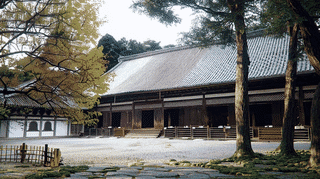
Zuigan-ji Kitchen (Kuri) and Corridor: A Masterpiece of Momoyama Architecture

Standing proudly within the precincts of Zuigan-ji Temple in Matsushima, Miyagi Prefecture, the Kuri (kitchen) and corridor are among Japan's most exceptional National Treasure buildings. Completed in 1609 under the patronage of Date Masamune, the powerful feudal lord of the Sendai domain, these structures embody the grandeur and refined aesthetics of the Momoyama period. Remarkably, only two temple kitchens in all of Japan have earned the distinction of National Treasure designation, and the corridor at Zuigan-ji is the only one of its kind to hold this honor.

The History of Zuigan-ji Temple

Zuigan-ji Temple, whose full name is Shoto Seiryuzan Zuigan Enpuku Zenji, is a Zen temple belonging to the Myoshinji school of the Rinzai sect. Its origins trace back to the early 9th century, when the Tendai monk Jikaku Daishi Ennin is said to have founded a temple called Enpuku-ji on this site. During the mid-13th century, under the influence of the Kamakura shogunate regent Hojo Tokiyori, the temple was converted to a Rinzai Zen institution.

After the Battle of Sekigahara in 1600, Date Masamune established his seat of power in Sendai and turned his attention to restoring the temple, which had fallen into decline during the Sengoku (Warring States) period. Masamune personally oversaw the reconstruction, bringing some 130 master craftsmen from the Kyoto-Osaka region and sourcing the finest timber from Kumano in present-day Wakayama Prefecture. After five years of construction, the temple was completed in 1609 and renamed with its present title, serving as the family temple of the Date clan throughout the Edo period.

What Is a Kuri? The Heart of Zen Temple Life

In Zen Buddhist temples, the kuri (also written as 庫裡 or 庫裏) serves as the kitchen and administrative headquarters of monastic life. Traditionally, it is where meals are prepared for the monks and where daily temple affairs are managed. Throughout Japan, kuri buildings follow a distinctive form: a large gabled structure oriented with its triangular gable facing forward, topped by a smoke outlet (kemudashi) to vent cooking smoke from the massive interior hearths.

Because kuri buildings are fundamentally utilitarian in nature, they are rarely adorned with elaborate decoration. This is precisely what makes the kuri at Zuigan-ji so remarkable—it transcends its practical role with magnificent artistic embellishment that reflects Date Masamune's extraordinary aesthetic vision.

Why Were They Designated as National Treasures?

The kuri and corridor of Zuigan-ji were designated as National Treasures in 1959 (Showa 34), six years after the main hall (hondo) received its own National Treasure designation in 1953. Several factors contribute to their exceptional cultural value:

  • The kuri is one of only two temple kitchens in Japan designated as National Treasures, alongside the kuri at Myoho-in Temple in Kyoto. The corridor is the only one in Japan to hold National Treasure status.
  • The building preserves outstanding examples of Momoyama-period architectural artistry, including the spectacular arabesque carvings on the front gable, which were sculpted directly onto the white plaster surface—a rare and technically demanding technique.
  • The massive interior beam structure, with its powerful interlocking timbers, represents the pinnacle of Edo-era carpentry, skillfully combining structural necessity with aesthetic grandeur.
  • The corridor connecting the kuri to the main hall features elegant decorative rafters (kesho-daruki) and fine carpentry details that elevate a functional passage into a work of architectural art.
  • Together with the main hall, the kuri and corridor form a cohesive complex that documents the full scope of Date Masamune's ambitious temple-building program and the Momoyama artistic legacy in the Tohoku region.

Architectural Highlights of the Kuri

The kuri measures approximately 13.8 meters across the front and 23.6 meters in depth, presenting an imposing presence within the temple grounds. Its roof is of the kirizuma-zukuri (gabled) style with honkawarabuki (formal tile) roofing, and atop the main roof sits a smaller irimoya-zukuri (hip-and-gable) smoke outlet.

The most striking feature is the front gable decoration. Where most temple kitchens present a plain, unadorned facade, Zuigan-ji's kuri displays an intricate composition of arabesque (karakusa) carvings set against the white plaster of the gable wall. This ornamental treatment transforms the building's most visible face into a dramatic statement of Momoyama-period artistic ambition.

Inside, visitors are greeted by the bold framework of massive beams (hari) and struts (tsuka) that support the towering roof. These timber elements, sourced from the forests of Kumano, were assembled with extraordinary precision by the craftsmen Masamune recruited from the Kyoto-Osaka area. The interplay of structural power and visual beauty in this interior space makes it one of the most impressive timber-framed spaces in Japanese temple architecture.

The Corridor: A National Treasure Connecting Sacred Spaces

The corridor (roka) linking the kuri to the main hall is far more than a simple passageway. Its construction features decorative exposed rafters and carefully detailed joinery that elevate it to the level of fine architecture. As you walk through the corridor, you transition from the utilitarian world of the kitchen to the formal splendor of the main hall, experiencing the full range of Momoyama architectural expression.

The corridor is sometimes described as an "uguisu-bari" (nightingale floor) passage, where the floorboards produce a distinctive chirping sound underfoot. This phenomenon, whether intentional or a natural result of the construction, evokes the atmosphere of an era when samurai lords and high-ranking monks traversed these halls.

Visiting Zuigan-ji Temple

The kuri serves as the entrance point for visitors touring the temple's interior. After passing through the kuri, guests proceed along the corridor to the main hall, where they can admire the magnificent painted sliding doors, gold-leaf decorations, and audience chambers. The treasure museum (Seiryuden), located opposite the kuri, houses approximately 30,000 items related to the temple and Date clan history, and is included in the standard admission ticket.

Also on the temple grounds, visitors can explore the cave meditation grottoes near the entrance and see the ancient plum trees believed to have been planted by Date Masamune himself. The nearby Godai-do hall, a small wooden pavilion on a tiny island overlooking Matsushima Bay, is managed by Zuigan-ji and is free to visit.

Matsushima: One of Japan's Three Most Scenic Views

Zuigan-ji Temple sits at the heart of Matsushima, celebrated since ancient times as one of Japan's Three Most Scenic Views (Nihon Sankei). The bay is dotted with over 260 pine-clad islands, creating a landscape that has inspired poets and artists for centuries. The haiku master Matsuo Basho famously visited in 1689 during his journey along the Narrow Road to the Deep North, and the temple holds an annual Basho Festival every November in his honor.

Visitors to Zuigan-ji can easily combine their temple visit with a sightseeing cruise around Matsushima Bay, a stroll through the adjacent Entsuin Temple's beautiful moss garden, or fresh seafood at the many restaurants along the waterfront. The area is particularly stunning during cherry blossom season in April and autumn foliage season from late October through November.

Nearby Attractions

  • Entsuin Temple: Adjacent to Zuigan-ji, this serene temple is renowned for its exquisite moss garden and the mausoleum of Date Mitsumune, Masamune's grandson. The autumn illumination is especially popular.
  • Godai-do Hall: A small Momoyama-period pavilion on a tiny island connected to shore by a red bridge, offering panoramic views of Matsushima Bay. The hidden Buddhist statues inside are revealed only once every 33 years (next scheduled for 2039).
  • Matsushima Bay Cruise: Excursion boats depart regularly from the nearby pier, offering close-up views of the bay's scenic islands.
  • Kanrantei Tea House: A historic tea pavilion overlooking the bay, originally part of Fushimi Castle and gifted to the Date family by Toyotomi Hideyoshi.
  • Fukuurajima Island: A natural botanical garden on an island connected to the mainland by a 252-meter vermilion bridge.
📍 Plan Your Visit to Miyagi
Find tours, activities & transport passes near Zuiganji Temple Priests' Quarters and Corridor
[ Matsushima Bay Cruise & Sendai Food Tours ]

Q&A

QWhat makes the Zuigan-ji kuri different from other temple kitchens in Japan?
AWhile most temple kitchens are plain, utilitarian buildings, the Zuigan-ji kuri features elaborate Momoyama-period arabesque carvings on its front gable and a spectacular interior beam structure. It is one of only two kuri in Japan designated as a National Treasure, alongside the one at Myoho-in Temple in Kyoto.
QCan I take photographs inside the main hall and kuri?
APhotography is generally not permitted inside the main hall, as it contains National Treasure-designated paintings and cultural artifacts. Please follow the instructions provided by temple staff during your visit. You are welcome to photograph the temple grounds and exterior buildings.
QHow long does it take to visit Zuigan-ji Temple?
AThe standard visit takes approximately 30 to 40 minutes, covering the kuri, corridor, main hall, and treasure museum. If you wish to explore the cave grottoes and temple grounds more thoroughly, plan for about 60 minutes.
QIs the temple accessible for wheelchair users?
AThe treasure museum (Seiryuden) is wheelchair accessible, but unfortunately the main hall and kuri are not accessible by wheelchair due to the historic architectural features of the buildings, including raised floors and steps.
QHow do I get to Zuigan-ji from Sendai?
AFrom Sendai Station, take the JR Senseki Line to Matsushima-Kaigan Station (approximately 40 minutes). The temple is a 5-minute walk from the station. If traveling by car, take the Sanriku Expressway to Matsushima-Kaigan Interchange, then drive about 10 minutes to the temple area.

Basic Information

Official Name Zuigan-ji Kuri (Kitchen) and Corridor (瑞巖寺庫裏及び廊下)
Designation National Treasure (Architecture) — Designated June 27, 1959
Construction Date Keicho 14 (1609)
Patron Date Masamune, 1st Lord of the Sendai Domain
Architectural Style Kuri: Kirizuma-zukuri (gabled), honkawarabuki (formal tile roof), with irimoya-zukuri smoke outlet
Dimensions (Kuri) Front width: approx. 13.8 m; Depth: approx. 23.6 m
Temple Affiliation Rinzai sect, Myoshinji school (臨済宗妙心寺派)
Address 91 Matsushima-aza Chonai, Matsushima-machi, Miyagi-gun, Miyagi 981-0213, Japan
Admission Adults: 700 yen / Children (elementary & junior high): 400 yen
Hours 8:30 AM – 3:30 PM (Dec–Jan) to 5:00 PM (Apr–Sep); last entry 30 min before closing
Access 5-minute walk from JR Senseki Line Matsushima-Kaigan Station; approx. 40 minutes from Sendai by train
Official Website https://www.zuiganji.or.jp/english/

References

National Treasure Zuiganji Temple (Official Website — English)
https://www.zuiganji.or.jp/english/
拝観案内|国宝 瑞巌寺(Official Visitor Guide)
https://www.zuiganji.or.jp/guide/
国宝-建築|瑞巖寺 庫裏・廊下|WANDER 国宝
https://wanderkokuho.com/102-00136/
瑞巖寺庫裏及び廊下 庫裏 — 文化遺産オンライン
https://bunka.nii.ac.jp/heritages/detail/184286
指定文化財〈国宝〉瑞巌寺庫裏及び廊下 — 宮城県公式ウェブサイト
https://www.pref.miyagi.jp/soshiki/bunkazai/05zuiganji.html
Zuiganji Temple — Matsushima Travel (japan-guide.com)
https://www.japan-guide.com/e/e5102.html
日本三景松島 — 瑞巌寺
https://www.matsushima-kanko.com/miru/detail.php?id=140
Zuiganji Temple | VISIT MIYAGI
https://visitmiyagi.com/articles/zuiganji-temple/
Zuigan-ji — Wikipedia
https://en.wikipedia.org/wiki/Zuigan-ji

Last verified: 2026.03.20

Cultural Treasures in the Same Area

All are within walking distance in the same area, so we recommend visiting them together.

  1. Zuiganji Temple Priests' Quarters and Corridor kuri 0.00 km
  2. Zuiganji Temple Priests' Quarters and Corridor corridor 0.03 km