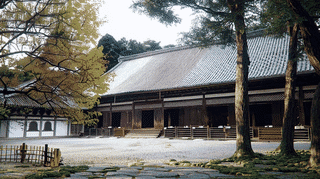
The Gate for Lords and Emperors
The Zuiganji Temple Onari Gate (瑞巖寺御成門, Zuiganji onarimon) is a gate of about 1609 at Zuiganji in Matsushima, Matsushima Town, Miyagi Prefecture, and it was designated an Important Cultural Property on April 7, 1900. The Agency for Cultural Affairs records it as a single-bay yakuimon gate with a hip-and-gable tiled roof, with two taikobei walls designated as attached items.
According to the temple, the Onari Gate stands almost directly in front of the Onari entrance and was reserved for the emperor, the imperial family and the lord of the domain.
Why the Onari Gate Matters
The Onari Gate was designated an Important Cultural Property in 1900. Miyagi Prefecture explains that it is a yakuimon, with rear support posts behind the main posts and a ridge set forward of the midpoint between them, and that its deep eaves make it a weighty gate. The prefecture draws attention to the contrast between the Onari Gate and the Middle Gate, both built around 1609.
The walls on either side are white-plastered taikobei, hollow inside, according to the prefecture. They link the Onari Gate and Middle Gate and enclose the courtyard in front of the main hall. As a gate reserved for lords and the imperial family, it expresses the standing of the Date family's temple.
What to Look For
The temple points to the shippo-wachigai decoration above the doors, a pattern of interlocking circles that adds a touch of brilliance to this heavy, hip-roofed gate.
Compare it with the Middle Gate next to it. Miyagi Prefecture highlights the contrast between the Onari Gate, with its tiled hip-and-gable roof and deep eaves, and the Middle Gate, with its shingled gable roof and exposed framework. Look too at the white taikobei walls joining the two.
Visiting the Onari Gate
The Onari Gate stands within Zuiganji's precinct. It was reserved for the emperor, imperial family and lord, and is not the route visitors walk through. Admission, hours and access are on the Zuiganji Temple page.
- 📍 Plan Your Visit to Miyagi
- Find tours, activities & transport passes near Zuiganji Temple Onari Gate
- [ Matsushima Bay Cruise & Sendai Food Tours ]
Q&A
- When was the Zuiganji Onari Gate built?
- The Agency for Cultural Affairs dates it to around 1609.
- When was the Zuiganji Onari Gate designated?
- On April 7, 1900, with two taikobei walls included as attached items.
- What kind of gate is the Zuiganji Onari Gate?
- A single-bay yakuimon gate with a hip-and-gable tiled roof, reserved for the emperor, imperial family and lord.
- What should I look for at the Onari Gate?
- The interlocking-circle decoration above the doors, the contrast with the Middle Gate and the white taikobei walls.
- What are the taikobei walls?
- Hollow, white-plastered walls linking the Onari Gate and Middle Gate; two are designated as attached items.
Basic Information
| Name | Zuiganji Temple Onari Gate (瑞巖寺御成門) |
|---|---|
| Location | 91 Chonai, Matsushima, Matsushima Town, Miyagi Prefecture (Zuiganji) |
| Designation | Important Cultural Property (Structure) |
| Year Designated | Designated 1900/4/7 (Meiji 33) |
| Quantity | 1 structure (with 2 taikobei walls) |
| Dimensions | Single-bay yakuimon gate, hip-and-gable roof, tiled |
| Owner | Zuiganji |
| Public Access | Viewable within the precinct |
References
- 瑞巖寺御成門 (Database of National Cultural Properties, Agency for Cultural Affairs)
- https://kunishitei.bunka.go.jp/bsys/maindetails/102/133
- 瑞巖寺御成門、瑞巖寺中門 (Miyagi Prefecture)
- https://www.pref.miyagi.jp/soshiki/bunkazai/0607zuiganji.html
- Onari Gate (Zuiganji official site)
- https://zuiganji.or.jp/guide/keidai_04.php
- Visitor information (Zuiganji official site)
- https://www.zuiganji.or.jp/guide/
Last verified: 2026.10.04
Last verified: 2026.10.04