
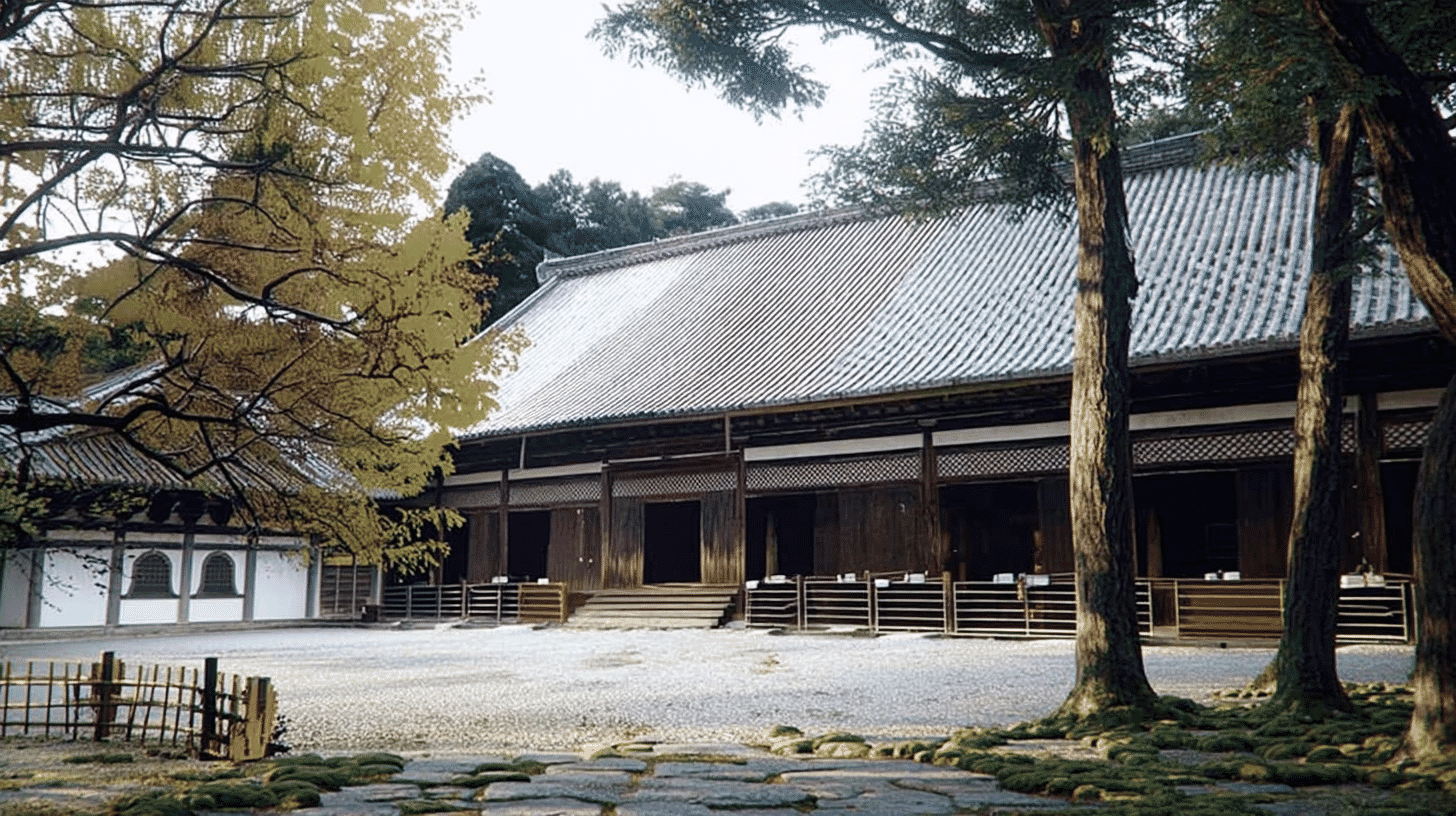
Date Masamune's Abbot's Hall
The Zuiganji Temple Main Hall (former Abbot's Chamber) (瑞巖寺本堂(元方丈), Zuiganji hondo) is the main hall of Zuiganji in Matsushima, Matsushima Town, Miyagi Prefecture, built in 1609 and designated a National Treasure on March 31, 1953. It was the abbot's quarters (hojo) built when Date Masamune revived the temple, with its framework raised in the third month of 1609. It had first been protected under earlier law in 1900.
The Agency for Cultural Affairs records it as 13 ken by 8 ken, a single storey under a hip-and-gable tiled roof with an attached entrance, and two ridge tablets are designated with it. According to the temple, it measures 38 metres across the front, 24.2 metres deep and 17.3 metres to the ridge, and contains ten rooms, from the central Peacock Room and the Buddha room to the Upper Rooms and the Ink Painting Room.
Why It Is a National Treasure
According to the Agency, the hall enlarges the standard plan of a Zen abbot's quarters and sets aside rooms to the left of the Buddha room for receiving the lord, Date Masamune. In the principal room, the jodan-no-ma, there is an oshiita alcove and a chodaigamae doorway, but the chodaigamae is only nominal: instead, a cusped opening (kato-guchi) with two sliding panels is set into the middle of the alcove. The Agency knows of no other alcove of this kind.
In the central room, the coved coffered ceiling and the panelled doors are decorated with carving. The Agency's short note says the painted details, transoms and carved doors show the character of Momoyama architecture, and that with the National Treasure Osaki Hachimangu shrine the hall is a remnant of Date culture in the Tohoku region of great cultural-historical significance.
At the front left corner is the attached Onari entrance, larger than a usual Zen abbot's entrance and bent in plan, with a hip-and-gable roof at the front, carved bargeboards and doors, decorative diamond lattice in the cusped side windows and a floor of diagonally laid stone, according to the Agency.
What to Look For
Miyagi Prefecture describes how a plain Japanese exterior gives way inside to carving, colour, metalwork and painted doors and walls that express the full splendour of Momoyama architecture. Outside, posts stand at the edge of the lower veranda, with boarded lower walls and sliding storm shutters set bay by bay above a middle sill.
The central Peacock Room, where services are held, has sliding-door paintings of pines and peacocks by Kano Sakyo, the first official painter of the Sendai domain, according to the temple. The jodan-no-ma was the lord's room, and the still higher jojodan-no-ma is said to have been built to receive the emperor or imperial family; it served as Emperor Meiji's lodging during his tour of the northeast in 1876.
Except in the Ink Painting Room, the wall and door paintings on view are precise reproductions made since 1985. The Ink Painting Room is closed while a five-year conservation and reproduction project that began in May 2026 is under way, the temple says. It also notes that the transom carving of grapes and squirrels above the Onari entrance's doors moved the poet Shimazaki Toson.
Visiting the Main Hall
The main hall is on Zuiganji's visitor route and its interior can be seen. Wheelchairs cannot be used in the main hall, according to the temple, and the Ink Painting Room is closed for conservation. Admission, hours and access are on the Zuiganji Temple page.
- 📍 Plan Your Visit to Miyagi
- Find tours, activities & transport passes near Zuiganji Temple Main Hall (former Abbot's Chamber)
- [ Matsushima Bay Cruise & Sendai Food Tours ]
Q&A
- When was the Zuiganji main hall built?
- It was the abbot's hall built when Date Masamune revived the temple, with its framework raised in 1609.
- When was the Zuiganji main hall designated a National Treasure?
- On March 31, 1953. It had been protected under earlier law in 1900.
- What is unusual about the main hall's alcove?
- In the jodan-no-ma, a cusped opening with two sliding panels is set into the middle of the alcove, a form the Agency for Cultural Affairs says is unparalleled.
- Are the paintings in the Zuiganji main hall originals?
- Except in the Ink Painting Room, they are precise reproductions made since 1985. The Ink Painting Room is closed for conservation from May 2026.
- Is the Zuiganji main hall wheelchair accessible?
- No. According to the temple, wheelchairs cannot be used in the main hall or kuri; only the treasure museum is accessible.
Basic Information
| Name | Zuiganji Temple Main Hall (former Abbot's Chamber) (瑞巖寺本堂(元方丈)) |
|---|---|
| Location | 91 Chonai, Matsushima, Matsushima Town, Miyagi Prefecture (Zuiganji) |
| Designation | National Treasure (Structure) |
| Year Designated | National Treasure 1953/3/31 (Showa 28); earlier designation 1900/4/7 (Meiji 33) |
| Quantity | 1 building (with 2 ridge tablets) |
| Dimensions | 13 ken by 8 ken, single storey, hip-and-gable roof, tiled, with attached entrance |
| Owner | Zuiganji |
| Public Access | Open during Zuiganji visiting hours (Ink Painting Room closed for conservation) |
References
- 瑞巖寺本堂(元方丈) (Database of National Cultural Properties, Agency for Cultural Affairs)
- https://kunishitei.bunka.go.jp/bsys/maindetails/102/132
- 瑞巌寺本堂 (Miyagi Prefecture)
- https://www.pref.miyagi.jp/soshiki/bunkazai/04zuiganji.html
- Main hall (Zuiganji official site)
- https://zuiganji.or.jp/guide/keidai_01.php
- Onari entrance (Zuiganji official site)
- https://zuiganji.or.jp/guide/keidai_03.php
- Visitor information (Zuiganji official site)
- https://www.zuiganji.or.jp/guide/
Last verified: 2026.10.04
Last verified: 2026.10.04
