
Kofun
Nara · 古墳Browse Nara’s cultural heritage from the Kofun period (300 – 538). Filter by type and keyword, with concise stories, maps, and travel tips.
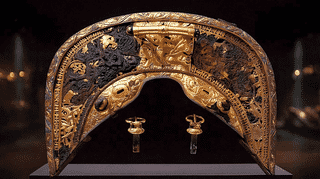
Kofun-period finds in Nara Prefecture, listed as a single lot. The tomb itself is placed about 350 metres to the west of Horyuji, and not by any address.

Discover the Seven-Branched Sword (Shichishitō), a unique National Treasure from the 4th century preserved at Isonokami Shrine in Tenri, Nara. Learn about its gold-inlaid inscription, the Baekje-Japan diplomatic connection, and how to visit this ancient sacred site.
Kept above ground rather than buried, the two iron shields of Isonokami Jingu in Nara are rare, near-complete Kofun-period pieces and an Important Cultural Property.
Spread across the foothills of Tenri City in Nara Prefecture, the Yamato Tumulus Group is a cluster of 24 ancient mounds dating from the late 3rd to early 4th century—the formative era of the Yamato polity. In 2014, three of its most significant mounds—Nomugi, Nakayama Otsuka, and Shimoikeyama Kofun—were designated a National Historic Site. With its unusual mix of keyhole and square-rear tombs, remarkable finds including special pedestal pottery and a silk-wrapped bronze mirror, and a setting along the ancient Yamanobe-no-michi path, the site offers a rare encounter with the very dawn of the Japanese state.
Kengoshizuka Kofun is a seventh-century octagonal mound in Asuka, restored in white stone in 2022 and thought to be the tomb of Empress Saimei and her daughter.
At the foot of Mount Miwa, the Makimuku Site preserves a 3rd-century building complex and 2,000 peach pits, central to the debate over Queen Himiko's Yamatai.
Woven in Tang-dynasty China in a Persian style, this Hōryū-ji National Treasure silk shows four winged-horse riders turning to shoot lions inside beaded roundels.
Discover the Haniwa Ushi, a nationally Important Cultural Property displayed at Karako-Kagi Archaeological Museum in Tawaramoto, Nara. Excavated in 1897 from Hagoda Tomb No. 1, this rare 6th-century cow-shaped haniwa is one of fewer than ten such examples ever found in Japan.