
Heian
Nara · 平安Browse Nara’s cultural heritage from the Heian period (794 – 1185). Filter by type and keyword, with concise stories, maps, and travel tips.
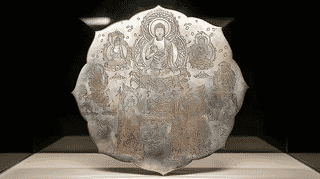
An eight-lobed Heian-period mirror in Nara Prefecture. Nine Buddhist figures stand engraved upon its face, while flowers and birds cover all the back.
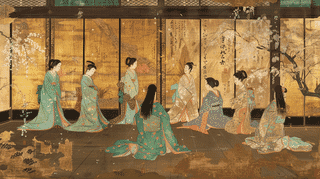
A Heian-period handscroll in Nara owned by a listed company. The company owns the scroll itself while a museum that it runs is the place that keeps it.

A single handscroll recording a waka poetry contest at the court of Emperor Daigo, hosted by a consort, preserving the verses and verdicts of a Heian gathering.
The Kachomon Kei is a Heian bronze ritual gong from Nara, decorated with flowers and birds and struck during Buddhist services as a signal. Designated in 1953.
A twelfth-century Heian lacquer box for a court cap, worked in hyomon with silver and gold set flush into black lacquer. A Kasuga Taisha treasure that lost its lid.
Discover the Lotus Sutra known as Kunoji-kyo, a National Treasure of Japan featuring exquisite gold and silver decorations created by the imperial court in the 12th century. Learn about its history, artistic value, and where to see it.
A National Treasure of Japan, the Ichiji Rendai Hokekyō (Fugen Kanpotsuhon) is a dazzling late Heian decorated sutra in which each written character is enthroned on a painted lotus pedestal and encircled by a golden halo. The gold- and silver-strewn paper and the yamato-e frontispiece depicting a Heian memorial rite make it one of Japan's finest sōshokukyō. It is preserved at the Museum Yamato Bunkakan in Nara.
A herdboy rides his ox home through falling snow in Li Di's Returning Herd in Snow, a Southern Song National Treasure kept at Nara's Yamato Bunkakan museum.
Discover the National Treasure 'Silk-Painted Image of the Eleven-Headed Kannon' at Nara National Museum — a 12th-century Heian-period masterpiece on silk. As one of Japan's oldest surviving silk paintings of this form of Kannon, it features an unusually naturalistic three-quarter pose, exquisite cut-gold-leaf (kirikane) decoration, and motifs newly introduced from Song-dynasty China. This guide covers the painting's iconography, history, and how to plan your visit to the museum in Nara Park.
Housed at the Nara National Museum, the Gyūhi Keman are a set of thirteen fan-shaped Buddhist pendant garlands of ox-hide, cut in openwork and painted on both faces with kalavinka and hōsōge arabesques. Originally preserved at Tō-ji Temple in Kyoto, they date to the 11th century and are the oldest surviving leather keman of this form in Japan.
Discover the Lotus Arabesque Maki-e Sutra Box, a National Treasure from the late Heian period housed at Nara National Museum. Crafted in the exceptionally rare lacquered-leather (shippi) technique and adorned with togidashi maki-e, this elegant container once preserved decorated sutras at Jingū-ji in Fukui.
Standing at the foot of Mount Nijō in Katsuragi City, Nara Prefecture, the Main Hall of Taima-dera—known as Mandala-dō—is a National Treasure of late Heian-period wayō architecture completed in 1161, incorporating an older Nara-period inner sanctuary. It enshrines the Taima Mandala within a National Treasure hexagonal cabinet and is famed for the Princess Chūjō legend and its seasonal flowers.
Beside the Hachiman Hall stands the Kanjin-sho Sutra Storehouse, a log-built (azekura) repository like the nearby Shōsō-in, raised in the early Heian period.
The Former Fukiji Arhat Hall at Horyuji in Ikaruga, Nara, was rebuilt by 1971 from late Heian timbers that left Fukiji in Kawanishi and sat in Tokyo from 1935.
Butsuryuji Sekishitsu is a stone chamber with a pyramidal roof behind the main hall in Uda City. The gorinto inside is held to mark the grave of the founder Kene.
Tsumamuro is a plain monks' dormitory of about 1121 in Hōryūji's West Precinct, a 27-bay hall that housed the monks who served the senior priests next door.
Housed at Kasuga Taisha Shrine in Nara, the Kinji Raden Kenukigata Tachi is a resplendent twelfth-century ceremonial sword designated a National Treasure of Japan. Known as the Golden Sword for its near-pure gold fittings, its gilt lacquer scabbard features a playful cat pursuing sparrows through a bamboo grove, rendered in exquisite mother-of-pearl inlay and colored glass.
The Amida Triad and Attendant Child on Silk, a National Treasure preserved at Hokke-ji in Nara, is a set of three large hanging scrolls painted in the late Heian to early Kamakura period. Its dramatic contrast between the serene, frontal Amida and the animated bodhisattvas and attendant child—richly ornamented with gold pigment and cut-gold leaf—has earned it recognition as one of the finest masterpieces in the history of Japanese painting. It is shown only briefly each autumn in the Jikō-den treasure hall.
Held by Hōryū-ji in Nara, the Important Cultural Property Star Mandala on Silk is a rare Heian-period four-court circular mandala. With Shaka Kinrin at its center surrounded by the Big Dipper, Nine Luminaries, twelve zodiac signs and twenty-eight lunar mansions, it is a cosmic map where Indian, Chinese and even Greek-Babylonian astronomical traditions meet on a single piece of silk.
Woven in Tang-dynasty China in a Persian style, this Hōryū-ji National Treasure silk shows four winged-horse riders turning to shoot lions inside beaded roundels.