
Taishō
Niigata · 大正Browse Niigata’s cultural heritage from the Taishō period (1912 – 1926). Filter by type and keyword, with concise stories, maps, and travel tips.
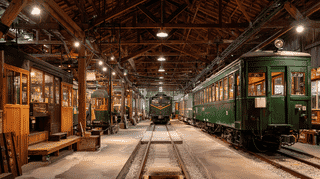
Discover the Former Kubiki Railway Engine House at Kubikino Rail Park in Niigata Prefecture—a nationally registered cultural property preserving Japan's rare narrow-gauge railway history. Experience vintage locomotives, ride historic trains, and explore a miraculous railway collection saved from oblivion.

A registered tangible cultural property museum housed in a 1925 Taisho-era former bank building. Enjoy free admission to world-renowned poster art by Takashi Akiyama while exploring Nagaoka's historic Settaya brewing district.
Ikinariya's front gate of 1914 is a sukiya-manner gate with a curved copper roof and korai-mon stance, a crane emblem carved in openwork above the door.
The Ōkōzu Diversion Channel Wash Weir in Tsubame City, Niigata Prefecture, completed in 1922, is recognized as Japan's first full-scale reinforced concrete weir. Built as part of a massive government project to protect the Echigo Plain from devastating Shinano River floods, it is registered as a national Tangible Cultural Property. Visitors can walk beneath the 26 massive piers spanning 146 meters and explore the surrounding park featuring 2,600 cherry trees and the free-admission Shinano River Ōkōzu Museum.
Kappo Miyoya is a Registered Tangible Cultural Property in Izumozaki, Niigata, standing along the historic Hokkoku Kaido highway. This Taisho-era wooden building features remarkable Western-style plaster moldings and angel reliefs created with traditional Japanese kote-e techniques. Still operating as an inn and restaurant, it offers fresh Sea of Japan cuisine in a heritage setting.
Completed in 1924 behind a courtyard in Niigata's Furumachi quarter, this wing holds an eighteen-mat guest room with a burled log alcove post and a round window.
Attached to the main house, this two-storey plaster storehouse carries saffron petals on its gable and dragons on its inner doors, an early work in the lime-relief craft.
Iron sheet covers the roof, base and inner walls of this storehouse at the southwest corner, rumoured to have made fireworks though its original use is unknown.
Attached to the rear of the main house, this storehouse held the brewing tanks and raw stock, its four free-standing pillars carrying the roof over the tonic-sake floor.
Attached north of the main house, this storehouse held the drug store and bottling floor where herbs became the tonic sake, roofed on a queen-post truss.
The largest storehouse of the compound stands behind the main house, its six free-standing pillars carrying the roof over a floor of roughly 219 square metres.
Discover Sanko-ji Temple Main Hall, a Registered Tangible Cultural Property in Shibata, Niigata. Built in 1916, this Jodo Buddhist hall features soaring interiors, Tokugawa hollyhock crests, and a rich samurai-era history on the charming Teramachi-dori.
Discover the Jizo-do in Nagaoka, Niigata — a compact Taisho-era (1922) brick chapel registered as a National Tangible Cultural Property. Featuring English bond brickwork, arched windows, and a rare diagonal corbelling technique at the eaves, this small Buddhist hall beautifully fuses Western masonry with traditional Japanese sacred architecture.
Dairinji's kuri of 1920 is a modern Zen monastery's living quarters joined to the main hall. Two rows of rooms hold upper study quarters and a board-floored kitchen.
The Takahashi Sake Brewery Chimney in Nagaoka City, Niigata Prefecture, is a striking hexagonal brick chimney standing approximately 20 meters tall, built around 1922 during the Taisho era. Registered as a National Registered Tangible Cultural Property, this rare hexagonal structure features meticulous decorative brickwork and has survived air raids and major earthquakes over its century-long history, serving as a beloved symbol of the local community alongside its adjoining red-brick brewing storehouse.
Discover Takahashi Brewery New Storehouse (Takahashi Shuzō Shingura), a Registered Tangible Cultural Property in Nagaoka, Niigata. This striking red brick sake brewery, built around 1922, stands along the Suyoshi River as an enduring symbol of Taisho-era industrial architecture and traditional craftsmanship.
Built in 1916 for Nagaoka Middle School and registered in 2011, this brick gate is the only prewar structure left on a campus born of the hundred sacks of rice.
Discover the Nishinotani Irrigation Canal in Myoko City, Niigata — a 1926 stone-lined waterway uniquely integrated with a sabo dam. This Registered Tangible Cultural Property combines flood control and irrigation, still serving local rice paddies nearly a century later.
The Workshop at the Ninomiya Residence in Seiro, built in 1919, is a single-story building. Under its swept-down eaves, the household's daily labor went on.
The Main House of the Ninomiya Residence in Tawarayanagi, Niigata, was rebuilt in 1918 after a flood: a gable-entry farmhouse with modern carpentry by the river.