
Meiji
Niigata · 明治Browse Niigata’s cultural heritage from the Meiji period (1868 – 1912). Filter by type and keyword, with concise stories, maps, and travel tips.
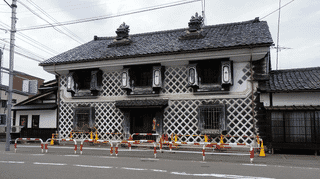
Discover Araso Misegura, a registered tangible cultural property in Tainai City, Niigata. This Meiji-era merchant storehouse features traditional namako-kabe walls and represents 200 years of commercial history.
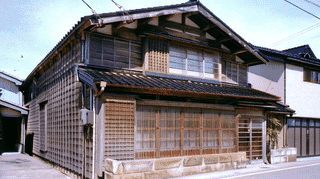
Discover the Yoshida Family Residence in Kashiwazaki, Niigata – a National Registered Tangible Cultural Property preserving authentic Meiji-era coastal architecture. Explore its distinctive tsuma-iri design, sasarago siding, and traditional chanoma with vaulted ceiling along the scenic Sea of Japan.
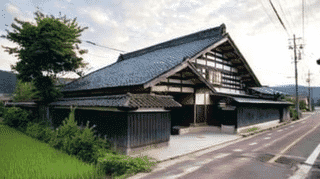
Discover the Yoshida Family Residence Main House in Niigata, a registered cultural property where historian Yoshida Togo lived. Experience authentic Meiji-era Azumadachi architecture and the birthplace of Japanese historical geography.

Igantei is a Meiji-era guest hall built in 1912 by the prominent Hosaka landowner family in Tonome, Joetsu City, Niigata Prefecture. Registered as a National Tangible Cultural Property in 2024, it features a striking copper-plated karahafu entrance and exquisite kumiko lattice windows showcasing the finest craftsmanship of the period.
Ikinariya's Kyuban-no-ma, an 1877 room of about 29 square meters, rests on a garden hill at the rear and tall posts at the front, projecting stage-like over the garden.
Ikinariya's Kotobuki-no-ma and Niban-no-ma, an 1877 hall and its largest registered room, sits at the back of the grounds, opening onto the pond garden for banquets.
Ikinariya's Sanban-no-ma, a compact 1877 room of about 40 square meters, pairs a kakekomi ceiling following the roof slope with a boat-bottom funazoko ceiling.
A small wooden warehouse from 1910 stands at Nihongi Station, built a year before it opened. It keeps a king-post truss roof and high windows. Registered 2019.
A brick lamp shed from 1910 stands at Nihongi, a 9.9-square-meter oil store for lamp fuel with a cornice and gable pediments. Locals call it the red-brick shed.
The Saito family's 1908 reception wing, re-erected in Hakusan Park at Niigata. Sukiya rooms, unjointed 18-metre beams, a buried water chime, and free admission.
Enjin Sonsha, a nationally Registered Tangible Cultural Property on the grounds of the Morohashi Tetsuji Memorial Museum in Sanjo City, Niigata, is the scholar's study where Dr. Morohashi Tetsuji compiled the Dai Kanwa Jiten — the world's largest Chinese-Japanese dictionary. Discover the history, architectural features, highlights, and access information for this Meiji-era retreat named after a poem by Tao Yuanming.
Rather than a costly steel viaduct, engineers filled a ravine at Myoko in 1887 and drove a brick-arched stone culvert through its base. Registered back in 2021.
Built in the first autumn of Meiji, this single-storey townhouse keeps the older form of the Takada machiya, with a gangi arcade over the pavement. Registered 2012.
Discover ryugon in Minamiuonuma, Niigata — a Registered Tangible Cultural Property farmhouse transformed into a luxury hot spring inn. Explore its chumon-zukuri architecture, samurai heritage, and snow country culture.
The Kaichi Shrine Haiden, located within the grounds of Inari Shrine in Niigata City's Kita Ward, is a worship hall dedicated to Endō Shichirōzaemon Munetoshi, the village headman who secured permission from the Tokugawa Shogunate to open the Kuzutsuka Market in 1761. Built in 1871, this Registered Tangible Cultural Property features a distinctive torii-gate-style front canopy and segai-zukuri eaves with closely spaced rafters—rare elements in shrine architecture that reflect regional building traditions.
Kappo Tochu Ue-no-kura in Ojiya, Niigata, is a Meiji-era storehouse whose ground floor became a billiard room before the war. It was registered in 2015.
Built in 1910 in Niigata's Furumachi quarter, the front wing of the former restaurant Ariake keeps a curved porch and a second floor overhanging the alley.
Shaped natural stones stacked six courses and capped with coping form the wall framing the Kina saffron sake compound and giving Nagaoka's Settaya a street-side face.
Standing alone at the north of the grounds, this storehouse is the oldest survivor from when brewing began here, its gable shaped into the character for good fortune.
Behind a heavy gabled porch and its old saffron-sake signboard, the 469-square-metre timber main house in Nagaoka opens for guided visits on weekends and holidays.