
Registered Tangible Cultural Properties of Okayama
岡 山 県 の 登 録 有 形 文 化 財Okayama · Registered Tangible Cultural Properties
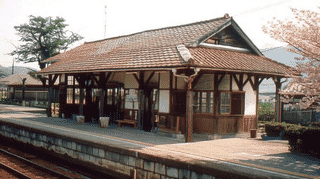
A single-storey timber station of 1900 in Okayama, 84 square metres. Of its seven bays, two and a half at the south end serve as the waiting room today.
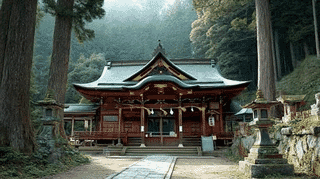
A shrine hall of 1919 in Maniwa, Okayama, just 12 square metres. Its walls are laid in two layers, with round posts outside and square ones set within.

Akebono Ryokan, in the heart of Tsuyama's former castle town in Okayama Prefecture, is the city's oldest surviving inn building and was registered as a National Tangible Cultural Property in 2000. Built in the early Meiji era, its inner two-story rooms preserve refined sukiya-style shoin joinery, and its guest register includes General Nogi Maresuke and other notable figures of modern Japan. Famed for its seasonal duck and pheasant hot pots, the inn lies within walking distance of Tsuyama Castle and the Jōtō historic district — a rare chance to actually sleep inside a piece of cultural heritage.
The Ibara Civic Hall Annex, located in central Ibara City in western Okayama Prefecture, is a two-story reinforced concrete structure completed in 1971 alongside the Main Hall. Registered as a Tangible Cultural Property in 2023, it embodies the legacy of postwar Japanese modernism through its exposed concrete finishes and distinctive vertical ventilation tower.
Completed in 1971, the Ibara Civic Hall Main Building is a striking reinforced concrete civic hall designed by Murayama Eikō of the Kansai Architectural Office. With its dramatic clock tower and diverse exposed concrete finishes, it was registered as a National Tangible Cultural Property in 2023, standing as a leading example of postwar modernist architecture in western Okayama.
The Iburodanigawa Sabo No. 3 Dam, standing in Minobe, Soja City, Okayama Prefecture, is a large stone erosion-control dam built around 1900. With a total height of approximately 12 meters and a crest length of 73 meters, its massive dry-stacked masonry is exceptional among surviving Meiji-era sabo structures and was added to Japan's National Register of Tangible Cultural Properties in 2002. As the symbolic starting point of organized erosion-control engineering in Okayama, the dam now anchors the Iburodanigawa Sabo Park, where visitors can quietly trace more than a century of disaster-prevention history.
Discover the Iri Power Station Water Tank, a reinforced concrete structure from 1920, registered as a Tangible Cultural Property in Kagamino, Okayama. Explore the oldest surviving hydroelectric facility on the Yoshii River.
Discover the Iri Power Station Penstock Retaining Wall and Main Building Retaining Wall, a Registered Tangible Cultural Property in Kagamino Town, Okayama. Built in 1920, these cobblestone retaining walls support Okayama's oldest surviving hydroelectric power station along the Yoshii River.
The Iri Power Station Main Building, nestled in the mountains of Kagamino Town, Okayama Prefecture, is a wooden hydroelectric plant building constructed in 1920 during the Taisho era. As the oldest surviving power station on the Yoshii River system, it has operated continuously for over a century and was registered as a national Registered Tangible Cultural Property in 2006. With its king post truss roof structure and copper-clad gabled roof, it preserves the distinctive character of Taisho-era industrial architecture.
Discover Emi Photo Studio in Tsuyama, Okayama — a Registered Tangible Cultural Property built in 1929. Featuring distinctive early Showa-era architecture with arched windows and a semicircular reception room, this working studio also safeguards over 10,000 historic photographs.
Discover the Oura Shrine Torii Gate in Asakuchi, Okayama — a Registered Tangible Cultural Property built in 1927 from Kitagi Island granite, featuring calligraphy by former Prime Minister Inukai Tsuyoshi. Explore its connection to Japan's only horse-racing Shinto ritual.
Set on a high stone platform in Yorishima, Asakuchi City, Okayama, Oura Shrine's Main Hall is a magnificent 1927 reconstruction featuring a copper-plated irimoya roof topped with a chidori-hafu and karahafu, lavishly carved with mythological creatures. Founded by the legendary onmyoji Abe no Seimei, this Registered Tangible Cultural Property is also home to the centuries-old Keiba Shinji sacred horse-racing ritual—one of the rare Shinto rites of its kind preserved in Japan.
The Oga Family Residence Inner Storehouse in Okayama guards 55 square metres behind iron-grilled windows, thick plaster doors and a boarded lower wall.
The late Edo Oga Family Residence Front Gate faces a canal in Okayama, with deep bracketed eaves and sliding board and lattice doors across 4.1 metres.
Only 1 bay deep, the Oga Family Residence Sundries Store and Mortar Shed turns the street corner of an Okayama merchant estate under a continuous tiled roof.
Okayama's Oga Family Residence Main House anchors a late Edo merchant estate of 9 registered buildings, with a 6-room plan and a tiled namako gable wall.
The Oga Family Residence Pickle Barn and Cargo Barn holds a closed pickling room at one end and an open loading bay at the other, 48 square metres in all.
At 19 square metres the Oga Family Residence Barn is the smallest registered building on this Okayama estate, its northeast corner cut back for a canal.
The Ōga Family Residence Nikai-Zashiki in Okayama City is a nationally registered tangible cultural property that forms part of a remarkable merchant estate dating from the late Edo to early Meiji period. Discover this kura-style second-floor sitting room and the surrounding compound of seven cultural properties that preserve the legacy of provincial merchant life in Japan.
The Oga Family Residence Detached Reception Room in Okayama turns its 8-mat sukiya room towards a garden said to have come from a nearby domain villa.
More from Okayama
Okayama’s registered properties across designations, with featured heritage and travel notes.
The complete kokuhō catalogue — browse by prefecture, period, and category.
Nationwide jūyō bunkazai — architecture, sculpture, painting, crafts, and documents.