
Shōwa
Wakayama · 昭和Browse Wakayama’s cultural heritage from the Shōwa period (1926 – 1989). Filter by type and keyword, with concise stories, maps, and travel tips.
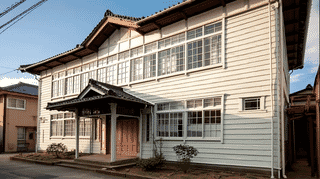
A school building of 1937 south of the Shingu Castle ruins in Wakayama, its entrance porch carrying a transom carved as an abacus. Listed as heritage in 2024.

A 1937 timber schoolhouse in Hashimoto, Wakayama, designated an Important Cultural Property in 2014 and still holding classes. A 98-metre range, four wings.
The Kongobuji Temple Kondo (1932) and Konpon Daito (1937) hide concrete frames under timber. See the 48-meter pagoda's mandala interior and how to visit both.
Ichiki Ryokan Entrance Building is a small 1937 hall in Kainan, Wakayama, whose black-stone entry floor leads to corridors joining three guest buildings of the inn.
Ichiki Ryokan New Building is an early Showa guest wing at the back of a Kainan inn, with five self-contained sukiya rooms whose verandas overlook the Miya River.
Ichiki Ryokan Gate and Wall fronts the road to Chohoji in Kainan, Wakayama: a 1937 cedar-bark gate with knotted posts and a plaster wall skirted with split logs.
A 1970 hipped-and-gabled gatehouse facing the lane at a Kinokawa farm estate, with double doors, a wicket, a barn and a boat-hull-ceiling room; registered in 2023.
The Ueda family's main house, built around 1929 on the Kinokawa's south bank in Hashimoto, Wakayama, pairs a traditional hipped roof with a quietly modernised plan.
A small barn in Kimino, Wakayama, whose ridgepole went up on March 5, 1957, framed in new cypress and chestnut salvaged from an older building; registered in 2019.
A detached room of around 1957 in Kimino, Wakayama, built of fine cypress, with a black fukiyose batten ceiling, kumiko latticework and views east; registered 2019.
The Okamoto storehouse in Hashimoto, Wakayama, built in 1962, is a two-storey plastered kura under a separately set roof, standing northwest of the main house.
The annex of the Okamoto Residence in Hashimoto, Wakayama, built about 1965, is a two-room wing linked to the main house, with an alcove and pierced transoms.
Kada Family Residence Front Gate, an early Showa gate in Wakayama City, pairs a central gate with two side doors under stepped gables of fine cypress and zelkova.
Kada Family Residence Koshikake Machiai, an early Showa waiting bench in a Wakayama tea garden, uses log posts and rafters, a lattice window and a privy behind.
Kada Family Residence Main House, a 1929 one-storey home in Wakayama City, sets its rooms in a stepped plan along the garden under three gabled entrance roofs.
Kada Family Residence Tea Room, built in 1931 in Wakayama City by sukiya carpenter Hirai Gisaburo, joins the small Furoan and eight-mat Gyogetsutei by a corridor.
Kada Family Residence Storehouse, a 1931 two-storey plastered store in Wakayama City, hides a Western king post truss and carries swirl motifs in lime plaster.
Kada Family Residence Torii, a granite shinmei torii of 1931 in Wakayama City, stands 2.2 m high before the household shrine with straight pillars and lintel.
Kada Family Residence Wall, an early Showa brick wall in Wakayama City, runs 31 m along the street, faced outside with green schist and finished inside in mortar.
Kada Family Residence Shrine, an early Showa household shrine in Wakayama City, is a tiny copper-roofed nagare-zukuri hall of fine cypress on a stone platform.