
Registered Tangible Cultural Properties of Yamagata
山 形 県 の 登 録 有 形 文 化 財Yamagata · Registered Tangible Cultural Properties
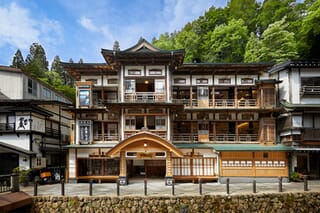
A three-storeyed Taisho timber building in the Ginzan hot-spring town, Yamagata, Japan. Its ground-floor bath faces the street; its river verandas shape the town.

Two-storey earthen storehouse of 1910 behind the Ichijima gun shop in Yamagata City, with a sukiya-style tatami room and thick plastered walls with double doors.
Two-storey concrete shop of 1927 on Nanokamachi in Yamagata City, built for a gunpowder merchant; the first concrete shop in Yamagata, with stone-like walls.
Treasure hall of Uesugi Shrine in Yonezawa, Yamagata, opened in 1923 and attributed to Ito Chuta, a shrine-style concrete hall for the heirlooms of the Uesugi lords.
A plain board-floored shed of about 1943 at a working silk works in Tsuruoka, Yamagata, where finished silk was checked by north light. Registered in 2024.
The 1940 office and preparation wing of the Uzen Kenren silk-scouring works in Tsuruoka, with a 140-mat winding room and stepped gabled roofs. Registered 2024.
A late Taisho workshop at the Uzen Kenren works in Tsuruoka where silk is boiled clean, venting steam through a raised roof, with rails to tanks. Registered 2024.
A 1929 dye room and a boiler room added about 1933, joined under sheet metal, at a working silk scouring works in Tsuruoka, Yamagata. Each keeps its own ridge vent.
A late-Taisho shed at a working silk works in Tsuruoka, Yamagata, where silk is rinsed and dried, hipped at one end and gabled at the other. Registered in 2024.
A long late Taisho workshop at the Uzen Kenren works in Tsuruoka where shrunken silk is set right, with a central vent roof and winding machines. Registered 2024.
A two-storey plastered storehouse from the late Taisho period, moved in 1940, holding the goods at a working silk works in Tsuruoka, Yamagata. Registered in 2024.
A board fence of about 1910 running 62 metres along the west side of the Kazama villa in Tsuruoka, relocated in 1954 and registered in 2003. Visible from the street.
A tiled yakuimon gate of about 1910 at the Kazama villa in Tsuruoka, registered in 2003. Just 2.1 metres wide, it has fish-shaped ridge tiles and splayed wing walls.
A plain bracket-armed gate of the early Meiji period at the back of the Kazama villa in Tsuruoka, registered in 2003, with big foundation stones and fine hinges.
A 1910 sukiya-style guest hall of Tsuruoka's Kazama merchants, registered in 2002. Seven nail-cover designs, a 1913 dog door, Mokuan's calligraphy and garden views.
A tiny bracket-armed gate of about 1910 beside the Shakado at the Kazama villa, registered in 2003. Herringbone sliding door, curved roof and carved bargeboards.
A storehouse of about 1897 moved in 1955 from the Kazama family home to their villa in Tsuruoka, registered in 2003. Separate roof, sturdy posts, lacquered interior.
Completed in 1922 at Kaminoyama in Yamagata, this earthen-walled storehouse holds an altar room and a formal parlour downstairs, under heavy curved beams.
This 1927 Japanese wing at Kaminoyama in Yamagata joins the west flank of a Western clinic building. Its coffered-ceilinged upper floor received guests.
Built in 1927 at Kaminoyama in Yamagata, this two-storey clinic wing carries a pediment outside yet floors its waiting rooms in tatami. Registered in 2022.
More from Yamagata
Yamagata’s registered properties across designations, with featured heritage and travel notes.
The complete kokuhō catalogue — browse by prefecture, period, and category.
Nationwide jūyō bunkazai — architecture, sculpture, painting, crafts, and documents.