
Important Cultural Property of Yamagata
山 形 県 の 重 要 文 化 財Yamagata’s Important Cultural Properties — designated for their value to the nation’s cultural history.
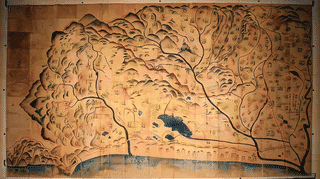
An Azuchi-Momoyama-period pictorial map held in Yamagata Prefecture. Its own commentary field there only points to an account held somewhere else now.

Discover the Tenyō Gannen Nyohōkyōsho Monument at Yamadera Risshaku-ji Temple in Yamagata—an Important Cultural Property of Japan. This 107.5 cm andesite stele, inscribed in 1144, records a sacred Lotus Sutra interment and opens a rare window onto Heian-era devotion, sutra-copying rituals, and the spiritual heritage of Tōhoku.
A Muromachi-era Noh hunting robe in Kurokawa, Yamagata. Ming figured silk, tailored in Japan, bears a gold-leaf heavenly palace, sun, moon, stars and cranes.
A National Important Cultural Property at Wakamatsu-dera, Tendo: a sacred-horse votive panel painted in 1563 by samurai-artist Gonome Sadashige for his late wife.
Kannonji Temple Kannon Hall in Shirataka is a thatched late Muromachi hall whose old-style exterior hides a Zen-style interior. Important Cultural Property, 1953.
Former Yamagata Normal School in Yamagata: a symmetrical 1901 timber school with a central tower and fire-resistant brick-backed walls, now an education museum.
Former Yonezawa Higher Technical School in Yamagata: a 94-metre Renaissance-style timber school of 1910 on a university campus. Interior tours by booking.
Kinbo Shrine Main Hall in Tsuruoka, Yamagata: a Shugendo hall of 1608 near the summit of Mt. Kinbo, blending a Zen-style temple form with a shrine plan.
Tsuruoka Catholic Church in Yamagata: a three-aisled timber church of 1903 on a former samurai estate, with a red tower and a Black Madonna from France. Free entry.
Discover the Former Tsuruoka Police Station, a striking blue giyofu-style building from 1884, now preserved at the Chido Museum in Tsuruoka, Yamagata. Learn about its unique blend of Western and Japanese architectural design, its fascinating history, and how to visit.
Former Nishitagawa County Office in Tsuruoka: an 1881 Western-style timber office with a 20-metre clock tower by master builder Takahashi Kenkichi, now a museum.
Pyramidal-roofed hall at the foot of Mount Haguro in Tsuruoka, Yamagata, rebuilt in the 1590s, the oldest building on the mountain, with thirty-three Kannon statues.
Thatched main hall of the ancient temple Jionji in Sagae, Yamagata, rebuilt in 1618 by the Mogami lords; its roof was restored in 2024; five hidden Buddhas within.
Thatched three-bay shrine hall of the Muromachi period in Tsuruoka, Yamagata, a mature nagare-style design with delicate carving thought to be Kyoto work.
Timber three-storied pagoda only 2.5 metres high, made around 1519 and set in a cliff cave at Yamadera, Yamagata, with full bracket sets and gilt fittings.
Central hall of Yamadera in Yamagata, rebuilt in the 14th century and the oldest building at Risshakuji; its sanctuary holds a hidden Yakushi and the eternal flame.
Late-Muromachi Kannon hall of Jakushoji (Wakamatsu Kannon), a matchmaking temple in Tendo, Yamagata, repaired by Mogami Yoshiaki in 1611 and restored in the 1960s.
At Uesugi Shrine in Yonezawa, this Momoyama robe pairs imported Italian or Spanish damask with Japanese tailoring. Said to be worn by the retainer Naoe Kanetsugu.
An Important Cultural Property in Sakata: the shortest surviving Tales of Ise, with 115 episodes on gampi paper, an older text outside Teika's standard line.
At the Chido Museum in Tsuruoka, this Muromachi domaru is said to have been worn by Tokugawa retainer Sakai Tadatsugu. Laced in purple, crimson and white.
More from Yamagata
Yamagata’s registered properties across designations, with featured heritage and travel notes.
The complete kokuhō catalogue — browse by prefecture, period, and category.
Nationwide jūyō bunkazai — architecture, sculpture, painting, crafts, and documents.