
Registered Tangible Cultural Properties of Aichi
愛 知 県 の 登 録 有 形 文 化 財Aichi · Registered Tangible Cultural Properties
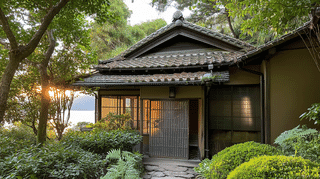
A single-storey timber tea house on a hill in Gamagori, Aichi, with a small tea room and an eight-mat guest room, built in the sukiya manner. Registered in 2022.
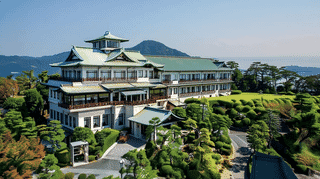
A 1934 building on a hill above Mikawa Bay in Gamagori, Aichi. A hip-and-gable copper roof sits on a concrete frame, with wings of three and two storeys.
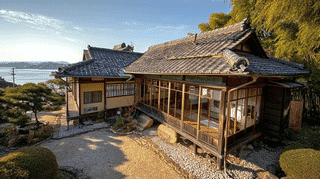
A detached building of 1916 on a hill in Gamagori, Aichi. A room stepping out to the southeast carries snow-viewing screens over Mikawa Bay. Registered in 2022.
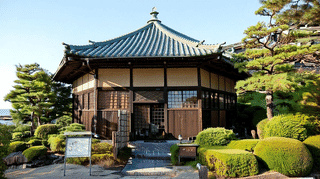
A single-storey timber building of 1936 in Gamagori, Aichi. Hexagonal, roofed in glazed blue tiles under a sacred jewel, it was a sales pavilion. Registered in 2022.
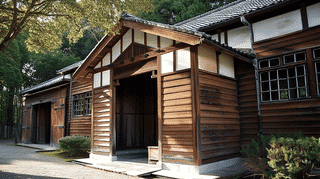
A martial arts hall of 1917 at Meiji Mura in Inuyama, Aichi, moved there from Kanazawa in 1970. A Western roof truss clears its floor of every column.
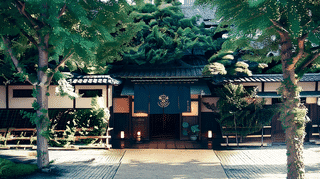
A two-storey timber building of 1950 in Nagoya, Aichi. Its rooms are set apart by corridors and narrow interstitial spaces rather than placed side by side.

Clad in brown scratch tile, this 1928 schoolhouse on Aichi Gakuin University's Kusumoto campus in Nagoya was designed by a pupil of the architect Suzuki Teiji.
Two reinforced-concrete pillars built in 1938 still mark the entrance to Nagoya's Asahigaoka High School, a campus with roots in an 1870 school of Western studies.
Built of stone around 1903, this is Aichi's oldest school gate, and one of thirteen working prefectural school gates registered together in 2017, a first for Japan.
Cast in reinforced concrete around 1929, the gateposts of Nagoya's Ishin High School carry Secession-style ornament and were registered as cultural property in 2017.
Two granite gateposts have framed Okazaki's Iwazu High School since 1937, topped with a 54-centimetre stone hemisphere and registered as cultural property in 2017.
Granite gate pillars at Okazaki High School, Aichi, early Taisho. Western classical columns meet a Japanese rough stone finish, registered in 2017 and still in use.
Reinforced-concrete gate pillars raised around 1925 for a sericulture school in Nishio, Aichi. Their Secession-style geometry won national registration in 2017.
Kariya High School's 1923 gate in Aichi, its reinforced-concrete posts scored to mimic stone in the Secession style, registered as a cultural property in 2017.
Komaki High School's 1929 front gate: reinforced concrete dressed as stone with carved acanthus capitals, registered in 2017 among thirteen old-system school gates.
Built in 1924 at Nagoya's Zuiryo High School, Kankido is the city's oldest reinforced-concrete auditorium. Note the four roof gables and Secession-style trim.
In Nagoya stand Zuiryo High School's old gate pillars, built around 1924 in reinforced concrete for a former commercial school in a straight-lined Secession style.
The 1923 reinforced-concrete front gate of Tsushima High School in Aichi became a Registered Cultural Property in 2017, listed with twelve other school gates.
Built around 1930 as a middle school's main gate in Nishio, Aichi, these concrete gateposts carry acanthus capitals and were registered in 2017. Still in daily use.
Built in 1921 for a girls' school in Handa, Aichi, these brick-tiled gateposts closed in 1961, were repaired in 1995, moved in 2008, and registered in 2017.
More from Aichi
Aichi’s registered properties across designations, with featured heritage and travel notes.
The complete kokuhō catalogue — browse by prefecture, period, and category.
Nationwide jūyō bunkazai — architecture, sculpture, painting, crafts, and documents.