
Important Cultural Property of Aichi
愛 知 県 の 重 要 文 化 財Aichi’s Important Cultural Properties — designated for their value to the nation’s cultural history.
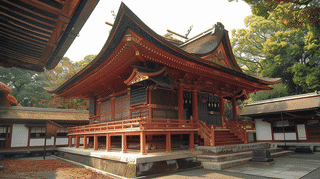
A Momoyama shrine hall in Tsushima, Aichi, three bays wide in the nagare form. The Agency dates it to 1605; it became an Important Cultural Property in 1920.
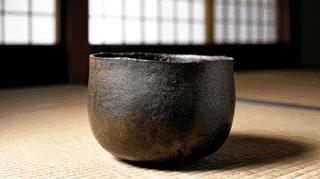
An Edo-period tea bowl by Hon'ami Koetsu in Nagoya, Aichi. Black glaze covers it but thins in places, letting the clay body show through. Designated in 2007.
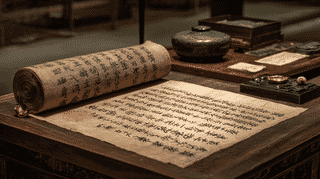
Forty volumes of the Shoku Nihongi at the Hosa Library in Nagoya. Volumes 11 to 40 are the oldest surviving copy, made in the later thirteenth century.

A haori held at the Tokugawa Art Museum in Nagoya. Its own period field says Momoyama, while its own date range reaches well into the Edo era besides.

A late-Heian tale of the Fujiwara regents and Michinaga's glory. The six-volume Tosho-bon in Aichi is an early copy, an Important Cultural Property since 1953.
A Momoyama-period Oribe ware square bowl held privately in Aichi Prefecture, designated an Important Cultural Property in 1967 and fired at the Mino kilns.
Preserved in Aichi Prefecture and designated an Important Cultural Property in 1957, this unsigned katana is attributed to the Yoshioka Ichimonji school of Bizen Province, active from the mid to late Kamakura period. Although shortened (o-suriage), the blade retains a vivid midare-utsuri and a richly varied hamon of choji clove-blossoms mixed with gunome and tobiyaki—hallmarks of this celebrated school. With its excellent workmanship and remarkably healthy condition, it offers a rare window into the Bizen tradition, the apex of Japan's five great sword-making schools (Gokaden).
A grandly proportioned katana attributed to the Kamakura-to-Nanbokucho master Sadamune, this Important Cultural Property descended through the Owari Tokugawa family and is now displayed at the Nagoya Sword Museum (Touken World) in Aichi.
Shortened long ago and unsigned, this Kamakura blade in Nagoya is attributed to the Kyoto smith Kunitoshi by its temper and point, and is unusually well preserved.
An unsigned Kamakura katana attributed to Moritoshi of Bitchu's Old Aoe school, an Important Cultural Property since 1950, and where to see Aoe blades in Nagoya.
Discover the Sword (Unsigned, Rai Kunimitsu), an Important Cultural Property held privately in Aichi and once part of the Tokugawa shogunal collection. Forged in late Kamakura-period Kyoto by the master Rai Kunimitsu, this 69.6 cm blade exemplifies the refined Yamashiro tradition. Explore its history, artistry, 1960 designation, and where to see Kunimitsu's other works in Nagoya.
An Edo-period katana by the Kyoto smith Kunimichi, a leading pupil of Horikawa Kunihiro, held privately in Aichi, designated an Important Cultural Property in 1959.
Discover the Three-Eared Jar with Chrysanthemum Design (Tamba ware), an Important Cultural Property of Japan housed at the Aichi Prefectural Ceramic Museum. Crafted in the early 13th century at one of Japan's Six Ancient Kilns, this exquisite jar features bold chrysanthemum incisions and a pristine form. Learn about its history, artistic significance, and visitor information.
The Kuroito Odoshi Domaru Gusoku (Black-Laced Domaru Armor) is an Important Cultural Property of Japan, worn by Honda Tadakatsu (1548–1610), one of the Tokugawa Four Heavenly Kings. Featuring towering deer antler helmet crests, a fierce lion-biting front piece, and gold-leafed Buddhist rosary beads, this iconic armor embodies the spirit of a legendary warrior who fought in 57 battles without receiving a single wound. Currently deposited at the Mikawa Bushi no Yakata Ieyasukan in Okazaki City, Aichi Prefecture.
A Yayoi bronze bell excavated at Imukai in Fukui in 1868 and designated an Important Cultural Property in 1953. Now privately held in Aichi and not on view.
A 13th-century Kamakura hanging scroll at Rinsenji in Hekinan, Aichi, designated in August 2024. Just 82.8 cm tall, dense with cut-gold-leaf kirikane work.
A Kamakura-period silk mandala of Butsugen Butsumo, the Buddha-Eye Mother whose eye embodies wisdom. It served an esoteric rite and survives privately in Aichi.
Pale green ash glaze runs down the shoulder while the foot scorches black. The Momoyama Iga flower vase Fuyo holds warped, deliberate beauty in 28 centimeters.
A surviving album of the Kokin Wakashu, Japan's first imperial poetry anthology, written on decorated paper and known as Sujikiri for its silver ruling lines.
Discover the Sekido-bon Kokin Wakashū, a National Treasure of Japan featuring exquisite 11th-century kana calligraphy on richly dyed paper. Learn about its history, artistry, and where to view fragments at museums in Nagoya, Tokyo, and New York.
More from Aichi
Aichi’s registered properties across designations, with featured heritage and travel notes.
The complete kokuhō catalogue — browse by prefecture, period, and category.
Nationwide jūyō bunkazai — architecture, sculpture, painting, crafts, and documents.