
Taishō
Aichi · 大正Browse Aichi’s cultural heritage from the Taishō period (1912 – 1926). Filter by type and keyword, with concise stories, maps, and travel tips.
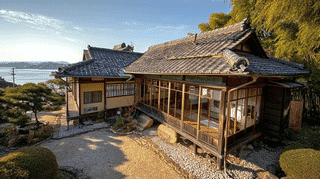
A detached building of 1916 on a hill in Gamagori, Aichi. A room stepping out to the southeast carries snow-viewing screens over Mikawa Bay. Registered in 2022.
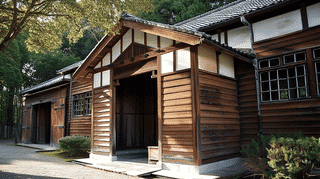
A martial arts hall of 1917 at Meiji Mura in Inuyama, Aichi, moved there from Kanazawa in 1970. A Western roof truss clears its floor of every column.

The Former Saionji Family Okitsu Villa 'Zagyoso,' preserved at the Museum Meiji-mura in Inuyama, Aichi Prefecture, was the seaside retreat of Prince Saionji Kinmochi, Japan's last elder statesman. Designated as an Important Cultural Property in 2017, the complex includes the main house, guard station, attendants' waiting area, and gate—showcasing exquisite sukiya-style craftsmanship and the political history of modern Japan.
Discover the Former Nukata County Public Hall and Products Exhibition Hall in Okazaki, Aichi. Designated as an Important Cultural Property, these 1913 Renaissance-inspired Western-style buildings showcase Japan's early mastery of European architecture in a provincial setting.
The 1913 Church of St. Matthew at Toyohashi is a wooden Orthodox sanctuary attributed to Kawamura Izo, Aichi's oldest, named an Important Cultural Property in 2008.
Completed in 1922, this Nagoya courthouse is Japan's oldest surviving court of appeals. Free entry to its Neo-Baroque stairwell and restored 1922 conference room.
Granite gate pillars at Okazaki High School, Aichi, early Taisho. Western classical columns meet a Japanese rough stone finish, registered in 2017 and still in use.
Reinforced-concrete gate pillars raised around 1925 for a sericulture school in Nishio, Aichi. Their Secession-style geometry won national registration in 2017.
Kariya High School's 1923 gate in Aichi, its reinforced-concrete posts scored to mimic stone in the Secession style, registered as a cultural property in 2017.
Built in 1924 at Nagoya's Zuiryo High School, Kankido is the city's oldest reinforced-concrete auditorium. Note the four roof gables and Secession-style trim.
In Nagoya stand Zuiryo High School's old gate pillars, built around 1924 in reinforced concrete for a former commercial school in a straight-lined Secession style.
The 1923 reinforced-concrete front gate of Tsushima High School in Aichi became a Registered Cultural Property in 2017, listed with twelve other school gates.
Built in 1921 for a girls' school in Handa, Aichi, these brick-tiled gateposts closed in 1961, were repaired in 1995, moved in 2008, and registered in 2017.
Discover Eijuji Chinjuden, a registered tangible cultural property in Shinshiro, Aichi Prefecture. This Taisho-era guardian hall enshrines Dakiniten within the historic precinct of a Soto Zen temple linked to haiku master Matsuo Basho.
The Okura Park Thatched Gate in Obu, Aichi, fronted Okura Kazuchika's Taisho villa. Moved in 1979 and still rethatched by Tono craftsmen, it was registered in 2015.
The Okura Park Rest House in Obu, Aichi, was the guest annexe of Okura Kazuchika's Taisho villa. Four tatami rooms step around a central pantry; registered in 2015.
Standing at the western foot of sacred Mt. Hongu in Toyokawa City, Aichi Prefecture, the Otani Family Residence Main Building is a stately wooden home completed in 1916 (Taisho 5). It features remarkably thick structural timbers cut from the family's own mountain holdings, a formal shikidai entrance organizing reception rooms and a Buddhist altar room to the north and living quarters to the south through a central corridor, and an early reinforced concrete basement. Together with its earthen storehouse, rice storehouse, and connecting corridor, the residence was registered as a national Tangible Cultural Property in October 2017.
Tucked into the foothills of Mount Hongū in Toyokawa City, Aichi Prefecture, the Otani Family Residence Earthen Storehouse is a small two-story dozō-zukuri building completed in 1916 to commemorate the enthronement of Emperor Taishō. Owned by the Otani family — once headmen of Ashiyamada village in the Edo period — it was registered as a Tangible Cultural Property in 2017 alongside the main hall, rice storehouse, and connecting passageway. Its clapboard skirting, lattice-patterned namako-kabe façade, and butterfly-motif door stops embody the refined craftsmanship of early-Taishō rural architecture in Mikawa.
The Otani Family Residence Corridor in Toyokawa, Aichi, covers 2.5 square meters. Built around 1916 and registered in 2017, it links a house and a storehouse.
Discover the Okazaki Shinkin Bank Museum, a nationally registered tangible cultural property in Okazaki, Aichi. Built in 1917, this stunning Renaissance-style brick building was designed by Suzuki Teiji, a protégé of Tokyo Station architect Tatsuno Kingo.