A Medieval Temple Above the Onomichi Channel
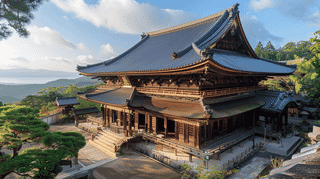
Jodoji Temple (浄土寺, also written Jōdo-ji) is a head temple of the Sennyūji branch of Shingon Buddhism in Higashikubo-cho, Onomichi City, Hiroshima Prefecture, said to have been founded by Prince Shōtoku in 616, with its core halls rebuilt from 1327 after a fire in 1325. The name means "Pure Land Temple," but Jodoji has no tie to the Jōdo sect; it has been a Shingon temple for centuries. Its grounds hold two National Treasures and six Important Cultural Properties among its buildings.
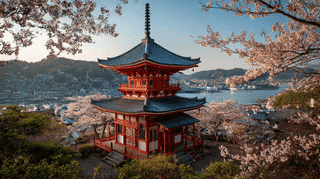
Ships entering Onomichi harbor from the channel see Jodoji first. The temple sits at the foot of Mount Jōdoji, and the hill and the halls read together as one piece of the town's layered, garden-like cityscape.
The temple's own chronicle describes a place so neglected in the late Kamakura period that no one was left to tend the halls. The monk Jōshō, a disciple in the Saidaiji lineage, took on the revival with backing from the Onomichi patron Kōami Dabutsu, and new halls went up between 1303 and 1306. Twenty years later, in 1325, fire took nearly everything.
Townspeople paid for the rebuilding. A lay couple, the novice Dōren and the nun Dōshō, led the effort: the Kondō (today's Main Hall) was finished in 1327, the Tahoto pagoda in 1329, and the hall then serving as the main hall, now the Amida Hall, in 1345. Jodoji suffered no major disaster afterward, which is why all three survive together.
In 1336 Ashikaga Takauji, the future first Muromachi shogun, stopped here on his way to Kyushu to pray for victory. By the Edo period the temple's patrons were Onomichi merchants, and their gifts paid for a rebuilt abbot's hall, new priests' quarters and guest hall, and the relocation of the Rotekian tea house.
Walking the Grounds of Jodoji Temple
Jodoji Temple faces south, and you enter through the Main Gate. The Main Hall stands straight ahead to the north. The Amida Hall sits just east of it, and the two-story Tahoto pagoda stands further east still. These three medieval buildings, lined up from west to east, form the oldest view in the precinct.
Beyond the pagoda, at the eastern edge of the grounds, a stone sutra stupa dated 1278 stands beside a hōkyōintō stupa inscribed 1348. A second hōkyōintō, long called "the grave of Ashikaga Takauji," stands south of the pagoda.
West of the Main Hall lies the Edo-period side of the temple. Behind the Karamon gate are the priests' quarters and guest hall, with the abbot's hall (Hōjō) to the north. The garden opens in the northwest corner, framed by the Hōjō and the priests' quarters, and the thatched Rotekian tea house sits on its artificial hill. The storehouse stands to the northwest and the long rear gate at the southwest corner. These six buildings are designated together as an Important Cultural Property under the single name "Jodoji."
In 1994 the precinct land around the Main Hall was designated a National Treasure together with the hall. The judgment covers more than individual buildings: the arrangement of the medieval and early modern compound is itself part of what is protected.
What Is Designated at Jodoji Temple
The two National Treasures are the Main Hall (1327) and the Tahoto pagoda (1329), both raised to that rank on March 31, 1953. The Important Cultural Property buildings are the Amida Hall, the Main Gate, the sutra stupa, two hōkyōintō stupas, and the six-building "Jodoji" designation headed by the Hōjō.
The dates span a long stretch. The oldest piece is the sutra stupa of 1278, which predates Jōshō's revival. The youngest is the rear gate from the late 18th century, roughly 500 years later.
Beyond the architecture, many of the temple's statues, paintings and documents carry national or prefectural designation, starting with the hidden main image, a standing wooden Eleven-Headed Kannon. Apart from hidden images, most are shown in the treasure hall or in the halls themselves.
Getting to Jodoji Temple and Visiting
From JR Onomichi Station, Jodoji Temple is about 25 minutes on foot, about 10 minutes by local bus, or about 5 minutes by taxi (around 1,000 yen). From Shin-Onomichi Station on the shinkansen, a taxi takes about 15 minutes (around 1,300 yen). Drivers can reach it in about 30 minutes from the Onomichi or Fukuyama interchange, and the temple has free parking for about 15 cars inside the grounds. Two coach spaces are available on Route 2 near the Jodoji-shita intersection; call the temple before using them.
Walking the grounds and viewing the buildings from outside is free. Fees apply only to the interiors and the garden, with two options.
- Standard admission: reception from 9:00 a.m. to 4:00 p.m.; 300 yen for adults, 150 yen for junior high students and younger. It covers the priests' quarters, guest hall, Hōjō, garden and the side aisles of the Main Hall, without a guide.
- Special admission: reception from 9:00 a.m. to 3:30 p.m.; 800 yen for adults, 400 yen for junior high students and younger. It adds the inner sanctuaries of the Main Hall and the Amida Hall, partly with a guide.
Memorial services, tea gatherings and repair work sometimes close the interiors. Groups of 10 or more should book ahead with Jodoji Temple (0848-37-2361). The Rotekian tea house is normally closed and opens only for occasional limited viewings with advance booking, as in spring 2025.
References
- Agency for Cultural Affairs Database: Jodoji Main Hall
- https://kunishitei.bunka.go.jp/bsys/maindetails/102/3125
- Agency for Cultural Affairs Database: Jodoji Tahoto Pagoda
- https://kunishitei.bunka.go.jp/bsys/maindetails/102/3124
- Agency for Cultural Affairs Database: Jodoji (Hojo)
- https://kunishitei.bunka.go.jp/bsys/maindetails/102/3130
- Agency for Cultural Affairs Database: Jodoji Sutra Stupa
- https://kunishitei.bunka.go.jp/bsys/maindetails/102/3127
- Hiroshima Prefectural Board of Education: Cultural Properties of Onomichi (PDF, Japanese)
- https://www.pref.hiroshima.lg.jp/uploaded/attachment/655404.pdf
- Japan Heritage Portal: Jodoji Main Hall and Precinct, Tahoto Pagoda (Japanese)
- https://japan-heritage.bunka.go.jp/ja/culturalproperties/result/1256/
- Jodoji Temple: History (Japanese)
- https://ermjp.com/j/temple/histry/engi.htm
- Jodoji Temple: History, continued (Japanese)
- https://ermjp.com/j/temple/histry/engi2.htm
- Jodoji Temple: Visiting Information (Japanese)
- https://ermjp.com/j/temple/haikan/index.htm
- Jodoji Temple: Access (Japanese)
- https://ermjp.com/j/temple/access/index.htm
Last verified: 2026.09.27
Basic Information
| Name | Jodoji Temple |
|---|---|
| Location | Higashikubocho, Onomichi City, Hiroshima Prefecture |
| Owner | Jodoji Temple |
| Designation | National Treasure (2) · Important Cultural Property (6) |
| Coordinates | 34.41186, 133.21080 |