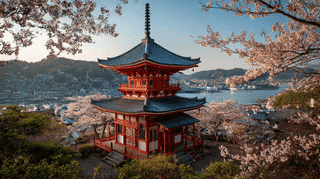
The Kondo Rebuilt Two Years After the Fire
Jodoji Temple Main Hall (浄土寺本堂, Jōdo-ji Hondō) is a late Kamakura-period Buddhist hall at the center of Jodoji Temple in Higashikubo-cho, Onomichi City, Hiroshima Prefecture, built in 1327, designated an Important Cultural Property on April 14, 1913 and a National Treasure on March 31, 1953.
A fire in the sixth month of 1325 destroyed almost every building at Jodoji. According to the Agency for Cultural Affairs, the temple began rebuilding at once and completed the Kondō, or Kannon Hall, in the fourth month of 1327. That Kondō is today's Jodoji Main Hall. The building called "main hall" at the time was a different one finished in 1345, now the Amida Hall; the names later traded places.
The builders are named. According to the Hiroshima Prefectural Board of Education, the Onomichi couple Dōren, a lay novice, and Dōshō, a nun, commissioned the hall, and the carpenters Fujiwara no Tomokuni and Kunisada built it. Of the two ridge tablets designated with the hall, one is dated the 11th day of the fourth month of 1327; the other carries the same month and day in 1712.
The short summary in the national database says the hall was rebuilt in 1345, but the same database's date field, its detailed commentary and the ridge tablet all point to 1327. This article follows 1327.
Why the Jodoji Main Hall Is a National Treasure
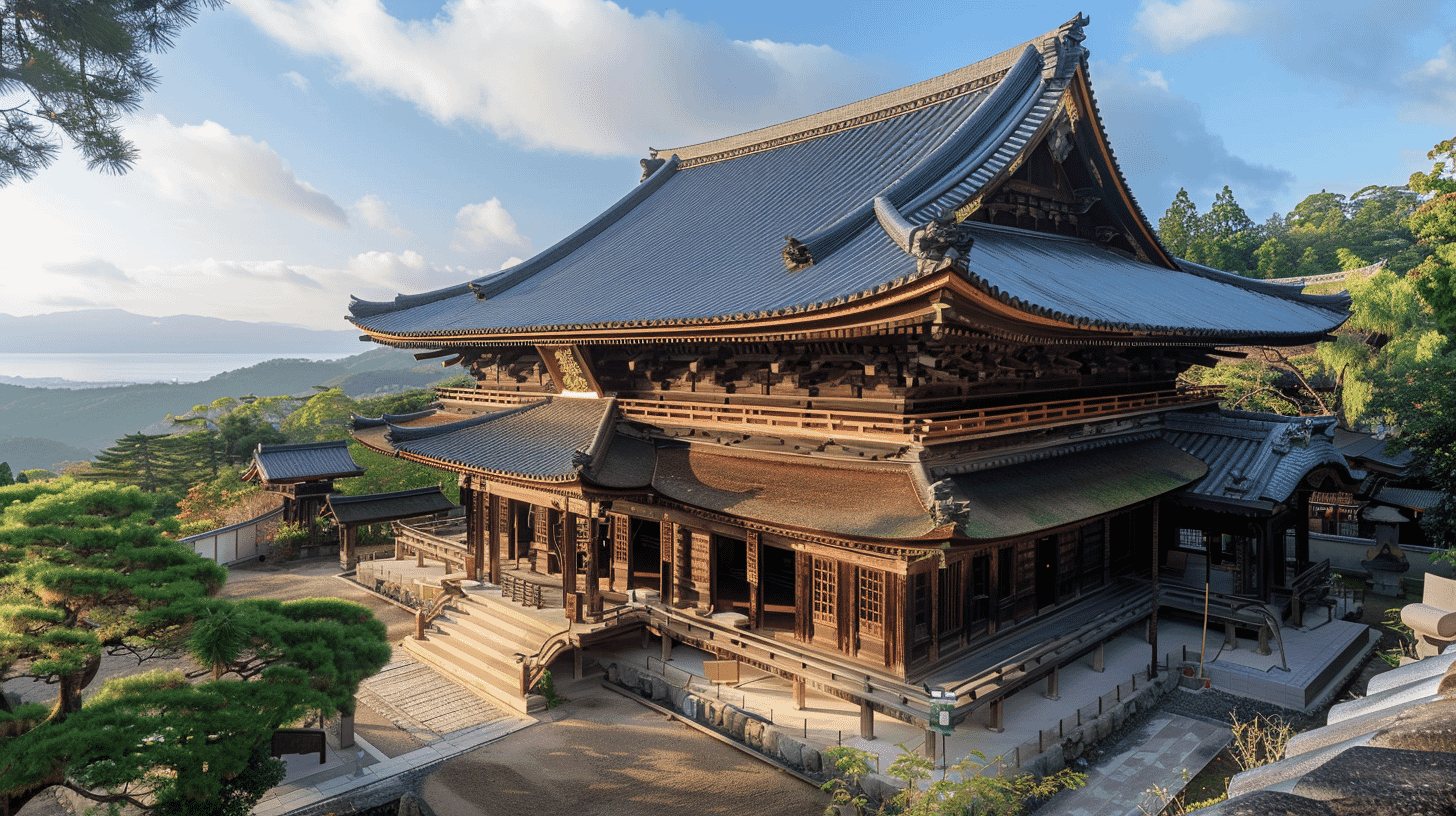
The Jodoji Main Hall is five bays square, a single story under a hip-and-gable roof of interlocking clay tiles, with a one-bay entrance porch. Inside, the front two bays form the outer worship area and the rest the inner sanctuary, the standard plan of an Esoteric Buddhist main hall that separates the space of worshippers from the space of the Buddha.
Its value rests on style. The hall is built on a native wayō frame but takes in elements from the continental Zen and Great Buddha styles: paneled doors, carved bracket arms and paired bearing blocks. Japanese architectural history calls this mix the eclectic style. The Agency for Cultural Affairs rates the Jodoji Main Hall as representative of eclectic-style buildings along the Seto Inland Sea coast and among the oldest of them. The ridge tablet's firm date is what supports the word "oldest."
Designated with the hall are a shrine cabinet, two ridge tablets and two old maps of the precinct. In 1994 the precinct land around the Jodoji Main Hall was made a National Treasure together with the hall, so the layout of the temple is protected along with the building.
What to Look For at the Main Hall
Pass through the Main Gate and the Jodoji Main Hall stands straight ahead. Look up at the eaves of the entrance porch first. The Hiroshima board of education notes that the Main Gate's eaves follow the same proportional rules for rafter spacing and curve as these porch eaves. Look up under the gate and then under the porch and you can check the match yourself.
Then take in the front. Paneled doors and carved bracket arms of continental type sit inside the native frame of posts and brackets. Standing under the porch, you can pick out several of the eclectic features the commentary names.
Once inside, notice the line between the outer and inner areas. The front two bays for worshippers and the sanctuary behind them are experienced directly as you move from the side aisles toward the inner sanctuary. The main image, a standing wooden Eleven-Headed Kannon, is a hidden image and is not normally shown.
Visiting the Jodoji Main Hall
The exterior of the Jodoji Main Hall can be viewed freely from the grounds at no charge.
The interior opens at two levels. Standard admission (reception 9:00 a.m. to 4:00 p.m.; 300 yen for adults, 150 yen for junior high students and younger) takes you into the side aisles without a guide. For the inner sanctuary, choose special admission (reception 9:00 a.m. to 3:30 p.m.; 800 yen for adults, 400 yen for junior high students and younger), partly guided by temple staff.
Services and events sometimes close the interior. The hidden main image is not normally visible on either option. Directions are on the Jodoji Temple page.
- 📍 Plan Your Visit to Hiroshima
- Find tours, activities & transport passes near Jodoji Temple Main Hall
- [ Itsukushima Shrine & Hiroshima Peace Memorial ]
Q&A
- When was the Jodoji Temple Main Hall built?
- In the fourth month of 1327, two years after the fire of 1325, as the temple's Kondō. A ridge tablet confirms the date.
- Why is the Jodoji Main Hall a National Treasure?
- It is an eclectic-style hall mixing continental details into a native frame, regarded as representative and among the oldest of its kind on the Seto Inland Sea coast. It became a National Treasure in 1953.
- Can I go inside the Jodoji Main Hall, and how much does it cost?
- Standard admission (300 yen for adults) covers the side aisles; special admission (800 yen for adults) adds the inner sanctuary. Reception closes at 4:00 p.m. and 3:30 p.m. respectively.
- Who built the Jodoji Main Hall?
- The Onomichi couple Dōren and Dōshō commissioned it, and the carpenters Fujiwara no Tomokuni and Kunisada built it.
- Can I see the main image of the Jodoji Main Hall?
- The standing wooden Eleven-Headed Kannon is a hidden image and is not normally shown.
Basic Information
| Name | Jodoji Temple Main Hall (浄土寺本堂) |
|---|---|
| Location | Higashikubo-cho, Onomichi City, Hiroshima Prefecture |
| Designation | National Treasure (Structure) |
| Year Designated | 1913 (April 14) Important Cultural Property; 1953 (March 31) National Treasure |
| Quantity | 1 building (with 1 shrine cabinet, 2 ridge tablets and 2 precinct maps attached) |
| Dimensions | 5 bays by 5 bays, single story, hip-and-gable roof, 1-bay porch, tiled (hongawarabuki) |
| Owner | Jodoji Temple |
| Public Access | Exterior free; side aisles on standard admission and inner sanctuary on special admission (fees); main image hidden |
References
- Agency for Cultural Affairs Database: Jodoji Main Hall
- https://kunishitei.bunka.go.jp/bsys/maindetails/102/3125
- Cultural Heritage Online: Jodoji Main Hall
- https://bunka.nii.ac.jp/heritages/detail/176362
- Hiroshima Prefectural Board of Education: Cultural Properties of Onomichi (PDF, Japanese)
- https://www.pref.hiroshima.lg.jp/uploaded/attachment/655404.pdf
- Japan Heritage Portal: Jodoji Main Hall and Precinct, Tahoto Pagoda (Japanese)
- https://japan-heritage.bunka.go.jp/ja/culturalproperties/result/1256/
- Jodoji Temple: Treasures and Cultural Properties (Japanese)
- https://ermjp.com/j/temple/houmotu/index.htm
- Jodoji Temple: Visiting Information (Japanese)
- https://ermjp.com/j/temple/haikan/index.htm
Last verified: 2026.09.27