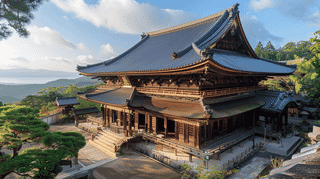
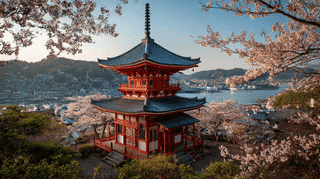
A 14th-Century Four-Legged Gate at the Front of Jodoji
Jodoji Temple Main Gate (浄土寺山門, Jōdo-ji Sanmon) is a four-legged gate of the Nanbokuchō period (14th century) at the south front of Jodoji Temple in Higashikubo-cho, Onomichi City, Hiroshima Prefecture, designated an Important Cultural Property on November 14, 1953.
The Jodoji Main Gate is a four-legged gate with a gabled roof of interlocking clay tiles and a small wicket door set into each side wing. The Agency for Cultural Affairs database dates it to the early Muromachi period and gives a range of 1333 to 1392. The Hiroshima Prefectural Board of Education calls it the temple's front gate, rebuilt in the Nanbokuchō period, and a building of high quality.
According to the temple's history, after the fire of 1325 the Onomichi couple Dōren and Dōshō paid to rebuild the Kondō, the gate, the pagoda and the Amida Hall one after another. The Jodoji Main Gate belongs to that campaign. Step through it and the Main Hall stands straight ahead at the north end of the grounds.
A ridge tablet recording construction was later added to the designation as an attached item; the database gives the date of that addition as July 12, 1994.
Same Eaves as the Main Hall
The strongest clue to the Jodoji Main Gate's value is its link to the hall in front of it. The Hiroshima board of education points out that the eaves of the gate follow the same kiku, the proportional rules for rafter spacing, projection and curve, as the eaves over the Main Hall's entrance porch. It suggests the same carpenters may have built both, and at the least that the two are close in date.
Eaves shape the whole look of a Japanese building, so a shared kiku means the gate and hall were set out on the same design logic. The Main Hall's ridge tablet names its builders, the carpenters Fujiwara no Tomokuni and Kunisada, and dates it to 1327, which places the Jodoji Main Gate in the same circle of builders and years.
The other clue is a crest. On the flat frog-leg strut in each gable end is the "two horizontal bars" crest (futatsu-hikiryō) of the Ashikaga family. Ashikaga Takauji prayed for victory at Jodoji in 1336, and the gate carries that relationship in its carving.
What to Look For at the Main Gate
Go to the side first. From the front of the Jodoji Main Gate you see only the tiled eaves, but step around to the east or west and the triangular gable end comes into view with the carved strut inside it. The two parallel bars cut into it are the Ashikaga crest.
Then stand under the gate and look up at the rafters and the lift of the eaves. Walk the short distance to the Main Hall and look up at its porch the same way. The two sets of eaves that the prefecture calls identical can be compared within a minute's walk.
From directly underneath, the four-legged layout is easy to read: two main pillars carry the doors, with two support posts in front and two behind. The wicket doors in the wings are part of the recorded form of the Jodoji Main Gate.
Visiting the Jodoji Main Gate
The Jodoji Main Gate is the entrance to the temple, so every visitor passes through it. Viewing is free at any time the grounds are open.
There is no interior to open or close. Allow a few minutes to walk to either side for the Ashikaga crest. Directions and admission for the temple as a whole are on the Jodoji Temple page.
- 📍 Plan Your Visit to Hiroshima
- Find tours, activities & transport passes near Jodoji Temple Main Gate
- [ Itsukushima Shrine & Hiroshima Peace Memorial ]
Q&A
- How old is the Jodoji Temple Main Gate?
- It was rebuilt in the Nanbokuchō period. The Agency for Cultural Affairs dates it between 1333 and 1392.
- Is there really an Ashikaga crest on the Jodoji Main Gate?
- Yes. The carved struts in the gable ends show the Ashikaga "two bars" crest. Walk to either side of the gate to see it.
- Did the same carpenters build the Jodoji Main Gate and the Main Hall?
- It is not proven. The Hiroshima Prefectural Board of Education notes that the gate's eaves follow the same proportional rules as the Main Hall porch and suggests the same builders may have made both.
- Is there a fee to see the Jodoji Main Gate?
- No. It is the entrance to the grounds and can be viewed and walked through freely.
- What type of gate is the Jodoji Main Gate?
- A four-legged gate (shikyakumon) with a gabled, tiled roof and small wicket doors in both wings, with support posts set in front of and behind the main pillars.
Basic Information
| Name | Jodoji Temple Main Gate (浄土寺山門) |
|---|---|
| Location | Higashikubo-cho, Onomichi City, Hiroshima Prefecture |
| Designation | Important Cultural Property (Structure) |
| Year Designated | 1953 (November 14) |
| Quantity | 1 building (with ridge tablet attached) |
| Dimensions | Four-legged gate, gabled roof, tiled (hongawarabuki), wicket doors in both wings |
| Owner | Jodoji Temple |
| Public Access | Entrance to the grounds; free to view |
References
- Agency for Cultural Affairs Database: Jodoji Main Gate
- https://kunishitei.bunka.go.jp/bsys/maindetails/102/3129
- Cultural Heritage Online: Jodoji Main Gate
- https://bunka.nii.ac.jp/heritages/detail/187276
- Hiroshima Prefectural Board of Education: Cultural Properties of Onomichi (PDF, Japanese)
- https://www.pref.hiroshima.lg.jp/uploaded/attachment/655404.pdf
- Jodoji Temple: History (Japanese)
- https://ermjp.com/j/temple/histry/engi.htm
Last verified: 2026.09.27