Six Edo-Period Buildings Under One Designation
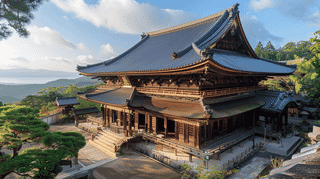
Jodoji Temple (浄土寺, Jōdo-ji), as an Important Cultural Property designation, is a group of six Edo-period buildings dating from 1690 to the late 18th century on the west side of the temple grounds in Higashikubo-cho, Onomichi City, Hiroshima Prefecture, designated in 1953 and enlarged in 1994. The six are the Hōjō, the Karamon gate, the priests' quarters and guest hall, the storehouse, the rear gate and the Rotekian tea house. Rotekian was designated an Important Cultural Property on November 14, 1953, and the other five were added on July 12, 1994.
The designation shares its name with the temple, but it does not cover the whole of Jodoji; the Main Hall and the pagoda are protected separately. What it gathers is the early modern side of the temple, where monks lived, guests were received and property was kept. The medieval halls line up to the east; these six Jodoji buildings sit together west of the Main Hall. Also included are the tea house's middle gate, ridge tablets from the Hōjō and the priests' quarters, and the altar cabinet and dais of the former refectory.
Their dates run from the late 17th to the late 18th century.
- Hōjō (abbot's hall): 1690. 16.7 by 13.1 meters, single story, hipped roof, tiled
- Karamon gate: around 1712. One bay, with a cusped karahafu gable facing front, tiled
- Priests' quarters and guest hall: 1719. The priests' quarters measure 15.9 by 12.0 meters under a gabled roof entered from the gable end
- Storehouse: 1759. Two-story plastered kura, 6.0 by 3.9 meters
- Rear gate: late 18th century. A nagayamon row gate, 14.9 by 5.0 meters
- Rotekian: mid-Edo period. A tea room of three and three-quarter mats with a preparation room and service rooms, hip-and-gable roof, thatched
Merchant Money and the Early Modern Jodoji
The six Jodoji buildings matter as a set. The Hiroshima Prefectural Board of Education notes that Jodoji keeps both its medieval halls and its early modern buildings, forming a unified temple complex. These six are the early modern half of that picture.
We know who paid for them. After the Battle of Sekigahara the temple lost its landholdings and came to depend on Onomichi's wealthy merchants. The temple's own history points to the Genroku-era Hōjō, the Kyōhō-era rebuilding of the refectory and the Bunka-era relocation of Rotekian as evidence of that change. The prefecture records that the merchant Hashimoto family sponsored the rebuilding of the priests' quarters, guest hall and Hōjō. The port town's commercial wealth became the shape of the temple.
The individual buildings reward a closer look. The Karamon is a small one-bay gate made entirely of zelkova wood. The storehouse is a two-story fireproof kura built to protect the temple's valuables. The rear gate is a nagayamon, with rooms built into the wings on either side of the opening.
Rotekian and the Other Jodoji Buildings
Of the six, the Rotekian tea house carries the most story. Temple tradition says it was a tea room Toyotomi Hideyoshi built inside Fushimi (Momoyama) Castle, later moved to the Honganji in Kyoto, then to the house of the Tenmaya, a wealthy family on Mukaishima across the channel from Onomichi, who gave it to Jodoji in 1814. The Agency for Cultural Affairs, however, dates the building to the mid-Edo period, between 1661 and 1750, which does not fit Hideyoshi's lifetime. Treat the Hideyoshi link as tradition.
The building itself is well documented. It has a thatched hip-and-gable roof. Inside, a room of three full mats and a daime mat connects to a preparation room and service rooms of four and four-and-a-half mats; the prefecture regards the service rooms as later additions. The host's mat and the guests' mat sit on either side of the three-mat room in the En-an arrangement associated with the tea master Furuta Oribe. A bamboo post at the host's entrance and the many windows are also cited as Oribe-style features.
Rotekian stands on the artificial hill of the garden in the northwest corner, framed by the Hōjō and the priests' quarters. The Hiroshima board notes that the garden leads into the tea house's approach path, so garden and tea room were planned as one. While you walk the grounds, also look at the zelkova Karamon west of the Main Hall and the 14.9-meter rear gate stretching along the southwest corner.
Visiting the Jodoji Buildings
The interiors of the Hōjō, priests' quarters and guest hall, together with the garden, are included in Jodoji's standard admission: reception from 9:00 a.m. to 4:00 p.m., 300 yen for adults and 150 yen for junior high students and younger, without a guide. The 800-yen special admission covers the same rooms as well.
Rotekian is normally closed inside; visitors see it from the garden. From April 29 to May 6, 2025, the interior opened to the public for the first time in seven years to mark the completion of conservation work, by advance booking at 1,700 yen for adults. Such openings are irregular, so check with Jodoji Temple (0848-37-2361).
The storehouse is not part of the admission route, and the Karamon and rear gate are viewed from outside. Services, tea gatherings and repairs sometimes close the interiors. Directions are on the Jodoji Temple page.
- 📍 Plan Your Visit to Hiroshima
- Find tours, activities & transport passes near Jodoji Temple
- [ Itsukushima Shrine & Hiroshima Peace Memorial ]
Q&A
- Which buildings are in the Jodoji Temple Important Cultural Property designation?
- Six: the Hōjō, the Karamon gate, the priests' quarters and guest hall, the storehouse, the rear gate and Rotekian. The Main Hall and the pagoda are separate designations.
- Was Jodoji's Rotekian really Hideyoshi's tea room?
- Tradition says it came from Fushimi Castle, but the Agency for Cultural Affairs dates it to 1661 to 1750. It was given to Jodoji in 1814.
- Can I see inside the Jodoji Hōjō and guest hall, and what does it cost?
- Yes, with standard admission: 300 yen for adults, 150 yen for junior high students and younger, reception 9:00 a.m. to 4:00 p.m. The garden is included.
- Can I go inside Jodoji's Rotekian tea house?
- Not usually. It opens for limited periods with advance booking, as in spring 2025. At other times you can see its exterior from the garden.
- When were the six Jodoji buildings built?
- The Hōjō in 1690, the Karamon around 1712, the priests' quarters and guest hall in 1719, the storehouse in 1759, the rear gate in the late 18th century, and Rotekian in the mid-Edo period.
Basic Information
| Name | Jodoji Temple (浄土寺): Hōjō, Karamon, priests' quarters and guest hall, storehouse, rear gate, Rotekian |
|---|---|
| Location | Higashikubo-cho, Onomichi City, Hiroshima Prefecture |
| Designation | Important Cultural Property (Structure) |
| Year Designated | 1953 (November 14, Rotekian); 1994 (July 12, 5 buildings added) |
| Quantity | 6 buildings (with middle gate, ridge tablets, and refectory altar cabinet and dais attached) |
| Dimensions | Hōjō 16.7m by 13.1m; priests' quarters 15.9m by 12.0m; storehouse 6.0m by 3.9m; rear gate 14.9m by 5.0m |
| Owner | Jodoji Temple |
| Public Access | Hōjō, priests' quarters and guest hall interiors open on standard admission (fee); Rotekian normally closed (occasional special openings) |
References
- Agency for Cultural Affairs Database: Jodoji (Hojo)
- https://kunishitei.bunka.go.jp/bsys/maindetails/102/3130
- Agency for Cultural Affairs Database: Jodoji (Karamon)
- https://kunishitei.bunka.go.jp/bsys/maindetails/102/3131
- Agency for Cultural Affairs Database: Jodoji (Priests' Quarters and Guest Hall)
- https://kunishitei.bunka.go.jp/bsys/maindetails/102/3132
- Agency for Cultural Affairs Database: Jodoji (Storehouse)
- https://kunishitei.bunka.go.jp/bsys/maindetails/102/3133
- Agency for Cultural Affairs Database: Jodoji (Rear Gate)
- https://kunishitei.bunka.go.jp/bsys/maindetails/102/3134
- Agency for Cultural Affairs Database: Jodoji (Rotekian)
- https://kunishitei.bunka.go.jp/bsys/maindetails/102/3135
- Cultural Heritage Online: Jodoji Rotekian
- https://bunka.nii.ac.jp/heritages/detail/176372
- Hiroshima Prefectural Board of Education: Cultural Properties of Onomichi (PDF, Japanese)
- https://www.pref.hiroshima.lg.jp/uploaded/attachment/655404.pdf
- Japan Heritage Portal: Rotekian Public Opening, 2025 (Japanese)
- https://www.japan-heritage.bunka.go.jp/ja/news/4963/
- Jodoji Temple: History, continued (Japanese)
- https://ermjp.com/j/temple/histry/engi2.htm
- Jodoji Temple: Visiting Information (Japanese)
- https://ermjp.com/j/temple/haikan/index.htm
Last verified: 2026.09.27
Cultural Treasures in the Same Area
All are within walking distance in the same area, so we recommend visiting them together.
- Jodo Temple Rotekian 0.00 km
- Jodo Temple Treasure trove 0.02 km
- Jodo Temple Hojo 0.03 km
- Jodo Temple Kuri and guest hall 0.03 km
- Jodo Temple Karamon 0.04 km
- Jodo Temple back gate 0.05 km