The Second Building of Jodoji's Rebuilding
Jodoji Temple Tahoto Pagoda (浄土寺多宝塔, Jōdo-ji Tahōtō) is a late Kamakura-period tahōtō pagoda in the grounds of Jodoji Temple, Higashikubo-cho, Onomichi City, Hiroshima Prefecture, rebuilt in 1329, designated an Important Cultural Property on March 27, 1901 and a National Treasure on March 31, 1953.
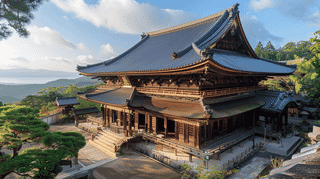
According to the Agency for Cultural Affairs, the pagoda burned in the fire of 1325 and was rebuilt in the first year of Gentoku, 1329. It was the second building of the recovery, after the Kondō, today's Main Hall, of 1327. It stands east of the Main Hall and the Amida Hall, closing the east end of the row of three medieval buildings.
Sources differ on the date. The database's detailed commentary and its era-name field both give Gentoku 1, but the same database's Western-calendar field reads 1319. Gentoku 1 corresponds to 1329, which this article follows. The Hiroshima Prefectural Board of Education gives 1328.
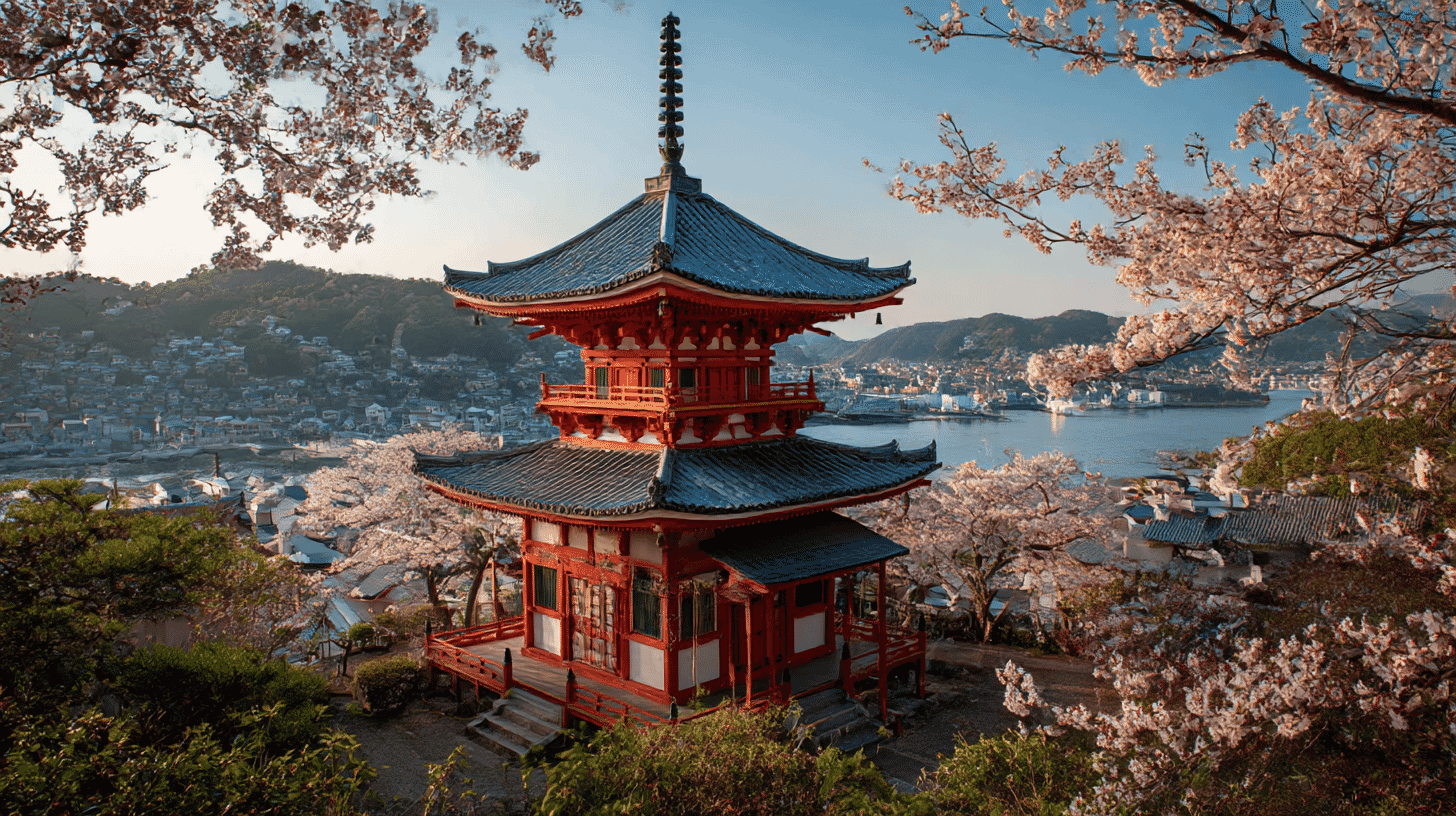
A tahōtō is a two-story pagoda with a square lower story and a round upper core under a square roof, crowned by a bronze spire of rings; the type is closely tied to Esoteric Buddhism.
Why the Jodoji Tahoto Is a National Treasure
The Jodoji Tahoto Pagoda is three bays square with a roof of interlocking clay tiles. The Agency for Cultural Affairs praises its overall balance as a tahōtō, notes that details such as the frog-leg struts, carved bracket arms and beam-end ornaments keep their original timber, and calls its orderly form and workmanship representative of late Kamakura architecture.
The Hiroshima board of education goes further. It calls the pagoda large for its type and well balanced, ranks it with the tahōtō of Kongō Sanmai-in on Mount Kōya and of Ishiyamadera, and mentions richly carved struts pierced with peonies, scrolling vines and butterflies.
Its present form carries a long repair history: the roof retiled in 1495, the spire replaced in 1688, the veranda repaired in 1732 and the whole pagoda dismantled and repaired in 1936. For the 1732 work the record notes that the railing was added for the first time, so the veranda railing you see today dates from about 400 years after construction.
What to Look For at the Tahoto
The best story is inside the spire. When the Jodoji Tahoto was built, many copies of the Lotus Sutra and other texts, written out by people who wished to join in the merit of the project, were sealed inside the ringed spire. They came to light in the 1936 repair and are now designated with the pagoda as an attached item. When you look up at the metal rings, remember that the handwriting of the Onomichi people who helped rebuild the temple was once stored there.
Next, look for the carved struts under the eaves. The pierced peony, vine and butterfly carvings the prefecture describes are among the original details that survive.
For the whole form, step back and view the pagoda from the east or south. From a distance you see the square lower story, the dome-shaped collar, the round upper story and the square roof in one frame, and the balance the Agency for Cultural Affairs praises becomes easy to read.
Visiting the Jodoji Tahoto Pagoda
The exterior of the Jodoji Tahoto Pagoda can be viewed freely from the grounds at no charge.
The interior is not part of either the standard or the special admission. According to the Hiroshima board of education, a seated Dainichi Buddha with attendants is enshrined inside and the walls are painted with the eight patriarchs of Shingon, but visitors see the pagoda from outside. Directions and admission are on the Jodoji Temple page.
- 📍 Plan Your Visit to Hiroshima
- Find tours, activities & transport passes near Jodoji Temple Tahoto Pagoda
- [ Itsukushima Shrine & Hiroshima Peace Memorial ]
Q&A
- When was the Jodoji Temple Tahoto Pagoda built?
- According to the Agency for Cultural Affairs commentary, it was rebuilt in 1329 after the fire of 1325. The prefecture gives 1328, and the database's Western-date field reads 1319, so sources vary.
- Why is the Jodoji Tahoto a National Treasure?
- It is regarded as a representative late Kamakura tahōtō, well balanced and keeping original timber in its carved details. It became a National Treasure in 1953.
- What was found inside the spire of the Jodoji Tahoto?
- Many hand-copied sutras, including the Lotus Sutra, placed there when the pagoda was built. They were found in the 1936 repair and are designated with the pagoda.
- Can I go inside the Jodoji Tahoto Pagoda?
- No, the interior is not included in the temple's admission routes. The exterior is free to view.
- Is the railing on the Jodoji Tahoto original?
- No. Records of the 1732 veranda repair state that the railing was added for the first time then.
Basic Information
| Name | Jodoji Temple Tahoto Pagoda (浄土寺多宝塔) |
|---|---|
| Location | Higashikubo-cho, Onomichi City, Hiroshima Prefecture |
| Designation | National Treasure (Structure) |
| Year Designated | 1901 (March 27) Important Cultural Property; 1953 (March 31) National Treasure |
| Quantity | 1 pagoda (with sutra scrolls from inside the spire attached) |
| Dimensions | Three-bay tahōtō, tiled (hongawarabuki) |
| Owner | Jodoji Temple |
| Public Access | Exterior free to view in the grounds; interior closed |
References
- Agency for Cultural Affairs Database: Jodoji Tahoto Pagoda
- https://kunishitei.bunka.go.jp/bsys/maindetails/102/3124
- Cultural Heritage Online: Jodoji Tahoto Pagoda
- https://bunka.nii.ac.jp/heritages/detail/148321
- Hiroshima Prefectural Board of Education: Cultural Properties of Onomichi (PDF, Japanese)
- https://www.pref.hiroshima.lg.jp/uploaded/attachment/655404.pdf
- Jodoji Temple: Visiting Information (Japanese)
- https://ermjp.com/j/temple/haikan/index.htm
Last verified: 2026.09.27