
Muromachi
Hiroshima · 室町Browse Hiroshima’s cultural heritage from the Muromachi period (1336 – 1573). Filter by type and keyword, with concise stories, maps, and travel tips.
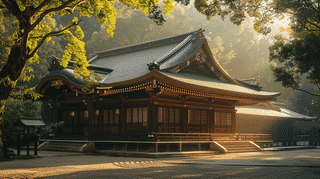
A late Muromachi-period hall in Hiroshima Prefecture. It once stood in Yamaguchi as the Buddha hall of a Zen temple, and was later moved over to here.
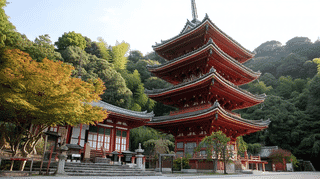
An early Muromachi-period pagoda in Hiroshima Prefecture. The image standing within it was renamed after an investigation carried out there in the 1990s.
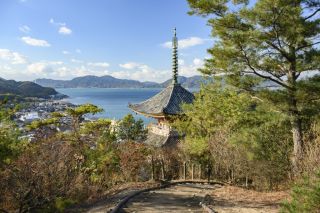
Kojoji Temple Three-Storied Pagoda on Ikuchijima dates from 1432: a Zen pagoda with strong karayo details and mostly original timber. National Treasure since 1958.

Zen-style Buddha hall at Ankokuji in Tomo, Fukuyama, said to be the hall of the former Kinpoji, repaired by Ankokuji Ekei in 1599 and housing an Amida triad.
Erected in 1407 on Tonooka hill, the Itsukushima Shrine Five-Storied Pagoda hides Shingon patriarchs and a Chinese landscape inside a storey no visitor may enter.
Built in 1523 in Omoto Park, this three-bay hall carries a long-board roof laid six deep in three courses, a covering with no other surviving example in Japan.
Late Muromachi and entered from the gable, this hall has a roof sweep close to straight where every neighbour curves, and its worship space doubles as a corridor.
Built by Mori Takamoto in 1556, this is the one hall at Itsukushima left as bare timber with plaster walls, and a rare survival of a Muromachi renga poetry hall.
Built in 1523 by the Zen monk Shukan, the Itsukushima Shrine Two-Storied Pagoda sets a circular upper storey on a square base beneath a rare shingled roof.
Two bays by one and built of stacked logs, the Itsukushima Shrine Treasure House is the only building here whose walls carry themselves. Its contents left in 1934.
Raised in 1441 by a man named on its ridge tablet, this one-bay hall in the Miyajima town district breaks the symmetry of its carving slightly at the centre.
Katsurahama Shrine's main hall on Kurahashi Island, near Kure, dates to 1480 by its ridge tag, a Muromachi hall rare in the region for round eaves pillars.
The gate of Saigoji in Onomichi, Hiroshima, is a plain munemon of the late 1300s, tile-roofed and listed in 1961. Two posts, one beam, and Muromachi carving above.
Saigoji's main hall in Onomichi, Hiroshima is the oldest surviving Jishu main hall in Japan, begun in 1353 and listed in 1961. Clap inside and the ceiling answers.
Rebuilt in 1386 under the Yamana governors of Bingo, Saikokuji Kondo in Onomichi crowns 108 stone steps, its wayo bracketing and tiled roof designated in 1913.
Given by shogun Ashikaga Yoshinori in 1429, Saikokuji's three-storey pagoda in Onomichi rises from a stone podium with no veranda, a rare revivalist wayo design.
Jodoji Temple Amida Hall in Onomichi was built in 1345 as the temple's main hall. A hipped-roof wayo hall; see how it differs from its neighbor and how to enter.
Jodoji Temple Main Gate in Onomichi is a 14th-century four-legged gate with the Ashikaga crest in its gables and eaves matching the Main Hall porch. What to see.
The south Hokyointo at Jodoji Temple, Onomichi, long called Ashikaga Takauji's grave, is a 14th-century stone stupa with its spire intact. Tradition and facts.
The 1348 Hokyointo at Jodoji Temple, Onomichi, 3.2 meters tall, was raised for the living and the dead and shows a receiving platform typical of the region.