
Taishō
Hiroshima · 大正Browse Hiroshima’s cultural heritage from the Taishō period (1912 – 1926). Filter by type and keyword, with concise stories, maps, and travel tips.
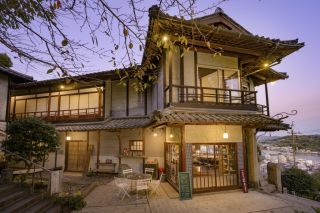
Former inn of about 1923 on Senkoji hill in Onomichi, Hiroshima, set on a high stone wall with a veranda over the Onomichi Channel; now used for lodging.

The Ihara Sōjūrō Residence storehouse in Shiraichi is the town's only three-storey kura, built by an ironcasting family in the Taishō era. Registered 2025.
Raised in 1925 and opened in 1927, this playhouse in Fuchū keeps its revolving stage, under-stage pit and hanamichi walkway beneath a Western king post truss roof.
A Taisho house in Higashihiroshima, Hiroshima, registered in 2012. Its 231 sq m plan has a cusped gable at the porch and a coved coffered ceiling in the main room.
A 31 sq m Taisho annexe in Higashihiroshima, Hiroshima, linked to the main house by a roofed corridor. A cusped window and lobed bamboo lattice show unusual care.
Late Taisho sukiya-style annex at the Kanemitsu brewery in Kurose, Higashihiroshima, with a formal eight-mat room, a veranda all round and polished-log beams.
Early Taisho timber building at the Kanemitsu brewery in Kurose, Higashihiroshima, part of a dwelling converted into a bottling house, with white plaster walls.
Former bank office of 1921 in Kake, Akiota, Hiroshima: a single-storey timber building given pent roofs and plastered eaves to look like a two-storey town house.
East of the storehouses stands this square Taisho brick chimney, about 17.7 metres tall and laid in English bond, kept as a landmark on the Saijo sake street.
This Taisho earthen-walled block links the main house with the storehouses and now works as a store, its masonry recording the layout of the young Kamoizumi brewery.
This large Taisho storehouse divides into East and Middle halves across a ground-floor passage, its white great-walls and red tile defining the Saijo brewery street.
Joining the passage on the west, this late-Taisho storehouse was refaced with namako-kabe under Shigemori Mirei's direction as the backdrop to the New Zashiki garden.
Early Taisho L-shaped brewhouse of 918 sq m behind Kamotsuru's No. 2 front wing in Saijo, its upper floor one room; the only listing registered as hard to reproduce.
Early Taisho brick chimney west of Kamotsuru's No. 3 Brewhouse in Saijo: 23.4 m of English bond, tallest of the four, lettered for the third brewery on steel bands.
Late Taisho brewhouse of 1,099 sq m at the north end of Kamotsuru's site in Saijo, largest of the 19, with namako tilework and a steam vent; it closed in 1995.
Late Taisho well outside Kamotsuru's No. 4 Brewhouse in Saijo: a low hexagonal cut-stone curb over a round shaft under a well roof; the largest of four wells.
Late Taisho brick chimney beside Kamotsuru's No. 4 Brewhouse in Saijo: 22 m of English bond with a corbelled crown, lettered for the fourth brewery; twin of No. 3.
The main house of the Former Fukui Family Residence in Onomichi joins a hipped east wing of 1912 and a west wing of 1927, finished in sukiya style with prized woods.
The storehouse of the Former Fukui Family Residence in Onomichi, built about 1912, is a plastered 2-storey kura with drip tiles, joined to the main house.
Kirei Sake Brewery No. 1 Storehouse Chimney is a square Taisho-era brick chimney 24 metres tall in Saijo, laid in the English bond seen across the town's breweries.