
Historic Sites, Places of Scenic Beauty, and Natural Monuments of Kyoto
京 都 府 の 史 跡 名 勝 天 然 記 念 物Kyoto · Historic Sites, Places of Scenic Beauty, and Natural Monuments
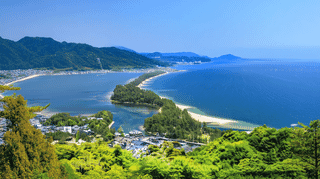
A sandspit at Miyazu, Kyoto, listed in 1922 and raised in 1952. Three criteria were applied, one of them naming it a point to view the place itself from.
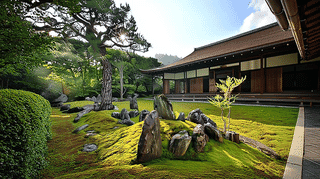
A flat garden of about 165 square metres in Kita Ward, Kyoto. A hedge closes off its background, and all of its stones are kept deliberately small in scale.
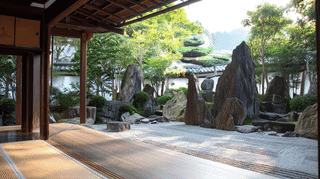
A garden in Kita Ward, Kyoto, covering the ground around the study garden and the abbot's hall garden, the latter of them plain in the extreme indeed.

A wild iris marsh at Ota Shrine in Kyoto with 25,000 rabbit-ear plants. Praised in a Heian waka by Fujiwara no Toshinari, designated a Natural Monument in 1939.
A state tile workshop near Kyoto that supplied the new capital of Heian-kyō. Found in 2004, twelve kilns are confirmed, with eaves tiles traced to the Heian Palace.
The Otokuni Kofun Group is a remarkable cluster of 13 ancient burial mounds spanning Kyoto City, Mukō, Nagaokakyō, and Ōyamazaki, tracing 400 years of regional power from the 3rd to 7th century. As one of the few sites in Japan where chieftain tombs were continuously built across the entire Kofun period, it serves as a microcosm of ancient political dynamics. The largest mound, Egenoyama Kofun (128m long), yielded over 700 iron weapons and is now preserved as a public park.
Discover Kamio-dera Temple Ruins, a fascinating 8th-century mountain temple in Kizugawa City, Kyoto. Renowned for over 5,000 lamp dishes, a Man'yoshu poem tablet, and rare ritual artifacts, this National Historic Site reveals the lost Buddhist ceremonies of the Nara period.
Kamo-wake-ikazuchi Jinja (Kamigamo Shrine), located in Kita-ku, Kyoto, is one of Kyoto's oldest shrines, with origins dating to 677. Its vast precincts — a designated national Historic Site and UNESCO World Heritage Site since 1994 — house 2 National Treasure buildings and 41 Important Cultural Properties. Visitors are drawn to time-honored rituals like the Aoi Matsuri, the historic priest quarter along the Myōjin River, and stunning seasonal landscapes throughout the year.
Designated a National Place of Scenic Beauty in 1975, this Momoyama garden was moved in 1605 from Fushimi Castle with the cosmetic palace of Hideyoshi's wife Nene.
Founded in 796 at the south gate of Heian-kyō and granted to Kūkai in 823, Tō-ji preserves Japan's tallest wooden pagoda and a Heian-era esoteric mandala.
Gyokuho-in is Myoshin-ji's oldest sub-temple in Kyoto. Its three-sided mid-Edo karesansui carries dual designation as Place of Scenic Beauty and Historic Site.
The Kiyotaki River, winding through the wooded valleys of northwestern Kyoto, hosts one of Japan's most cherished firefly habitats. Designated a National Natural Monument in 1979, the protected 4-kilometer stretch from Ochiai Bridge to Kiyotaki Bridge comes alive each early summer with the soft, pulsing glow of Genji fireflies. Near the celebrated mountain temples of Jingo-ji, Saimyo-ji, and Kosan-ji, this riverside corridor offers a deeply atmospheric encounter with both nature and Kyoto's spiritual heritage.
The Kutsukawa Kofun Group in Joyo City, Kyoto Prefecture, is a 5th-century burial complex of the chieftains who ruled southern Yamashiro. Four mounds — Kutsukawa Kurumazuka (the largest keyhole tomb in the region), Maruzuka, Bashōzuka, and Kuze Elementary School Kofun — are designated together as a National Historic Site. Important Cultural Properties recovered here, including a long stone coffin and seven bronze mirrors, illuminate the bond between local lords and the early Yamato court.
Hidden in a quiet residential corner of northern Kyoto, the Kurusuno Kiln Site is a designated National Historic Site that once supplied roof tiles for the great palaces and temples of Heian-kyo throughout the Heian period (794-1185). Identified with the imperial tile workshop named in the Engishiki regulations, this kiln produced tiles for the Daidairi palace, Toji and Saiji temples, and even the magnificent green-glazed roof of the Daigokuden audience hall. A rare and authentic glimpse into the craftsmanship that built a thousand-year capital.
Explore the Shibagahara Kofun in Joyo, Kyoto — a National Historic Site dating to the 3rd century. Discover rare bronze bracelets, ancient jade beads, and the origins of Japan's Kofun period.
The foundation of Emperor Kanmu's throne hall from his short-lived 784–794 capital in Mukō. National Historic Site (1964); a Japan Top 100 Historical Park.
Three wooded hills line up on Kyoto's western edge. The tallest holds a 1,400-year-old tomb and a wide view over Ninna-ji, a scenic landscape protected since 1941.
Hidden deep within the precincts of Nanzen-ji Temple in Kyoto, Nanzen-in Garden is the only surviving Kamakura-period pond-stroll garden in the city. Said to have been laid out by Emperor Kameyama at his imperial detached palace and completed with the involvement of the great Zen master Musō Soseki, it was designated a National Historic Site and Place of Scenic Beauty in 1923. As one of Kyoto's Three Great Scenic Historic Gardens alongside Tenryu-ji and Saiho-ji, its serene Sōgen Pond with the Crane Island, Dragon's Gate Cascade, and heart-shaped lower pond preserve a rare glimpse of medieval Japanese garden art.
Facing the National Treasure abbot's hall of Nanzen-ji in Kyoto, this karesansui masterpiece is a designated National Place of Scenic Beauty. Traditionally attributed to Kobori Enshu and known as the 'Tigers Crossing' garden, its raked white sand, low stone groupings, five-lined earthen wall, and borrowed mountain scenery embody early Edo-period Zen aesthetics in their most refined form.
Set beside the National Treasure Ninomaru Palace at Kyoto's Nijō Castle, the Ninomaru Garden is a Special Place of Scenic Beauty designed by the renowned Edo-period landscape master Kobori Enshū. Renovated in 1626 for the visit of Emperor Go-Mizunoo, this Momoyama-style stroll garden features three islands evoking the Daoist paradise of the immortals — a quintessential shoin-style garden within a UNESCO World Heritage castle.
More from Kyoto
Kyoto’s registered properties across designations, with featured heritage and travel notes.
The complete kokuhō catalogue — browse by prefecture, period, and category.
Nationwide jūyō bunkazai — architecture, sculpture, painting, crafts, and documents.