
Historic Sites, Places of Scenic Beauty, and Natural Monuments of Miyagi
宮 城 県 の 史 跡 名 勝 天 然 記 念 物Miyagi · Historic Sites, Places of Scenic Beauty, and Natural Monuments
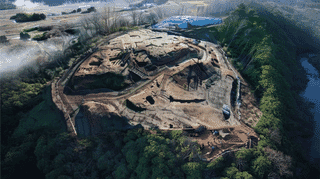
A large defended settlement of the later 4th century in Kurihara, Miyagi. Mirrors and ironwork came from pit dwellings that appear to have been burned.
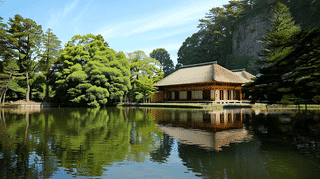
An Edo-period school and its garden at Iwadeyama in Osaki, Miyagi. The Agency for Cultural Affairs calls it the oldest surviving school building of that age.
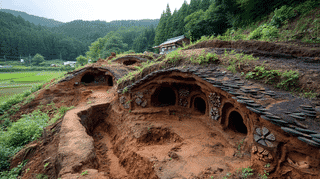
A Nara-period tile kiln site in Osaki, Miyagi, which supplied the first Taga Castle. Excavation from 2021 found six kilns for tiles and one for charcoal.

Standing on Mount Atago in Shibata, this male ginkgo rises 31 m with an 11 m trunk and 16 hanging aerial-root pillars. A National Natural Monument since 1968.
Enunkan Garden, named a national Place of Scenic Beauty in 2018, is a 17th-century stroll garden above Kesennuma Bay kept by the Ayukai family of the Sendai Domain.
Designated a Special Natural Monument in 1952, this geyser pair below Mount Araoyama in Miyagi has been dormant since 1979, with both vents now buried by sediment.
A 30-meter kaya tree in Obara, Shiraishi, this is one of two protected examples of the rare small-seeded kotsubugaya variety, a National Natural Monument since 1943.
A natural monument in Shiroishi, Miyagi: a towering kaya whose large seeds bear ridges spiraling counterclockwise, a rare form found at just a few sites in Japan.
Shiraishi's spheroidal diorite, designated in 1923, is Japan's only national-monument site for this rare rock, called kikumenseki—the chrysanthemum-face stone.
Two singing-sand beaches across a strait in Kesennuma Bay. Footsteps on dry quartz make a ku-ku sound. First reported in 1894; designated a Natural Monument in 2011.
Meiji garden of Saitō Zen'uemon, head of one of pre-war Japan's great landowning houses. Integrates residence, spring-fed pond, and Mt. Asahi's wooded slopes.
The Sendai Castle Ruins preserve the remains of the great hilltop fortress begun by Date Masamune in 1601 and used as the seat of the Date family, lords of the 620,000-koku Sendai domain, for nearly 270 years. Designated a National Historic Site in 2003, the castle ingeniously used Mount Aoba and the Hirose River as natural defenses. Excavations have revealed three successive phases of stone-wall construction. From the Honmaru, where Date Masamune's iconic equestrian statue stands, visitors enjoy sweeping views of Sendai and the Pacific Ocean.
Takimae Fudō no Fuji is a wisteria of more than four hundred years old, growing in the Hasekura district of Kawasaki Town, Miyagi Prefecture. Designated a National Natural Monument in 1976, it is one of Japan's largest wisteria specimens, climbing twenty-five to twenty-eight meters into surrounding cedars and zelkovas. Each May and June, the entire grounds of the Fudō hall are draped in lavender blossoms — a remarkable sight in the homeland of the famous Edo-period diplomat Hasekura Tsunenaga.
The Masubuchi River in Towa-cho, Tome City, Miyagi Prefecture, is recognized as the northernmost large-scale habitat of Genji fireflies in Japan and was designated a National Natural Monument in 1979. From late June to early July, thousands of fireflies fill the night air over a stream that local residents have protected for more than half a century, creating the magical display known as the hotaru gassen, or firefly battle.
Tomizuka Kofun, located in Wakabayashi Ward of Sendai City, is a keyhole-shaped tumulus about 110 meters in length. Built between the late 4th and early 5th century, it is the second-largest ancient tomb in Miyagi Prefecture and one of the largest in the entire Tohoku region. Designated a National Historic Site, it is freely open to visitors today as a public history park.
Within the wooded grounds of Ryūun-in, a Sōtō Zen temple in northern Sendai, stands the modest stone grave of Hayashi Shihei (1738–1793), the late-Edo scholar who warned Japan, more than half a century before Commodore Perry, that the country's coasts would need to be defended. Author of 'Sangoku Tsūran Zusetsu' and 'Kaikoku Heidan,' he was branded a criminal and placed under house arrest in Sendai, dying in disgrace. Only in 1842, decades after his death, was a tombstone finally raised. Designated a National Historic Site in 1942, the grave is now surrounded by memorial steles commissioned by Itō Hirobumi and other Meiji statesmen — a quiet shrine to the visionary whom history vindicated.
More from Miyagi
Miyagi’s registered properties across designations, with featured heritage and travel notes.
The complete kokuhō catalogue — browse by prefecture, period, and category.
Nationwide jūyō bunkazai — architecture, sculpture, painting, crafts, and documents.