
Registered Tangible Cultural Properties of Nara
奈 良 県 の 登 録 有 形 文 化 財Nara · Registered Tangible Cultural Properties
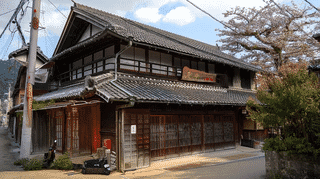
Explore Tamaya Omoya, a beautifully preserved Edo-period hatago (traditional inn) at Taima-dera Temple in Nara Prefecture. This Registered Tangible Cultural Property features exquisite kote-e plaster art and now operates as a restaurant serving local Nara cuisine.
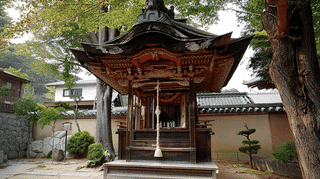
Discover the exquisite Nakanobō Inari Shrine, a Registered Tangible Cultural Property dating from the Edo period. This miniature architectural masterpiece features elaborate cypress bark roofing and vibrant decorations, enshrining the ancient deity Toyouke Ōkami once worshipped by the powerful Katsuragi clan.

Discover the Ikusei Kindergarten Building, doubling as the Nippon Sei Ko Kai Sakurai St. Paul's Church Chapel in Sakurai City, Nara. Built in 1930, this Registered Tangible Cultural Property blends Western church architecture with Japanese craftsmanship, featuring scissor trusses and pointed arch windows.
The formal gate of a senior headman's compound in Yoshino, Nara: a zelkova-framed yakuimon with a copper roof and twenty metres of plastered wall beside it.
Built in 1773 for a senior village headman below Mt. Ryumon in Nara, this thatched Yoshino farmhouse keeps stopped door grooves and a formal entrance board.
An early Meiji bracket gate in Yoshino, Nara, built for a detached guest wing that no longer stands, with curved rafters and notched weatherboarding beside it.
A late Edo document storehouse in Yoshino, Nara, built to guard a village headman's papers from fire and damp with an air-gapped roof and interlocking doors.
Quietly set on a wooded hillside in Uda City, Nara Prefecture, the Ushitani Family Residence Main House was completed in 1968 by the office of Junzo Sakakura, a disciple of Le Corbusier, and was added to Japan’s register of Tangible Cultural Properties in December 2024. Its deep-eaved roof, clockwise flow of ground-floor rooms, and radially arranged rafters make it a small but refined masterwork of mature post-war Japanese modernism.
Uchiyama-ke Kashiya, registered in 2020, is a single-storey Nara house built to be let in the Showa Depression. Grey lime walls, and no earth passage inside.
A small late-Edo storehouse in the Ota brewery courtyard in Tatsuta, Ikaruga. Its sea-cucumber plaster and framed doorway show a care that earned its listing.
A long late-Edo shed at the Ota brewery in Tatsuta, Ikaruga, linking the old kitchen to the inner storehouse. One side is open, the other a boundary wall.
The main house of the Ota sake brewery in Tatsuta, Ikaruga. A roof-tile inscription dates it to 1829, a rare benchmark for dating the region's town houses.
A late-Edo tea room at the Ota brewery in Tatsuta, Ikaruga, behind the main house across a courtyard. Its three-mat plan and crawl-in door reveal the family's wealth.
The largest building at the Ota brewery in Tatsuta, Ikaruga. This early-Meiji fermentation store on a stone base shows a long western wall and joins the south storehouse.
A large early-Meiji brewing storehouse at the Ota brewery in Tatsuta, Ikaruga. It links the living and brewing blocks and anchors the storehouses that shape the town.
Built in 1930 at the southeast corner of a Naramachi plot, this eleven-square-metre earthen storehouse has plastered walls, board skirting and a sliding door.
Built in early Meiji as a midwife's home, this Naramachi townhouse keeps three rooms lined beside an earth-floored passage under a low tiled roof. Registered 2014.
Behind the main house stands a Taisho detached room: a six-mat guest space, a board-floored bay, and a corridor left open to the courtyard under deep eaves.
Built in 1919 at Kashihara in Nara, this two-storey plaster storehouse joins the main house by a covered corridor and is roofed on trusses. Registered in 2020.
This 1917 house at Kashihara in Nara sets nine rooms in three ranks beside an earthen-floored bay, with a tea room on a covered corridor. Registered in 2020.
More from Nara
Nara’s registered properties across designations, with featured heritage and travel notes.
The complete kokuhō catalogue — browse by prefecture, period, and category.
Nationwide jūyō bunkazai — architecture, sculpture, painting, crafts, and documents.